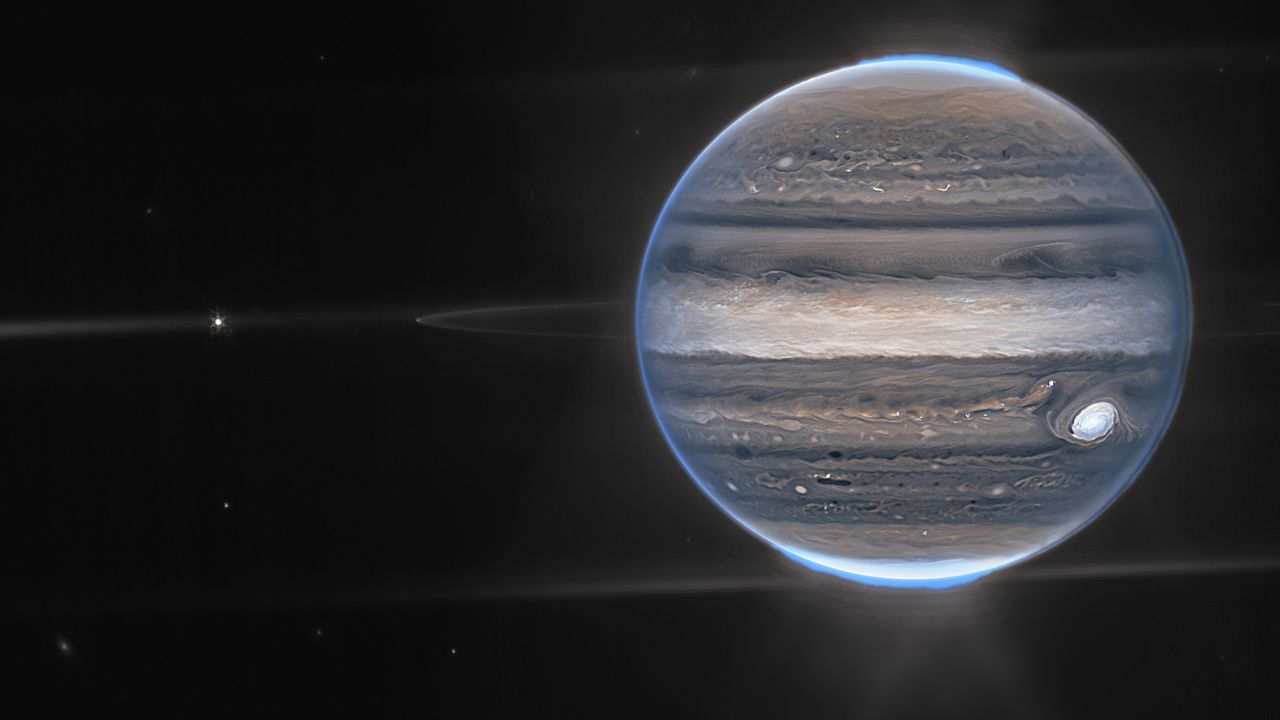
Jupiter’s moons are leaving remarkable cold ‘footprints’ in the planet’s auroras, a phenomenon discovered through observations made by the James Webb Space Telescope (JWST). The findings highlight how these moons interact with Jupiter’s vast magnetic environment, resulting in a unique impact on the auroral displays that encircle the gas giant.
The research, led by Katie Knowles, a Ph.D. researcher at Northumbria University in the U.K., reveals that the moons—particularly the four largest known as the Galilean moons: Io, Europa, Ganymede, and Callisto—are not just passive celestial bodies. Instead, they actively engage with Jupiter’s magnetic field and surrounding plasma, which triggers energetic particles to collide with the planet’s atmosphere, creating distinctive auroral footprints aligned with their orbits.
These auroral displays on Jupiter are formed similarly to those on Earth, where charged particles propelled by the solar wind interact with the planet’s magnetic field before reaching the poles. However, the Galilean moons enhance this process. The phenomenon known as the Io Plasma Torus plays a crucial role. Io, recognized as the solar system’s most volcanic body, emits substantial amounts of charged particles that contribute to this plasma torus, held in place by Jupiter’s gravitational pull.
As the moons complete their orbits, they interact with this plasma torus and the magnetic field, driving ions towards Jupiter’s atmosphere. This interaction not only contributes to the auroras but also generates electrical currents that affect the brightness of the auroral footprints.
In September 2023, researchers Henrik Melin and Tom Stallard from Northumbria University employed the JWST to capture snapshots of Jupiter’s auroral activity. Analyzing the data, Knowles discovered an unexpected cold spot beneath an aurora linked to Io’s footprint. While the surrounding auroral region maintained a temperature of 919 degrees Fahrenheit (493 degrees Celsius), the cold spot registered only 509 degrees Fahrenheit (265 degrees Celsius).
Moreover, the density of ions in the area was significantly elevated, with the trihydrogen cation (H3+) showing ion densities that were, on average, three times higher than those elsewhere in the aurora. In some instances, densities varied by as much as 45 times within that localized region. Knowles noted, “We found extreme variability in both temperature and density within Io’s auroral footprint that happened on the timescale of minutes.” This rapid change suggests a dynamic flow of high-energy electrons impacting Jupiter’s atmosphere.
Jupiter’s auroras are the most powerful in the solar system, but they are not alone. Earth’s auroras occur without similar footprints from its moon, as it does not generate sufficient interaction with Earth’s magnetic field. In contrast, Saturn’s moon, Enceladus, does influence the auroras on its planet, potentially indicating that similar cold spots may arise there.
Knowles emphasized the significance of this research, stating, “This work opens up entirely new ways of studying not just Jupiter and its other Galilean moons, but potentially other giant planets and their moon systems.” The observations made with the JWST allow scientists to witness the immediate responses of Jupiter’s atmosphere to its moons, which may shed light on processes occurring across the solar system and beyond.
Despite the groundbreaking findings, questions linger. The cold spot was only observed in one image, prompting inquiries about how frequently these phenomena occur and what mechanisms drive their formation. Knowles is poised to investigate further; she has been awarded time on NASA’s Infrared Telescope Facility in Hawaii to monitor various auroral footprints over six nights in January 2026. The results from the JWST observations were published on March 3, 2024, in the journal Geophysical Research Letters.
This ongoing research promises to deepen our understanding of the interactions between celestial bodies and their magnetic environments, revealing the complexities of auroras in our solar system.