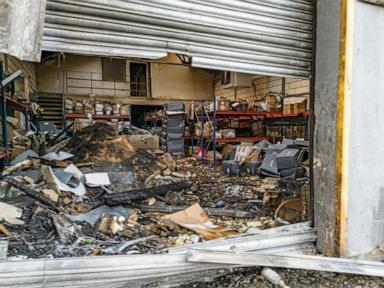
In a series of escalating incidents, Russia is reportedly orchestrating a campaign of sabotage across Europe, targeting critical infrastructure and straining security resources. Notable incidents include a train carrying nearly 500 people that came to an abrupt stop in eastern Poland last November after a damaged overhead line shattered windows and caused track damage. Another attack involved explosives detonating under a passing freight train. While no injuries were reported, Poland attributed these acts to Russian intelligence, prompting the deployment of 10,000 troops to safeguard vital infrastructure.
Scope of the Disruption Campaign
According to an extensive database compiled by the Associated Press, these incidents are part of a broader campaign of disruption attributed to Russia, which Western officials assert has been ongoing since President Vladimir Putin invaded Ukraine in 2022. The goal, they claim, is to undermine support for Kyiv, create divisions among European nations, and expose vulnerabilities within the continent’s security framework.
While the majority of these sabotage efforts have resulted in limited damage, their cumulative effect is significant. Each act, whether it be vandalism, cyberattacks, or arson, diverts essential security resources. The head of a prominent European intelligence agency noted that investigations into Russian activities are consuming as much time as counter-terrorism efforts.
Despite the minimal immediate damage, the campaign poses a serious threat to European stability. Every successful disruption, no matter how small, serves as a victory for Moscow by exhausting the resources of European security services.
Investigative Strain and International Cooperation
Information from over 40 European and NATO officials reveals a dynamic landscape of espionage, with investigations into Russian interference becoming increasingly complex. These operations often involve foreign nationals with criminal backgrounds acting as proxies for Russian intelligence, complicating the investigative process across various jurisdictions.
Data indicates a troubling spike in sabotage activities, with arson and explosive plots rising from one incident in 2023 to 26 in 2024, and six more recorded in early 2025. Countries bordering Russia, particularly Poland and Estonia, are frequently targeted, with additional incidents occurring in the United Kingdom, Germany, and France.
Officials observed a temporary lull in these activities in late 2024, likely in response to geopolitical dynamics with the U.S. However, they assert that the campaign has resumed with renewed vigor. “They are back to business,” remarked a senior European intelligence official.
The individual believed to have orchestrated the attack on the Polish railway is Yevgeny Ivanov, a Ukrainian national allegedly working with Russian military intelligence. Court documents reveal that Ivanov was previously convicted in Ukraine for plotting various arson attacks but managed to enter Poland due to a lack of communication regarding his criminal status.
This cross-border nature of the plots complicates investigations, often requiring collaboration between multiple European authorities, which is a key objective of Moscow’s strategy. As noted by Triinu Olev-Aas, an Estonian state prosecutor, the profiles of attackers have evolved from local suspects to foreign nationals, necessitating greater inter-country cooperation.
For instance, in January, fires were set at a supermarket and a Ukrainian restaurant in Estonia by individuals who had never previously been in the country. One perpetrator was captured on video attempting to escape after setting fire to the restaurant, underscoring the chaotic nature of these operations.
Russian intelligence, while appearing to mastermind these operations, often recruits individuals with criminal backgrounds to execute tasks. This strategy minimizes the risk to highly trained operatives, who have become scarce due to expulsions from European nations in recent years. According to officials, some recruits have even been sourced from European prisons.
A particularly alarming incident involved a Ukrainian man, operating under the direction of Russian military intelligence, who attempted to rig drones with explosives. Although the plot was thwarted, significant resources were expended in the investigative process.
The ongoing sabotage campaign is stretching law enforcement agencies thin across Europe. However, it has also fostered unprecedented cooperation among nations. Joint investigation teams have been established in Latvia, Lithuania, and Estonia to tackle foreign intelligence threats. Additionally, police forces in the U.K. are receiving specialized training to identify potential state-sponsored attacks.
Despite these efforts, officials acknowledge that Russia continues to test innovative tactics, such as using smuggling operations to deploy weather balloons into neighboring countries, prompting significant security responses. As articulated by Jacek Dobrzyński, spokesperson for Poland’s security minister, “Nowadays they only carry cigarettes, but in future they could carry other things.”
The ramifications of Russia’s sabotage campaign extend far beyond immediate threats, as European nations grapple with the need for enhanced collaboration and vigilance to counteract these insidious tactics. The situation remains dynamic as authorities adapt to ongoing challenges posed by Moscow’s hybrid warfare strategy.