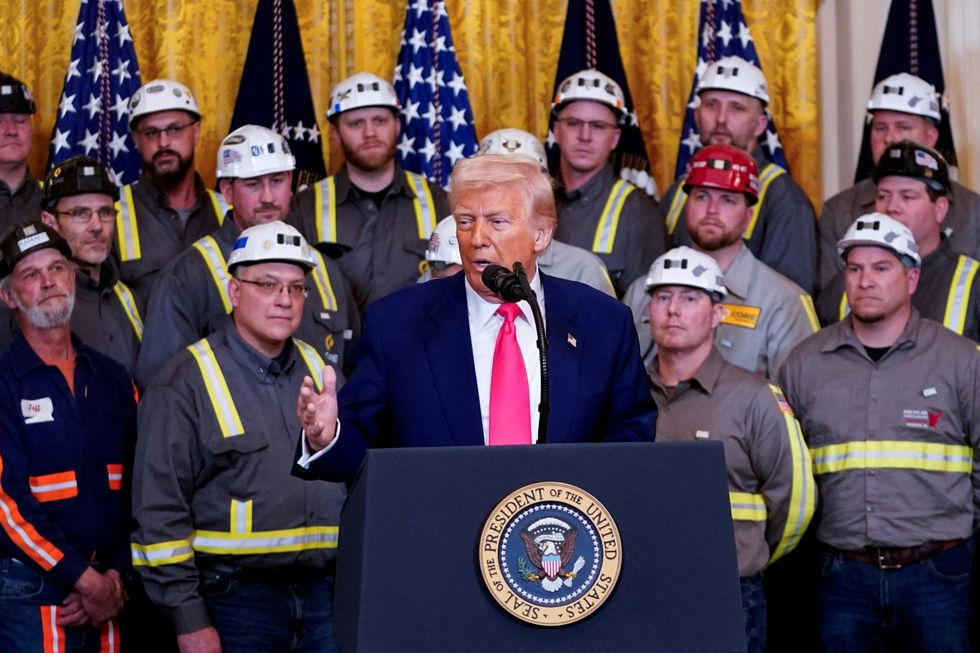
New reports confirm President Donald Trump’s aggressive push to revive the coal industry is fueling a deadly health crisis for miners, many of whom are his strongest supporters.
Experts warn that policies implemented during Trump’s second term are directly contributing to increased cases of black lung disease, a debilitating and often fatal lung condition caused by inhaling dangerous dust particles. Rebecca Shelton, policy director for the Appalachian Citizen’s Law Center, told Mother Jones that the administration’s failure to enforce strong safety rules is allowing miners to “get sick and die.”
Black lung disease, long a known risk in mining, has worsened in recent years due to increased exposure to crystalline silica dust. Modern mining involves cutting through much harder rock with high quartz content, amplifying dangerous silica inhalation. The Appalachian Plateau—encompassing parts of Ohio, Tennessee, Virginia, and Kentucky—remains the hub of coal mining operations. These states, except Virginia, were all decisively won by Trump in the 2024 election, with southwest Virginia being a particularly strong Republican stronghold.
Despite this, upon taking office, Trump dramatically cut the budget and staff of the Mine Safety and Health Administration (MSHA), the agency responsible for enforcing mining safety laws. Following intense lobbying by coal industry groups, MSHA also delayed rolling out a new rule designed to protect miners from silica dust exposure.
Former coal miner Justin Smarsh, 42, from Cherry Tree, Pennsylvania, is now battling progressive massive fibrosis, the deadliest form of black lung disease. Doctors have grimly told him he likely will not live past 50. Smarsh harshly criticized coal executives, stating:
“All they’re worried about is ‘you better have that black gold.’ They say they care about miners, but you go underground, you’re taking the risk, for you to get nothing but sick, and to fill their pockets full.”
The deepening health crisis underscores a stark contradiction. While Trump champions “beautiful, clean coal” to boost an industry vital to many of his core voters, his administration’s actions have weakened protections, allowing hazardous workplace conditions to persist and worsen.
Advocates say a strong silica rule that MSHA has long delayed could prevent further illnesses and deaths. As of now, the administration’s reliance on “a ridiculous legal process” to stall rule enforcement means miners are facing mounting health risks without legal safeguards.
These developments send immediate alarm signals for regions dependent on mining jobs, especially those with deeply Republican electorates who supported Trump’s coal revival agenda. The worsening health crisis among coal workers threatens to worsen local economies already strained by illness and loss.
The coal industry’s future—and its workers’ well-being—hang in the balance as federal protections remain stalled. Observers now watch closely for any new moves from the administration or Congress to address or ignore this escalating public health emergency.