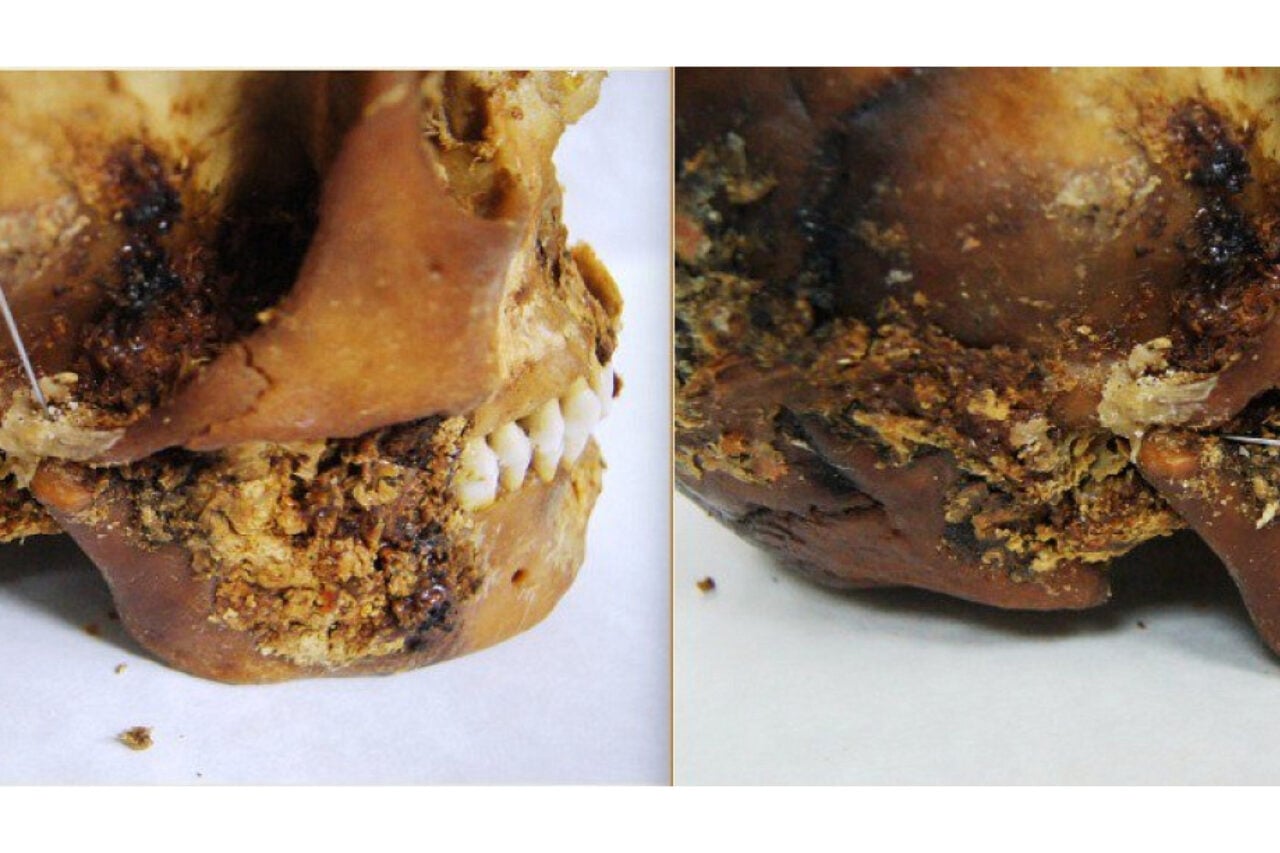
Archaeologists have uncovered remarkable evidence of ancient medical practices, revealing that a woman from the Iron Age had her shattered jaw repaired with a primitive prosthetic. Discovered in a grave on the Ukok Plateau in southern Siberia, the findings were announced by researchers from Novosibirsk State University, who conducted an analysis of the woman’s skull dating back approximately 2,500 years.
In a statement, the researchers explained that a recent CT scan of the skull indicated the woman sustained severe trauma, likely from a head injury. They identified remnants of an “elastic material,” believed to have been used as a surgical ligature to stabilize her jaw. Vladimir Kanygin, head of the university’s Laboratory of Nuclear and Innovative Medicine, referred to the CT scanner as a “time machine” that offered non-destructive access to the anatomical structures of the ancient remains.
New Insights from Ancient Practices
The mummified remains were initially uncovered in 1994, and at that time, researchers estimated the woman to be between 25 and 30 years old. The mummification process preserved only part of her head, complicating earlier efforts to study her injuries. The recent scans, however, revealed a detailed picture of her condition.
Notably, the scans showed that the woman’s right temporomandibular joint (TMJ) had been destroyed, indicating a severe injury that likely affected her ability to eat and speak. Further examinations uncovered thin canals drilled into the joint, suggesting the use of a surgical procedure, possibly involving materials like horsehair or animal tendon. The condition of her teeth also provided clues; the left side was significantly more damaged, indicating she primarily used that side for chewing, which suggests she adapted to her injury and potentially survived for some time after the surgery.
The exact cause of her injury remains uncertain, but researchers speculate it could have been the result of a fall from a horse, aligning with the nomadic lifestyle of the Pazyryk culture.
A Culture of Care and Respect
The discovery not only sheds light on medical practices in ancient societies but also reflects the values of the Pazyryk people. Known for their intricate craftsmanship, the Pazyryk exhibited a sophisticated understanding of both life and death. Natalia Polosmak, an archaeologist with the Russian Academy of Sciences, highlighted the community’s respect for individuals facing injury, as seen in the care the woman received, despite her injuries likely altering her appearance and possibly her role within the group.
The burial of the woman, while deemed “ordinary” compared to the more elaborate burial of the Siberian Ice Maiden, signifies a broader cultural practice of honoring individuals in death. Her proper burial in a wooden coffin—an important resource in the region—suggests that she was still valued by her community, even after her injuries would have rendered her a burden in harsh living conditions.
Polosmak pondered the woman’s significance within her society, stating, “We don’t know what her personal value to society consisted of. In this society, everyone was valued in life simply for their existence and honored after death.” This perspective adds depth to the understanding of social structures in ancient nomadic cultures, emphasizing that each individual held intrinsic worth, regardless of their physical condition.
The findings from this research not only contribute to the understanding of ancient medical practices but also enrich the narrative of the Pazyryk culture, showcasing their skills in both surgery and their profound respect for human life.