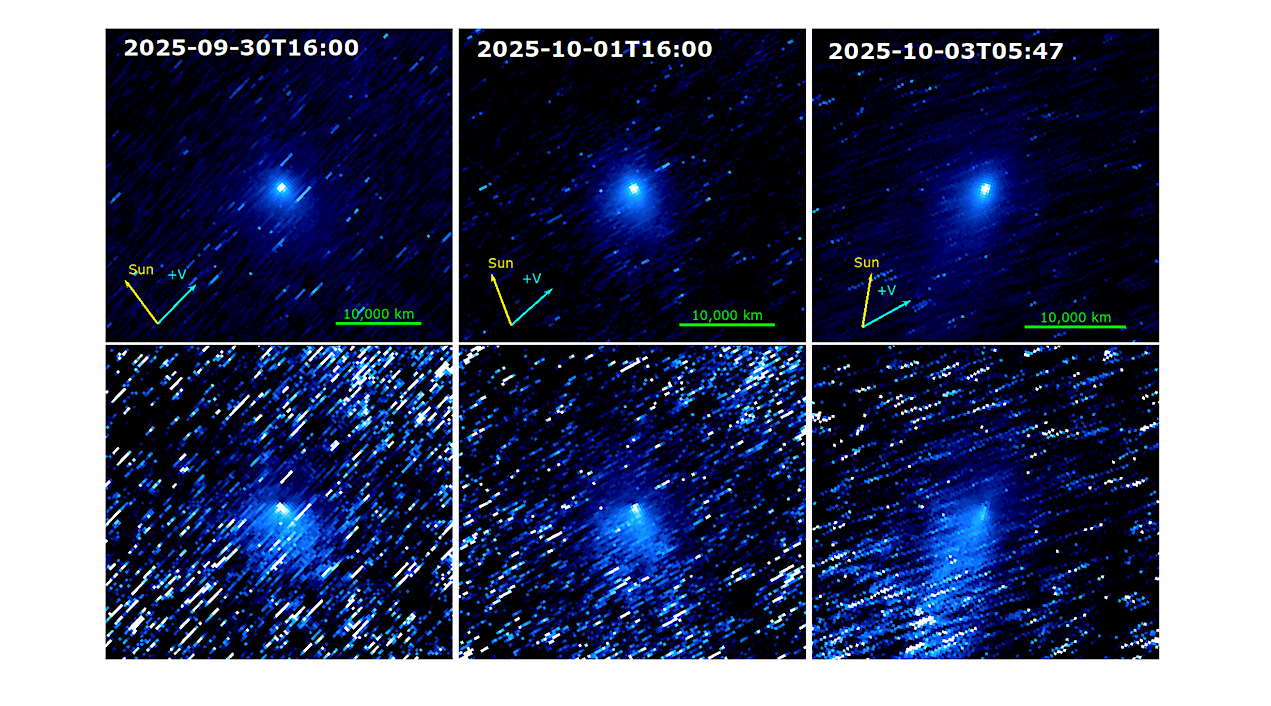
China’s Tianwen-1 Mars orbiter has successfully captured images of the third interstellar object, 3I/ATLAS, during its close approach to Mars. The observations were made using the orbiter’s onboard HiRIC CMOS camera, marking China’s first deep-space observation of an astronomical object. This achievement provides a unique perspective on the object’s dust dynamics from a vantage point significantly outside its orbital plane.
The imaging took place over three observational periods from September 30 to October 3, 2025. These observations revealed notable changes in the coma and tail morphology of 3I/ATLAS, driven by the evolving viewing geometry as it approached Mars. The data collected is significant for understanding the dynamics of dust ejected from the cometary nucleus.
Insights into Dust Dynamics
Analysis of the observations, particularly through comparisons with Finson-Probstein dust dynamical models, indicates that the coma is primarily composed of large grains. The solar radiation pressure parameter β is estimated to be between 10 -3 and 10 -2, corresponding to grain sizes of several hundred micrometers. The extent of the sunward coma suggests dust ejection velocities ranging from 3 to 10 m/s.
Despite the morphological changes observed, the azimuthally averaged surface brightness profile remained relatively constant across the three epochs. It transitioned from a radial slope near -1 close to the nucleus to slightly steeper than -1.5 at greater cometocentric distances. This consistency aligns with a steady-state dust outflow that is accelerated by solar radiation pressure.
Photometric measurements revealed an average Afρ value of approximately (2.0±0.2)×10^4 cm, which corresponds to a dust mass loss rate of about 1,000 kg/s. These findings suggest that large grains dominate both interstellar comets discovered thus far, including 2I/Borisov and 3I/ATLAS. This trend, along with the high supervolatile content of these objects, may imply their origins lie in the outer regions of their respective parent planetary disks.
Significance of the Findings
The successful imaging of 3I/ATLAS not only showcases China’s growing capabilities in space exploration but also contributes to the broader understanding of interstellar objects. The research, led by a team that includes scientists such as Xin Ren and Wei Yan, has been submitted for publication in the Astrophysical Journal Letters and is available on the preprint server arXiv.
As the scientific community continues to analyze these findings, they may offer new insights into the composition and behavior of interstellar objects, enhancing our understanding of the processes that govern our solar system and beyond. The ongoing exploration by missions like Tianwen-1 exemplifies the importance of international collaboration and innovation in the field of space science.