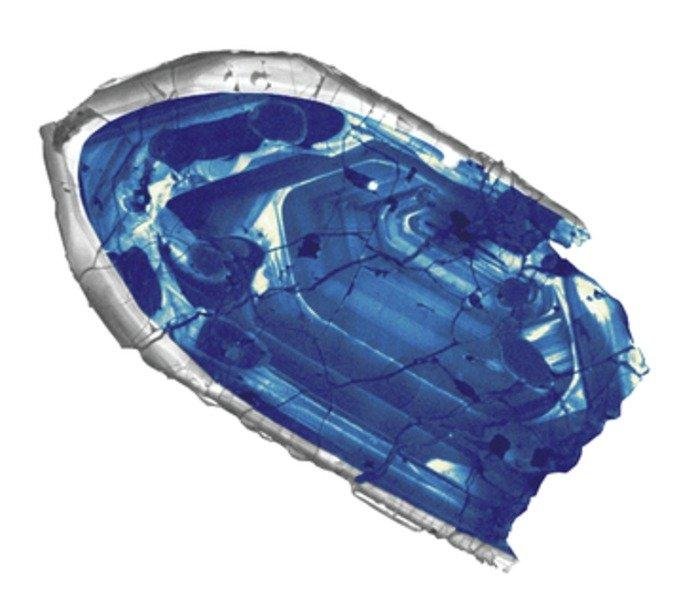
On February 24, 2014, researchers from Australia made a groundbreaking announcement: they had confirmed the discovery of the oldest-known fragment of Earth’s crust. A tiny zircon crystal, dated at approximately 4.4 billion years, has provided invaluable insights into the early history of our planet.
This remarkable find originated from the Jack Hills region in Western Australia. The zircon crystal, weighing less than a milligram, is believed to be a remnant of the Earth’s crust that formed during a period when the planet was still undergoing significant geological changes.
Significance of the Discovery
The zircon crystal’s age pushes back the timeline of Earth’s crust formation significantly. Previously, the oldest known crust was dated around 4.0 billion years. The new findings suggest that the crust began to solidify much earlier than previously thought, indicating a more complex geological history.
Dr. Mark Harrison, a geologist at the Australian National University, emphasized the importance of this discovery. He stated that these ancient zircons provide a rare glimpse into the conditions of the early Earth, including the presence of water and the formation of continental crust.
The study of such ancient materials has profound implications for understanding the evolution of the Earth’s surface and its atmosphere. The findings indicate that liquid water may have existed on the surface of the planet much earlier than scientists had anticipated, which is crucial for theories regarding the origin of life.
Future Research Directions
Following this discovery, scientists are eager to explore more ancient geological formations. The Jack Hills area is expected to yield further insights, as researchers continue to analyze the surrounding rocks for additional zircon crystals.
The implications of these findings extend beyond Earth. Understanding how our planet’s crust formed can help scientists draw parallels with other rocky planets in the solar system. This could enhance our understanding of planetary formation and the potential for life beyond Earth.
In summary, the announcement on February 24, 2014, has opened new avenues for research in geology and planetary science. The confirmation of the 4.4 billion-year-old zircon crystal not only reshapes our understanding of Earth’s history but also invites further exploration into the ancient processes that shaped our planet’s surface.