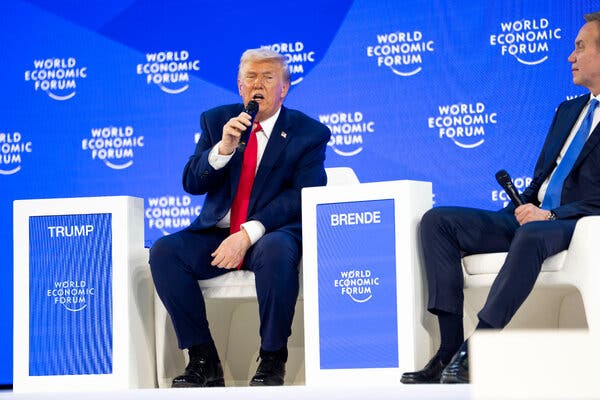
President Donald Trump has once again stirred uncertainty in international trade by threatening European nations with punitive measures unless they comply with his demands regarding Greenland. Over a four-day period, these threats led to significant declines in stock markets and prompted urgent meetings among European leaders, who scrambled to respond to the escalating situation. This tension has effectively stalled progress on a trade deal that had been painstakingly negotiated just months prior.
In a shift that many have come to expect, Trump later claimed to have reached “the framework of a future deal” concerning Greenland and the Arctic. While details of this purported agreement remain scarce, Trump asserted it would be a “great one” for the United States. Following this announcement, he declared that tariffs planned for eight European countries, set to take effect on February 1, 2024, would no longer be imposed. This sudden reversal caused stock markets to rebound sharply, illustrating the volatile nature of his trade policies.
Despite averting an immediate trade war, Trump’s actions have left a trail of instability in global commerce. As tensions rise, doubts are growing about the reliability of trade negotiations with the United States. Trump’s unpredictable approach has increasingly pushed foreign nations to reconsider their alliances and seek deeper connections with one another, particularly in relation to China.
As he embarks on the second year of his second term, Trump has had numerous opportunities to reshape the global trading landscape according to his vision. Yet, his inclination to disrupt established agreements persists. He continues to challenge even his closest trading partners, issuing new tariff ultimatums while jeopardizing existing trade arrangements before they can be fully realized.
Global businesses and international leaders had hoped that 2024 would mark the end of tariff-related uncertainties. Although tariffs may be higher, the expectation was that a more predictable trading environment would emerge as Trump’s trade vision solidified through various agreements. Instead, his recent actions suggest a renewed desire to inject chaos into the global trading system, leaving many stakeholders questioning the long-term implications of his presidency on international commerce.