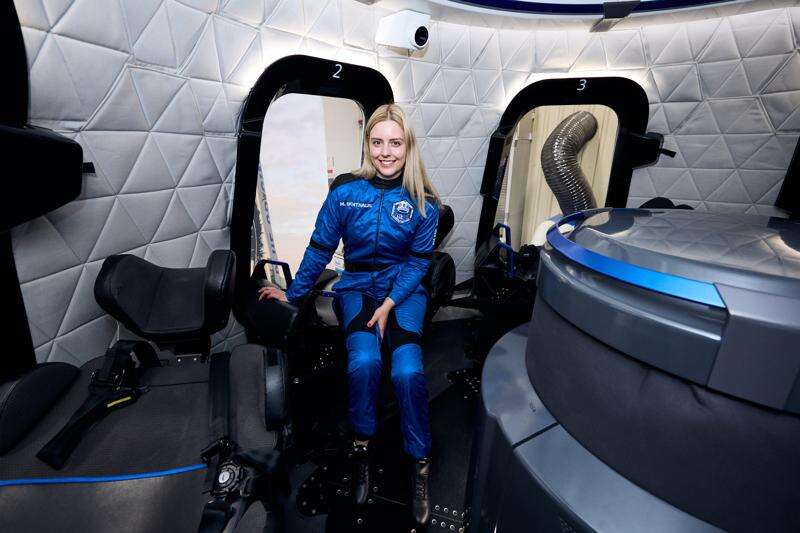
A paraplegic engineer from Germany, Michaela Benthaus, made history on March 2, 2024, by becoming the first wheelchair user to travel to space. Benthaus, who was severely injured in a mountain bike accident seven years ago, launched alongside five other passengers from West Texas aboard a Blue Origin rocket. This groundbreaking journey marks a significant milestone in making space travel more accessible.
Benthaus’s flight was sponsored by Hans Koenigsmann, a retired executive from SpaceX, who helped organize the trip. The exact ticket prices for the mission have not been disclosed. During the approximately ten-minute journey, minor adjustments were made to the New Shepard capsule to accommodate her needs. Blue Origin designed this spacecraft with accessibility in mind, which allowed for a broader range of individuals to experience space travel.
According to Jake Mills, an engineer at Blue Origin who trained the crew, the design enhancements aim to make spaceflight more inclusive. Previous passengers aboard Blue Origin’s flights have included individuals with limited mobility and sensory impairments. For Benthaus, a patient transfer board was added to facilitate her movement between the capsule’s hatch and her seat, while a carpet was laid out on the desert floor for her immediate return to her wheelchair after landing.
Preparation for the flight involved practice sessions, during which Koenigsmann participated in the design and testing phases. Prior to the launch, an elevator was installed at the launch pad to assist Benthaus in ascending the seven-story height to board the capsule.
At 33 years old, Benthaus is currently part of the European Space Agency’s graduate trainee program in the Netherlands. She previously experienced weightlessness during a parabolic flight in Houston in 2022 and participated in a two-week simulated space mission in Poland. Reflecting on her journey, Benthaus stated, “I never really thought that going on a spaceflight would be a real option for me… There is like no history of people with disabilities flying to space.”
When Koenigsmann approached her about the possibility of flying on Blue Origin, she initially doubted the feasibility of the opportunity but quickly embraced the idea and signed up. This mission was a private initiative, with no involvement from the European Space Agency, which recently approved John McFall, an amputee and former British Paralympian, for a future flight to the International Space Station.
Unlike McFall, who uses a prosthetic leg, Benthaus has a spinal cord injury that prevents her from walking. For this reason, Koenigsmann was designated as her emergency helper during the flight and assisted her in exiting the capsule. Despite these challenges, Benthaus expressed her desire to remain as independent as possible throughout the process. She aims not only to make space more accessible for individuals with disabilities but also to advocate for improved accessibility on Earth.
While Benthaus has received considerable support within her “space bubble,” she hopes that her journey will inspire broader societal inclusivity. “I really hope it’s opening up for people like me; like I hope I’m only the start,” she remarked.
The mission included other notable passengers, such as business executives and investors, bringing Blue Origin’s total number of space travelers to 86. Founded by billionaire Jeff Bezos in 2000, Blue Origin completed its first passenger spaceflight in 2021 and has since expanded its operations to include orbital missions from Cape Canaveral, Florida, using the more powerful New Glenn rocket. The company is also working on lunar landers, further emphasizing its commitment to pushing the boundaries of space exploration.