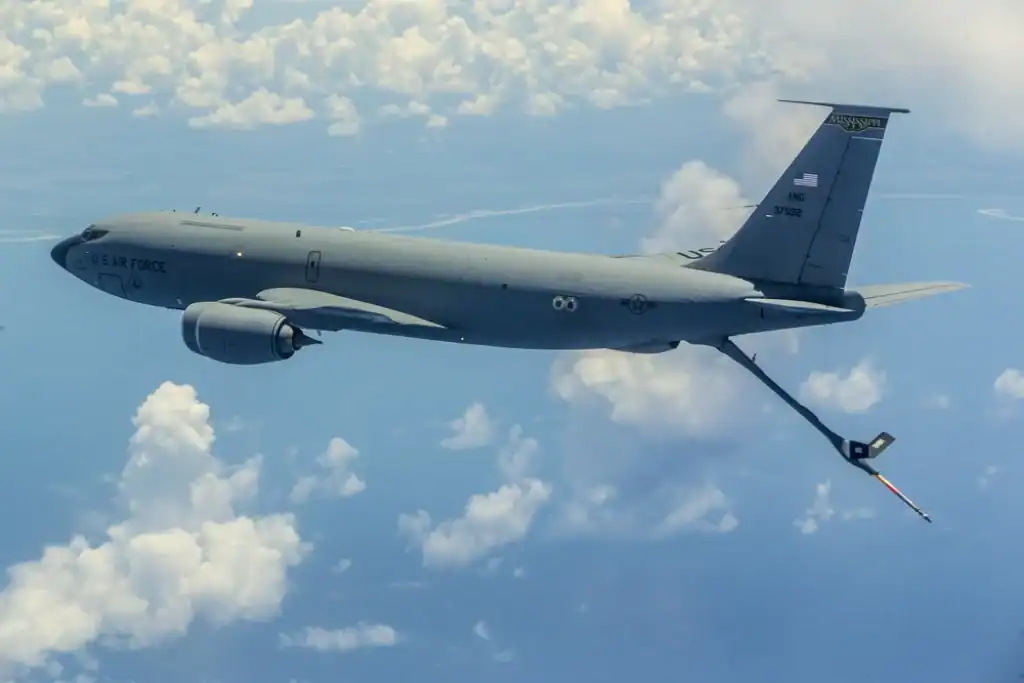
Iraqi militias with ties to Iran have announced that they shot down a US Air Force KC-135 Stratotanker over western Iraq on March 12, 2023. The US military confirmed that the aircraft crashed but clarified that it was not the result of “hostile fire.” This incident has raised tensions in a region already fraught with conflict, particularly concerning US operations targeting Iranian-affiliated groups.
According to US Central Command (CENTCOM), two KC-135 refueling aircraft were involved in an incident over Iraq on the same day. CENTCOM stated, “One of the aircraft went down in western Iraq, and the second landed safely.” The military further emphasized that the crash was not caused by either hostile or friendly fire. Tragically, the KC-135 that went down resulted in the loss of six service members. The second aircraft successfully landed at an Israeli airport.
The KC-135 Stratotanker plays a crucial role in US military operations, providing aerial refueling for strike aircraft engaged in various missions, including those targeting Iranian interests and affiliates. During Operation Epic Fury, American aircraft have been conducting operations in Iraqi airspace, specifically aimed at Iran and its allied militias. The refueling capability of the KC-135 is vital for extending the operational reach of these missions.
In stark contrast to CENTCOM’s assertions, the Islamic Resistance in Iraq (IRI), a coalition of Iran-backed militias, claimed responsibility for the downing of the aircraft. The group stated, “In defense of the sovereignty of our country and its airspace… the mujahideen of the Islamic Resistance in Iraq have shot down a KC-135 aircraft belonging to the American occupation in western Iraq, using the appropriate weaponry.” This statement was part of a larger narrative pushed by the IRI, which has claimed to be conducting multiple operations against US forces in the region.
Shortly after the initial claim, the IRI suggested that they had also targeted a second KC-135, which they alleged was hit but managed to land at “one of the enemy’s airports.” This assertion raises questions about the credibility of the claims, particularly since the IRI has not provided any evidence, such as video footage, to support their statements.
The IRI, which was formed in 2020 to unify various smaller Iranian-supported militias, claims to engage in a wide range of military operations. It comprises groups that are considered by the US to be Foreign Terrorist Organizations or Specially Designated Global Terrorist entities. These include well-known factions such as the Hezbollah Brigades, Asaib Ahl al-Haq, and Kataib Sayyid al-Shuhada.
Experts have expressed skepticism regarding the IRI’s capacity to successfully engage and shoot down a KC-135, which typically operates at altitudes between 20,000 and 30,000 feet. The militias are not known to possess the advanced surface-to-air missile systems required to reach these heights. More likely, they may have access to Man-Portable Air Defense Systems, with a maximum effective altitude of about 15,000 feet.
The IRI has also claimed to have conducted numerous operations against US and allied forces in Iraq. On March 10, they announced that they had executed 291 operations to date, claiming to have killed 13 American personnel and injured many others. However, as of now, there have been no confirmed reports of American casualties resulting from militia attacks within Iraq.
Since February 28, Iraqi militias have intensified their efforts against US bases, diplomatic installations, and other assets in Iraq. The situation remains volatile, with the potential for further escalations as both sides navigate this complex landscape of military engagement.
As this situation develops, the international community will be closely monitoring the implications for regional stability and US-Iran relations, which continue to be strained by ongoing military operations and proxy engagements. The actions of the IRI and other militias are likely to have significant repercussions not only for Iraq but also for broader geopolitical dynamics in the Middle East.