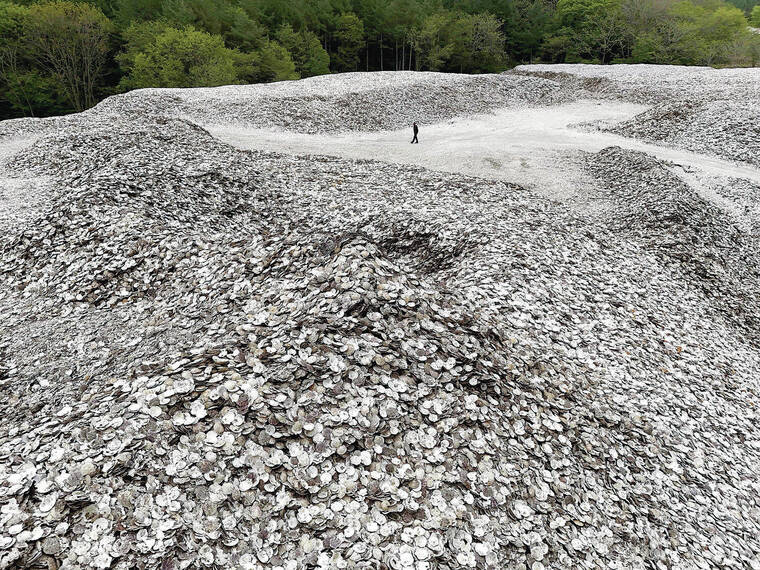
Piles of discarded scallop shells in Yubetsu, Hokkaido, are prompting innovative recycling efforts. This town, located by the Sea of Okhotsk, is currently dealing with an excess of shells, which have become a significant environmental concern. The local company, Kyoritsu Sangyo, typically processes these shells for various uses, including farmland drainage ditches. However, a recent decline in demand due to rising costs has led to a surplus, leaving the shells to accumulate like snow drifts.
Masao Sasaki, president of Kyoritsu Sangyo, expressed concern over the ongoing issue. “We have had an ongoing excess of shells for a few years now,” he stated. Yet, research teams are exploring new avenues for these discarded materials, potentially transforming them from waste into valuable resources.
Innovative Recycling Efforts
According to the Hokkaido Research Organization, which operates an Industrial Research Institute in Sapporo, about hundreds of thousands of tons of scallop shells are discarded annually in Japan. In a notable collaboration in 2005, the institute worked with Nihon Rikagaku Industry Co. to produce chalk from crushed scallop shells. The resulting product, made from particles as small as 5 micrometers, has been praised for its smoothness and durability, offering a sustainable alternative to traditional chalk.
In light of growing environmental consciousness, scallop shells are increasingly regarded as a biomass material. Incorporating crushed shells into plastics can significantly reduce the reliance on petroleum-based resources. This innovative mixture has already been applied in the production of food trays, and tests are underway to determine its feasibility for manufacturing interior car components.
Expanding Applications at the Osaka-Kansai Expo
Further highlighting the versatility of scallop shells, the upcoming 2025 Osaka-Kansai Expo plans to utilize a novel product known as “hotamet.” A creative blend of the words “helmet” and “hotate” (Japanese for scallop), these helmets will serve as safety equipment during the event. Notably, they comprise 10% crushed scallop shells, showcasing the potential of this material in ensuring public safety.
Kazuhito Nishikawa, head of the Nihon Rikagaku Industry plant in Bibai, Hokkaido, commented on the unexpected applications of scallop shells. “It’s so unexpected that a chalk ingredient could become biomass material,” he noted, reflecting on the innovative trajectory of this initiative.
As scallop shells find new life through these creative uses, Hokkaido stands at the forefront of sustainable practices. The efforts to recycle discarded shells not only address local environmental challenges but also represent a broader commitment to sustainability in material use. This transformation from waste to resource is poised to inspire similar initiatives in other regions, emphasizing the importance of innovation in tackling waste management issues.