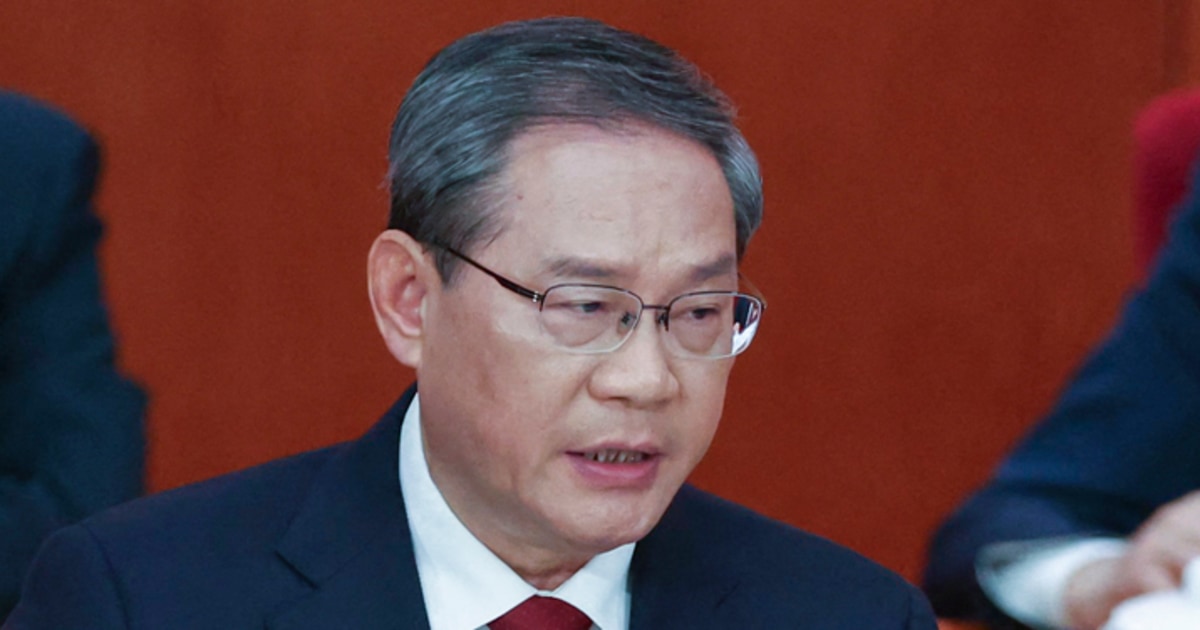
China has announced its lowest growth target in 35 years as the nation’s economy grapples with significant domestic and international challenges. During the opening session of the National People’s Congress on March 7, 2024, Premier Li Qiang revealed that the government aims for a gross domestic product (GDP) growth of between 4.5% and 5%. This target, the most conservative since 1991, represents a shift from the 5% target achieved in 2023 and is the first formal downgrade since that time.
In his lengthy address, which lasted over an hour, Li acknowledged the difficulties facing the economy, stating, “While recognizing our achievements, we are also clear-eyed about the difficulties and challenges we face.” The National People’s Congress, an annual political event where the ruling Communist Party sets key economic directions, is being overseen by Chinese leader Xi Jinping. The event serves as a platform for the government to communicate its priorities and policies, particularly regarding economic stability and growth.
Shifting Economic Strategies
China is transitioning from an export-driven economy to one that emphasizes domestic demand. This change is essential as the country confronts structural issues, including a prolonged slump in the property market, industrial overcapacity, and rising local government debt. In response, the government is investing heavily in advanced technologies like artificial intelligence and robotics to enhance competitiveness against the United States in these sectors.
Li announced that the government would introduce economic policies aimed at countering U.S. tariffs, which have fluctuated significantly since the onset of the trade war initiated by former President Donald Trump. Despite a sharp decline in exports to the U.S. due to these tariffs, China reported a record trade surplus of nearly $1.2 trillion last year, fueled by increased sales to markets outside the U.S.
Defense spending is also set to rise, with an increase of 7% to more than $275 billion. This budget aligns closely with recent years, reflecting China’s intention to modernize its military by 2035 amid escalating regional tensions, particularly regarding Taiwan.
International Relations and Economic Stability
The geopolitical landscape complicates China’s economic outlook. The ongoing conflict in Iran, a long-time ally, poses risks. As the largest buyer of Iranian crude oil, China has relied on discounted imports; however, these represent only about 13% of its total oil imports and can be substituted with other sources. The Strait of Hormuz, crucial for one-third of China’s oil imports, has become a focal point of concern following Iranian actions in reaction to U.S.-Israeli military strikes.
China’s leadership emphasizes stability in both domestic and international arenas, advocating for a “multipolar world” over one dominated by the U.S. Despite the tensions surrounding Iran, it is anticipated that the upcoming meeting between President Trump and Xi, scheduled for March 31, 2024, will proceed as planned, reflecting Beijing’s desire to maintain a stable relationship with Washington.
Li’s speech also highlighted the demographic challenges facing China, including an aging population and declining birth rates. The government aims to foster a “childbirth-friendly society” over the next five years, addressing concerns around the high costs of child-rearing and insufficient job prospects for young people. Additionally, initiatives to enhance services for the elderly population are part of a broader strategy to support the so-called silver economy.
As China navigates these multifaceted challenges, the newly set growth target signals an acknowledgment of the limits of its previous economic model while striving for resilience and adaptability in a changing global landscape.