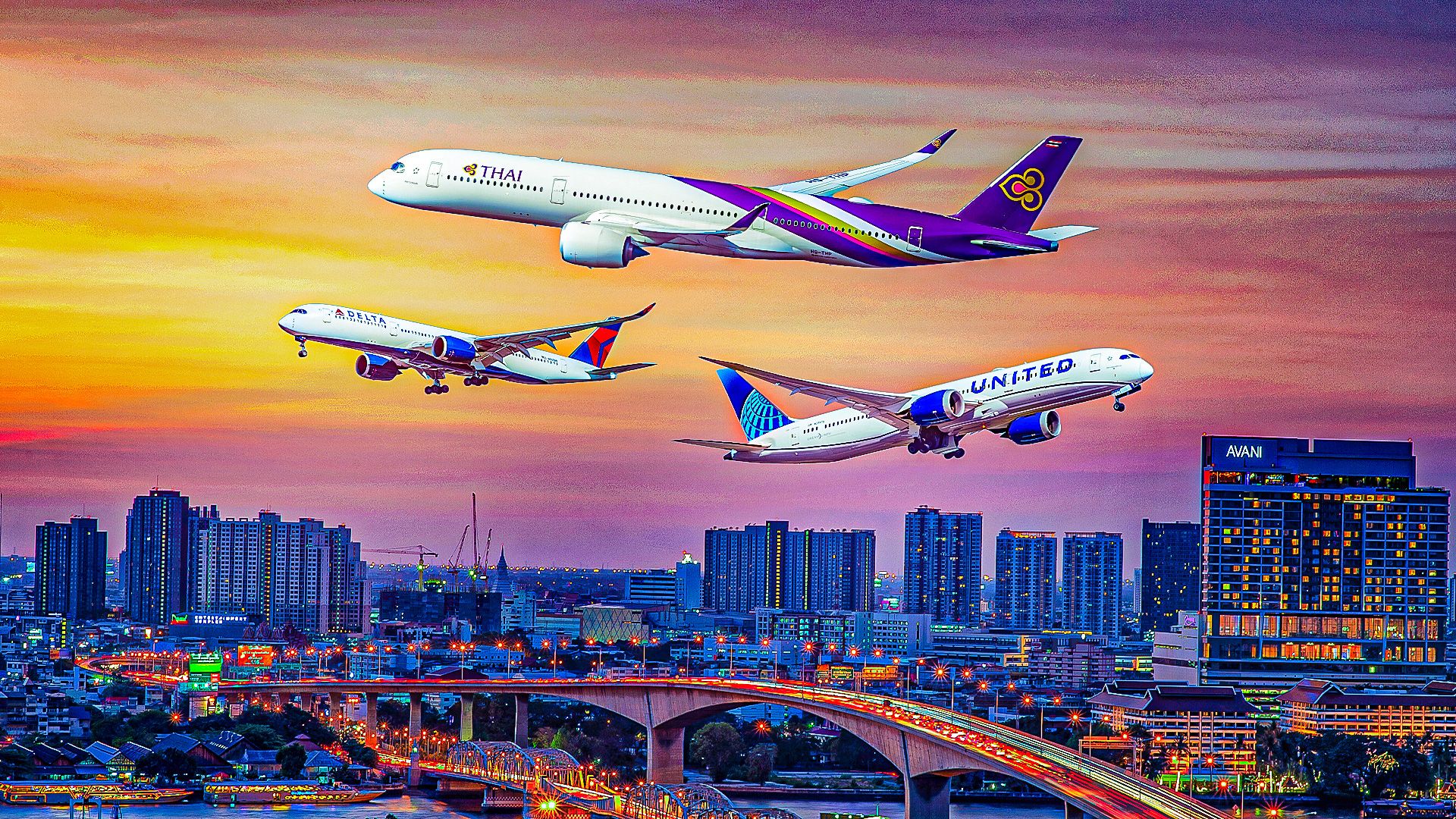
Thailand, a leading global tourist destination, attracted over 35 million international visitors in 2024, with significant numbers coming from China and India. Despite its rising appeal among US travelers, who are drawn to the country’s culture, cuisine, and scenic beauty, there are currently no nonstop flights connecting the United States and Thailand. This article explores the reasons behind this lack of direct services, alternative travel options, and the potential for future nonstop flights.
Thailand’s Air Safety Challenges
A key factor contributing to the absence of nonstop flights from the US to Thailand is the country’s air safety rating. In 2015, the US Federal Aviation Administration (FAA) downgraded Thailand’s air safety rating to Category 2 due to non-compliance with International Civil Aviation Organization (ICAO) standards. This downgrade restricted Thai carriers from operating direct flights to the US.
However, in April 2025, Thailand’s Deputy Prime Minister and Transport Minister, Suriya Jungrungreangkit, announced that the country had regained its Category 1 rating. Following this improvement, United Airlines unveiled plans for a one-stop service from Los Angeles International Airport (LAX) to Bangkok Suvarnabhumi International Airport (BKK), with a stop at Hong Kong International Airport (HKG). This service is set to launch in October 2025 using Boeing 787-9 aircraft.
While this development signals progress, the prospect of nonstop flights between the US and Thailand remains uncertain for several reasons.
Economic Considerations Affecting Nonstop Services
One major reason for the lack of nonstop flights is the perception of the Thailand route as low-yielding. Unlike other Southeast Asian destinations such as Singapore, which enjoys significant business traffic, flights to Thailand mainly cater to leisure travelers and those visiting friends and family. These passengers tend to be more price-sensitive and often prefer to save on costs by taking longer one-stop flights.
Considering the distance, a flight from LAX to BKK covers approximately 8,269 miles, categorizing it as an ultra-long-haul route. Such routes pose profitability challenges for airlines due to high fuel and staffing costs, as well as the extended time aircraft spend away from their home bases. Nonstop flights are generally more viable between major business hubs that can attract premium passengers willing to pay higher fares.
For instance, Singapore Airlines operates successful ultra-long-haul flights between Singapore Changi Airport (SIN) and New York’s John F. Kennedy International Airport (JFK), a route that attracts a healthy mix of business and leisure travelers. In contrast, the demand for a direct route to Thailand has not reached a similar level.
Historical Context and Current Options
Historically, Thai Airways provided direct flights from Bangkok to both Los Angeles and New York using Airbus A340-500 aircraft. Unfortunately, these routes were not financially sustainable, leading to their discontinuation in the late 2010s. Improved fleet efficiency with newer aircraft like the Airbus A350 and Boeing 787 could make future nonstop routes more feasible.
Currently, the only nonstop service connecting North America and Thailand is offered by Air Canada. The Canadian airline operates three flights per week from Vancouver International Airport (YVR) to BKK, increasing to five during peak winter months. This service, initiated in December 2022, has proven successful, likely due to the shorter distance of 7,344 miles compared to routes from the US West Coast.
Travelers seeking to visit Thailand still have several one-stop options from various major hubs. United Airlines’ upcoming service will complement existing connections via airports in East Asia, including Tokyo Narita and Seoul Incheon, serviced by airlines such as Korean Air and Japan Airlines.
Future Possibilities for Direct Flights
Considering the recent developments and the growth of Thailand’s popularity among US travelers, the possibility of nonstop flights could become more realistic. Should United Airlines choose to expand its offerings, it would likely operate these flights from either LAX or San Francisco International Airport (SFO). Both locations have significant Thai communities and a robust demand for travel to Thailand.
As travelers continue to seek unique experiences, particularly luxury leisure opportunities, the airline industry may eventually adapt to meet this demand. With the lifting of Thailand’s safety restrictions and potential advancements in aircraft efficiency, the prospect of nonstop flights between the US and Thailand may no longer be a distant dream.