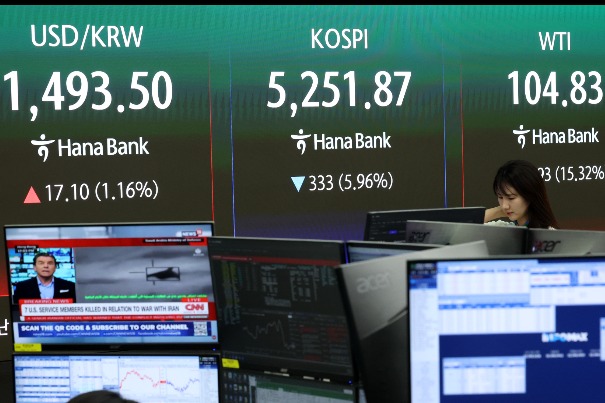
UPDATE: South Korean stocks have plunged dramatically today, with the benchmark Kospi index down more than 8% during trading, prompting a 20-minute circuit breaker halt. Investors are fleeing risk assets as oil prices surge amid escalating tensions in the US-Israel-Iran conflict, leading to widespread market panic.
The Kospi closed at 5,251.87, down 6% for the day, after briefly dipping below 5,100. The tech-heavy Kosdaq also suffered, ending down 4.5% at 1,102.28. This latest downturn follows an earlier record rebound, highlighting a potentially unstable market environment characterized by a W-shaped recovery rather than a quick rebound.
From the market’s opening, the Kospi fell precipitously, leading to a sell-side sidecar after Kospi 200 futures dropped over 5%. The Korea Exchange intervened, imposing a circuit breaker after the index remained down more than 8% for at least one minute, halting trading for all Kospi-listed shares.
The renewed selloff was driven by a surge in West Texas Intermediate crude prices, which spiked nearly 26% to $114.49 per barrel, the highest since July 2022. South Korea, heavily reliant on Middle Eastern energy imports, is particularly vulnerable to rising oil prices, which intensify risk-averse sentiment among investors.
“Given South Korea’s heavy dependence on energy imports, any spike in oil prices amid geopolitical tensions could lead to intensified market fear,” warned Lee Sung-hoon, an analyst at Kiwoom Securities Co.
The South Korean won tumbled significantly, trading at 1,495.50 per dollar, approaching the psychologically significant 1,500 mark. This represents its weakest level since March 2009 during the global financial crisis. Foreign investors led the selloff, offloading a net 3.2 trillion won (about $2.1 billion) of shares from the main board, while institutions sold off 1.5 trillion won.
Losses were widespread, affecting major companies across various sectors. Among the hardest hit were industry giants like SK Hynix Inc., which fell 9.5%, and Hyundai Motor Co., down 8.3%. Other notable declines included Samsung Electronics Co. at 7.8% and Kia Corp. at 8.1%.
The situation is compounded by a broader global risk-off sentiment. In New York, the Dow Jones Industrial Average fell nearly 1%, reflecting investor concerns over surging oil prices and disappointing labor market data.
Some analysts suggest that the current market conditions have pushed Korean equities into an oversold territory, indicating potential future gains. “The index has entered a deep-value zone,” said Lee Kyung-min of Daishin Securities Co. “It has already priced in a worsening economy and weaker earnings.”
However, others caution that the volatility may continue. “In past episodes of sharp declines, a V-shaped rebound has been rare,” noted Lee Eun-taek from KB Securities Co. “Markets typically form a W-shaped bottom, as it takes time for fear to be fully realized before uncertainty begins to clear.”
As the situation develops, investors are advised to closely monitor oil prices and geopolitical dynamics in the Middle East, as these factors will significantly impact South Korea’s economic outlook and market stability in the coming days.