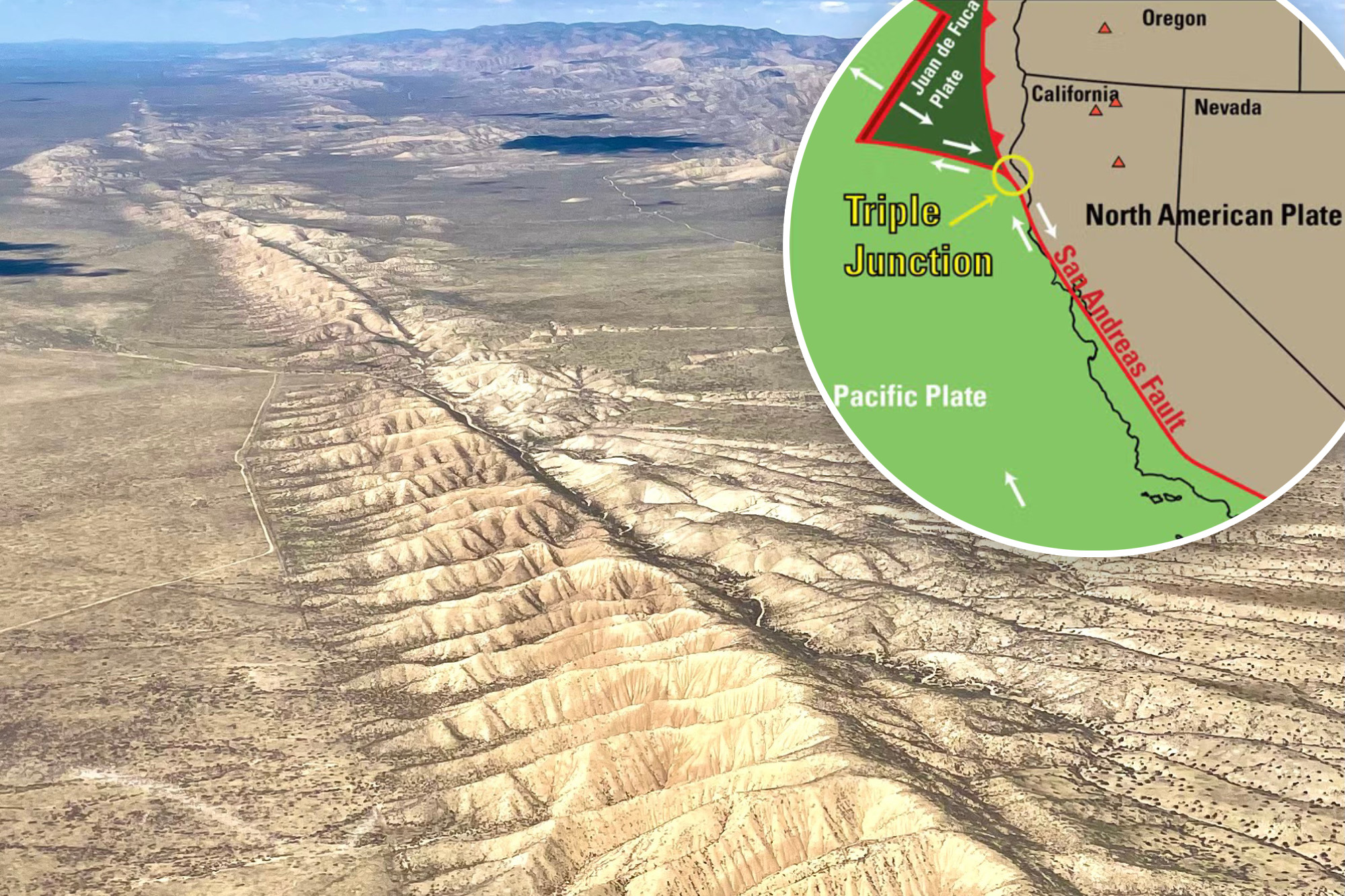
BREAKING: Scientists have just revealed a seismic hotspot along California’s north coast that could trigger devastating earthquakes up to magnitude 8.0. This alarming discovery, published in the journal “Science,” uncovers hidden fault lines in the Mendocino Triple Junction, escalating concerns over the region’s earthquake risk.
According to the study, the Mendocino Triple Junction, where three tectonic plates converge, has been found to consist of five moving plates, not just three as previously believed. This unexpected revelation means millions of residents could be at greater risk than initially understood. Lead author David Shelly of the USGS Geologic Hazards Center in Golden, Colorado, emphasized, “Our understanding is just the tip of the iceberg.”
The Mendocino Triple Junction is notorious for its high seismic activity, having produced a magnitude 7.2 earthquake that struck Humboldt County in 1992. With this new research, scientists fear the area could be even more unstable. “If we don’t understand the underlying tectonic processes, it’s hard to predict the seismic hazard,” stated co-author Amanda Thomas, a professor at UC Davis.
Using a network of seismometers across the Pacific Northwest, researchers detected “low-frequency” earthquakes deep underground—tremors too small to feel at the surface. This groundbreaking method confirmed the existence of previously theorized geological elements, including the Pioneer Fragment, a remnant of the ancient Farrallon plate now being dragged beneath the North American plate.
The implications of these findings are urgent. As tectonic plates grind against each other, the potential for catastrophic seismic events increases. “The plate boundary seems not to be where we thought it was,” said Kathryn Materna, a tectonic geodesist from the University of Colorado Boulder. This shift in understanding could redefine how scientists assess earthquake risks in the region.
As residents and officials brace for potential aftershocks from this announcement, the immediate response is crucial. Local governments and emergency services are urged to reevaluate preparedness plans in light of these findings. The study highlights the need for ongoing monitoring and research to mitigate risks associated with this seismic hotbed.
WHAT’S NEXT: Authorities will likely increase seismic monitoring in the Mendocino area and update emergency protocols to ensure public safety. The study serves as a stark reminder of nature’s unpredictability and the urgent need for preparedness in earthquake-prone regions.
Stay tuned for more updates as scientists continue to analyze this complex geological puzzle, which could significantly impact millions living along California’s coastline.