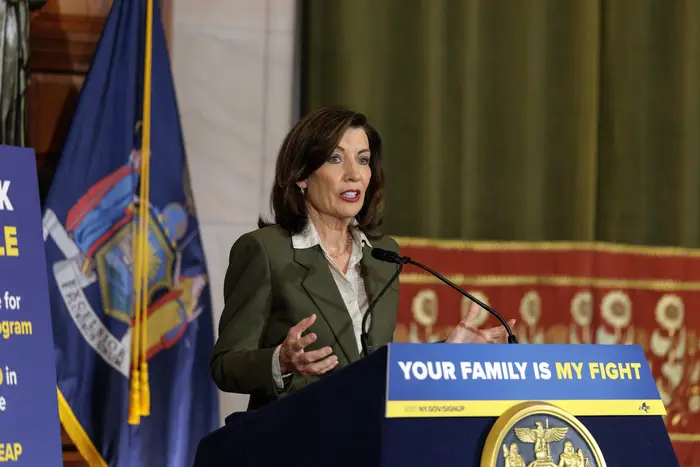
UPDATE: New York Governor Kathy Hochul has just announced significant amendments to the contentious Medical Aid in Dying Act that could reshape the future of physician-assisted deaths in the state. Sources reveal that Hochul is proposing a requirement for patients to videotape their requests for life-ending medications, intensifying the ongoing debate surrounding this sensitive issue.
The Democratic governor submitted these amendments to the state Legislature late last month, sparking urgent discussions among lawmakers. The proposed changes come amid ongoing negotiations and are Hochul’s first direct engagement in the emotionally charged conversation that has seen lawmakers share deeply personal stories related to faith, autonomy, and caregiving.
“I hear from a lot of people on that issue,” Hochul stated. “There are strong views on both sides of the spectrum — intense views on this. And I’m conscious of that, and it’s going to be a very weighty decision on me.”
Among the new stipulations, Hochul aims to establish a seven-day waiting period for terminally ill patients seeking life-ending drugs. Additionally, she wants all patients requesting physician-assisted deaths to undergo a mental health evaluation by a psychiatrist, further complicating the path to obtaining such assistance. The governor also seeks to limit the practice to New York residents only and proposes delaying the bill’s effective date by one year after her signature.
The Medical Aid in Dying Act, which has already passed in June, requires Hochul’s action before December 31, 2023, along with over 200 other bills. However, it remains uncertain whether these proposed changes, known as chapter amendments, will gain approval from lawmakers who initially backed the legislation.
Assemblymember Amy Paulin and state Senator Brad Hoylman-Sigal, sponsors of the bill, have declined to comment on the current status of the legislation. Hochul’s spokesperson, Kara Cumoletti, confirmed that the governor is “continuing to review the legislation.”
In the broader context, eleven other states and the District of Columbia have already legalized assisted death, each with varying regulations. Meanwhile, a similar bill awaits action from Illinois Governor JB Pritzker. Advocates for the New York bill have been actively reaching out to Hochul, sharing heart-wrenching letters that detail their experiences with terminal illness and suffering loved ones.
The state’s Roman Catholic bishops have voiced strong opposition, claiming the bill crosses a moral line. Bob Bellafiore, a spokesperson for the New York State Catholic Conference, criticized the amendments as mere “deck chairs on the Titanic,” arguing that they do not address the fundamental ethical issues surrounding the bill.
“[The bill] sanctions suicide, diminishes medicine forever and is guaranteed to lead to tragedies, mistakes and unintended consequences that the governor will be responsible for,” he stated, as the Catholic Conference organized a candlelight vigil outside the Executive Mansion in Albany.
In contrast, supporters of the bill have rallied at the State Capitol and in New York City, emphasizing the existing safeguards within the legislation. Groups like Compassion & Choices, the main advocacy organization for the bill, argue that no other states require videotaped requests for assisted death, although some have instituted waiting periods.
Under the current provisions of the bill, a patient must make a formal request for life-ending medication. Two physicians must then confirm the patient’s irreversible and incurable condition, with a prognosis of six months or less to live. A mental health evaluation is mandated if either physician questions the patient’s decision-making capacity, and a patient’s request must be witnessed by two unrelated individuals.
Corinne Carey, senior campaign director for Compassion & Choices, expressed optimism about the ongoing dialogue. “We’ve been working on refining this bill for ten years,” she said. “I am truly grateful that the governor’s office is engaging with this bill in good faith, and I trust that the three sides will come to the right decisions.”
As discussions continue and the December deadline looms, all eyes are on Governor Hochul and the state Legislature. The outcome of these proposed amendments could have far-reaching implications for the future of assisted dying in New York, making this an urgent issue for many residents. Stay tuned for further developments in this evolving story.