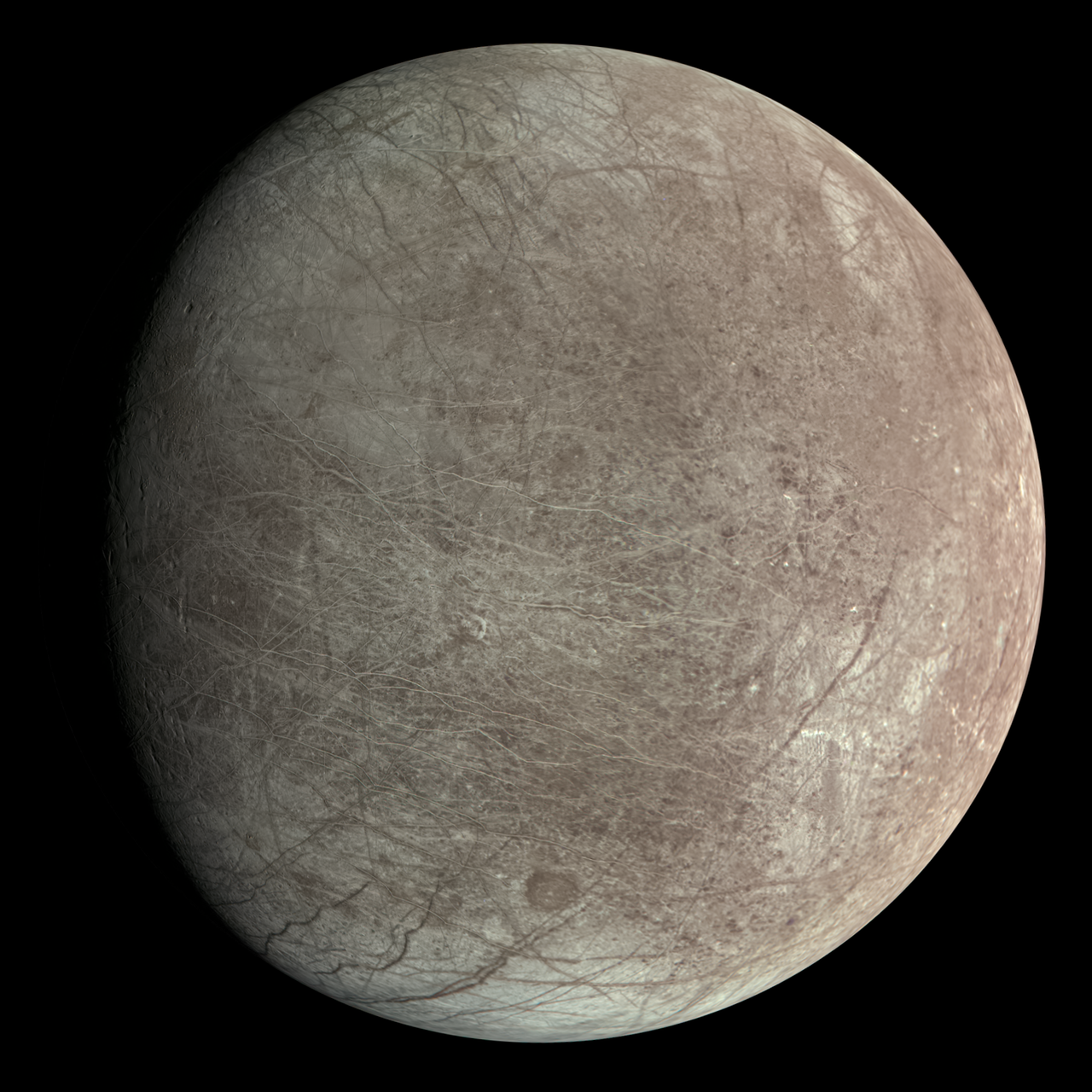
Scientists have made significant strides in understanding the icy moon Europa, one of Jupiter’s many satellites. A recent study utilizing the James Webb Space Telescope (JWST) has revealed crucial insights into the moon’s surface chemistry, suggesting dynamic processes taking place beneath its frozen exterior. The findings have important implications for the field of astrobiology, potentially indicating the presence of life-sustaining materials.
The research, led by Gideon Yoffe and his team, employed a technique known as spectral decomposition to analyze observations of Europa’s leading hemisphere. This method, likened to chemical fingerprinting, allows scientists to identify and map the unique signatures of molecules based on their absorption and reflection of light at specific wavelengths. By examining nine distinct spectral bands, the researchers focused on components such as water ice and carbon dioxide, unveiling a more complex chemical landscape than previously understood.
One of the key discoveries was the concentration of carbon dioxide in a geologically chaotic area known as Tara Regio. Previously thought to be a localized feature, the new analysis indicates that the carbon dioxide extends well beyond Tara Regio, covering multiple regions characterized by chaotic terrain. This expansive distribution suggests that the processes affecting the surface may be more widespread than initially believed.
The research team observed that in areas where carbon dioxide concentration is highest, the ice displays unusual textural properties. This observation implies that the surface has likely been reworked by processes originating from below. The correlation between the carbon dioxide distribution and the texture of the ice indicates that the microstructure of the ice itself may influence what materials are retained on the surface.
This nuanced understanding of Europa’s surface chemistry raises intriguing possibilities. Carbon dioxide is one of six elements deemed essential for life as we know it. If the surface deposits are indeed sourced from the subsurface ocean, as the findings suggest, then this ocean may contain carbon and other vital compounds. Furthermore, the exchange of materials between the ocean and the surface could be occurring in ways that scientists are just beginning to explore.
The future of this research will be bolstered by the upcoming Europa Clipper mission, scheduled to begin close flybys of Europa in 2031. The chemical map constructed from JWST observations will guide the Clipper in its exploration, highlighting areas of interest where the potential for life may be greatest.
As scientists continue to unravel the mysteries of Europa, these findings underscore the moon’s significance in the search for extraterrestrial life. The insights gained from the analysis not only enhance our understanding of Europa’s geological activity but also pave the way for future exploration and discovery in the broader context of the solar system.