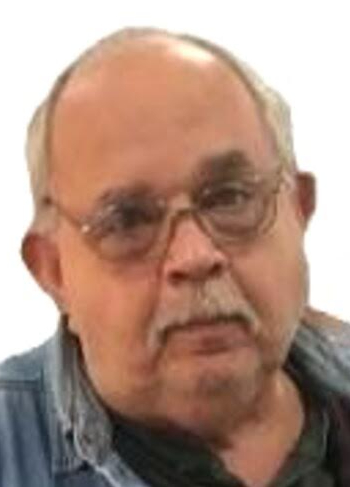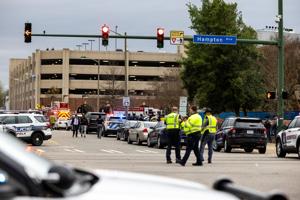
A man who opened fire at Old Dominion University in Virginia has been released early from federal prison after successfully completing a drug treatment program. Mohamed Bailor Jalloh, who had been sentenced to 11 years for providing support to the Islamic State group, was freed approximately two and a half years ahead of schedule in 2024. The details surrounding his eligibility for the program, which typically excludes inmates convicted of terrorism-related offenses, have raised significant concerns.
Jalloh was convicted in 2017 after pleading guilty to charges that included providing material support to a designated foreign terrorist organization. He was sentenced to an 11-year prison term but received credit for time served dating back to his arrest in July 2016. At the time of the shooting on Thursday, he was under supervised release, which is akin to probation, and that period was set to continue until 2029.
The tragedy unfolded when Jalloh fatally shot one person and injured two others before being subdued and killed by ROTC students on campus. U.S. Representative Jen Kiggans, who represents the area surrounding the university, expressed disbelief over the incident, emphasizing that such a tragedy should never have occurred.
Background on Jalloh’s Criminal History
Jalloh’s criminal history includes a plea agreement stemming from a three-month FBI sting operation. During this operation, he confessed to an undercover agent about his intentions to carry out an attack similar to the 2009 Fort Hood shootings, which resulted in 13 deaths. Authorities became aware of Jalloh after he made contact with members of the Islamic State group in Africa earlier that year.
In court documents, it was revealed that Jalloh attempted to donate $500 to the Islamic State, inadvertently sending the money to an account controlled by the FBI. He also tried to purchase an AR-15 assault rifle from a Virginia store but was initially denied due to missing paperwork. The next day, he managed to buy a different assault rifle, which was rendered inoperable before he left the store. Jalloh was arrested shortly thereafter.
Controversy Surrounding Early Release
The early release of Jalloh has sparked debate about sentencing practices and the eligibility of inmates for drug treatment programs. The U.S. Department of Justice had sought a 20-year sentence for Jalloh, citing multiple attempts to join the Islamic State and his efforts to obtain a firearm for a murder plot. Prosecutors highlighted his understanding of the gravity of his actions, noting that his motivations were deeply rooted in extremist ideology.
Despite the Justice Department’s recommendations, Jalloh’s defense team argued for a significantly shorter sentence of six and a half years, advocating for his placement in a facility focused on drug treatment. Ultimately, he was sentenced to 11 years, with a requirement to participate in programs for substance abuse and mental health treatment.
Following Jalloh’s release, questions have arisen about the decision-making process that allowed him to qualify for the drug treatment program, especially given the nature of his conviction. Under current federal guidelines, inmates convicted of terrorism-related offenses typically do not qualify for sentence-reducing programs, including the First Step Act, which limits good conduct credits for such inmates.
Jalloh, a naturalized citizen from Sierra Leone, has been described in court documents as a troubled individual influenced by radical ideologies, specifically citing the sermons of Anwar al-Awlaki, an infamous al-Qaida propagandist. His military service in the Virginia Army National Guard, where he served as a specialist until his honorable discharge in 2015, has also come under scrutiny in light of his eventual radicalization and violent actions.
As investigations continue, the case raises urgent questions regarding public safety, rehabilitation programs, and the effectiveness of the justice system in managing individuals with extremist ties.