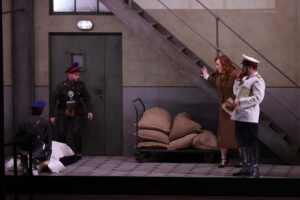
Teatro alla Scala in Milan opened its 2025-2026 season with a striking new production of Lady Macbeth of the Mtsensk District, a groundbreaking opera by Dmitri Shostakovich. This bold presentation, directed by Vasily Barkhatov, not only revives a classic work but also invites audiences to reflect on its enduring themes of oppression and female agency.
Originally composed between 1930 and 1932, Shostakovich’s opera tackles the complexities of a patriarchal society. Upon its premiere in 1934, it received critical acclaim, only to be banned two years later by the Soviet regime after a scathing review in the newspaper Pravda. The editorial lambasted the opera as “Chaos instead of music,” marking a significant rift between the composer and the Stalinist authorities.
The narrative centers on Katerina Izmailova, a woman suffocated by her loveless marriage and oppressive male authority. Shostakovich, alongside librettist Alexander Preis, transforms her from a mere criminal into a tragic victim of her circumstances, creating one of the most powerful female characters in opera history.
Staging with Impact
Barkhatov’s production is set against the backdrop of Stalin’s Soviet Union, enhancing the opera’s historical and political resonance. The visual narrative unfolds during a police interrogation, oscillating between the present and flashbacks that reconstruct Katerina’s tragic story. Barkhatov described the opera as “both simple and extremely difficult,” emphasizing a delicate balance between violence and clarity.
The set design by Zinovy Margolin features a stark contrast between the affluent exterior of a restaurant and the oppressive interiors where Katerina’s suffering unfolds. This juxtaposition underscores the themes of power and control inherent in the narrative. The staging does not shy away from violence, yet it remains sensitive, avoiding gratuitousness while effectively portraying the dire circumstances faced by the characters.
One of the most audacious moments in the production is Barkhatov’s reimagining of the opera’s ending. In a departure from Shostakovich’s original conclusion, Katerina douses herself in gasoline and ignites her own demise alongside another character, Sonetka. This dramatic portrayal, executed with remarkable physicality by stuntwomen Beatrice Del Bo and Marie Schmitz, leaves the audience in stunned silence, feeling the literal heat of the flames on stage.
Musical Excellence and Performance Highlights
Conductor Riccardo Chailly led the orchestra in what marked his final season-opening performance. His interpretation of the score was noted for its clarity, successfully navigating the complexities of Shostakovich’s modernist techniques. Chailly’s ability to maintain tension throughout the performance allowed the narrative to unfold with relentless urgency.
The Orchestra of Teatro alla Scala delivered a powerful performance, particularly in the brass and percussion sections, which captured the opera’s intense emotional landscape. The strings shifted away from their typical romantic sound, creating a stark atmosphere that enhanced the feelings of despair and alienation present in the piece.
The vocal performances were equally commendable, with Sara Jakubiak portraying Katerina with remarkable depth and technical skill. Her ability to convey the character’s vulnerability and strength made her performance stand out. Jakubiak’s mastery of the Russian language and expressive phrasing contributed to a deeply human representation of Katerina.
In supporting roles, Najmiddin Mavlyanov offered a nuanced portrayal of Sergei, highlighting his character’s opportunism rather than traditional heroism. Meanwhile, Alexander Roslavets embodied the oppressive patriarch Boris with a powerful presence that added to the opera’s tension.
The audience responded with enthusiastic applause, particularly acknowledging the performances of Chailly and Jakubiak, the central figures in this gripping reinterpretation of Lady Macbeth of the Mtsensk District. As the curtain fell, the production resonated with its viewers, echoing Shostakovich’s original critique of power and societal repression, reminding all of the opera’s timeless relevance in today’s context.