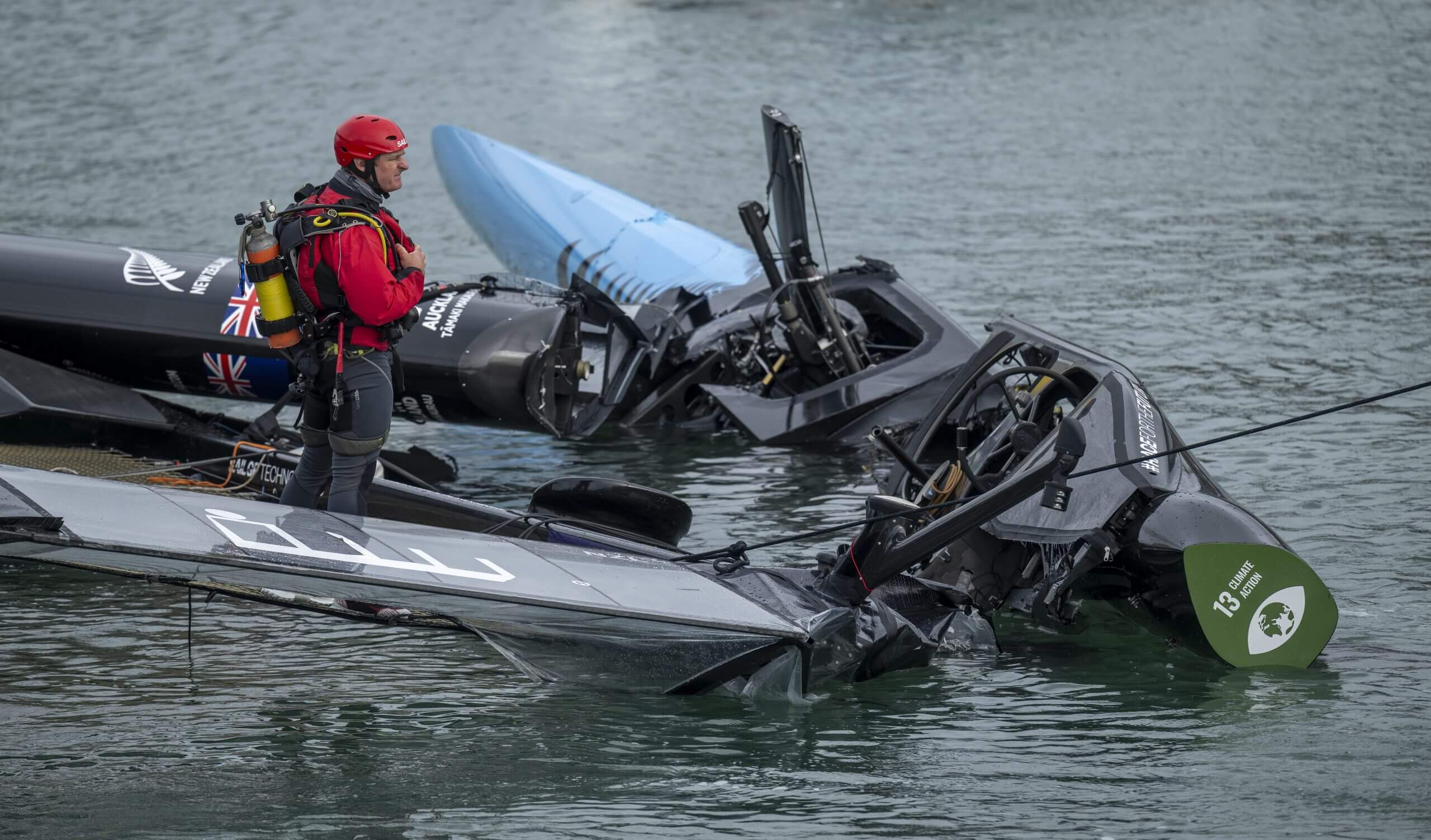
Australia emerged victorious at the New Zealand Sail Grand Prix held in Auckland, but the event’s excitement was marred by a serious collision between the New Zealand and French teams. The opening day of racing was abandoned due to the crash, which left two sailors hospitalized and raised concerns about safety in high-speed competitions.
Details of the Collision
On Saturday, during the competition, a catastrophic incident occurred when the New Zealand boat lost grip and nosedived, colliding with the French vessel. Both boats were moving at speeds approaching 60 miles per hour (approximately 100 km/hLouis Sinclair, a grinder for the New Zealand team, underwent surgery for serious injuries, including compound fractures in both legs. A team statement confirmed that his surgery was successful and that medical staff were optimistic about his recovery.
Meanwhile, Manon Audinet, the strategist for France, sustained injuries during the incident and was placed under observation at Auckland Hospital. Reports indicated that she was violently thrown within her cockpit at the moment of impact, leading to further evaluations for potential internal injuries.
Australia’s Hard-Won Victory
Despite the tragic circumstances, racing resumed on Sunday, where Australia triumphed in a challenging final against Great Britain and Spain. Tom Slingsby, Australia’s driver, expressed mixed emotions following the victory, stating, “Obviously, it sucks that the French team and the New Zealand team weren’t out there. We want to compete against the best teams and would have loved to have had them out there.”
This victory marks the second consecutive win for Australia in the gusty conditions of Auckland Harbour, but the team’s achievement felt overshadowed by the previous day’s events. The New Zealand team, having faced a difficult start to the season with no points from the previous event in Perth and only two from Auckland, now faces an uphill battle to qualify for the grand final in Abu Dhabi this November.
With just two weeks until the next event in Sydney, the team will likely struggle to return to the water, raising doubts about their season prospects.
Changes to Race Format and Competitor Challenges
Following the collision, race officials implemented a split-fleet format to enhance safety, dividing the remaining fleet of boats into Groups A and B. This decision proved prudent when Italy experienced a similar loss of control shortly after racing resumed. The split allowed for sufficient spacing on the course, preventing further incidents.
While most teams agreed that the split-fleet format was necessary, there was considerable dissatisfaction regarding the points allocation system. Races held on Sunday were worth only half the points of those completed on Saturday. As a result, despite being eliminated from Sunday’s races, France still qualified for the final due to their earlier performance.
Conversely, lower-ranked teams like Germany and Canada, despite strong showings, found themselves unable to advance to the final, prompting calls for a reevaluation of the points system.
The Spanish team also faced challenges, struggling with mechanical issues that hindered their performance throughout the weekend. Diego Botin, the Spanish team’s driver, noted that despite attempts to rectify issues before racing, the team ultimately had to withdraw from a race due to equipment failure.
As the season progresses, the SailGP faces a dramatic start filled with unexpected challenges and thrilling victories. The upcoming Sydney Grand Prix promises to continue this trend, with sailors hoping for a more stable weather forecast.
With the backdrop of Auckland’s turbulent weekend, the competition’s future remains uncertain, but the resilience of teams and the ever-present thrill of high-speed sailing ensure that excitement will continue to dominate the SailGP narrative.