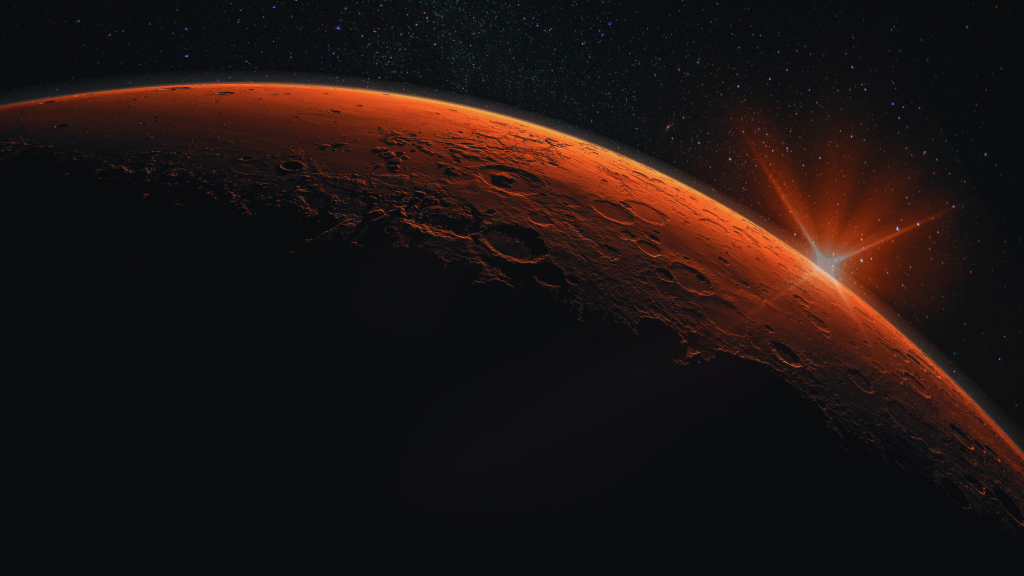
A recent study by the National Institute of Standards and Technology (NIST) has provided critical insights into how time flows on Mars compared to Earth. Researchers published their findings in The Astronomical Journal, revealing that an atomic clock on Mars would operate 477 microseconds faster each day than a similar clock on Earth. This knowledge is essential for future space missions and potential colonization of Mars, although it comes with complexities.
The difference in time is not constant; depending on Mars’ position in its orbit around the Sun, this daily variance can fluctuate by as much as 226 microseconds. While these figures may seem trivial, they pose significant challenges for scientific applications that require precise timing.
Understanding the mechanics behind this phenomenon reveals that Mars does not follow a perfectly circular orbit. Instead, its trajectory is influenced by the gravitational forces of the Sun, Earth, and even the Moon. This results in a complex interplay that disturbs Mars’ orbit, which NIST physicist Bijunath Patla describes as a classic “three-body problem.” He notes that with multiple celestial bodies exerting influence, the calculations can become exceedingly intricate.
Challenges of Synchronizing Clocks
The NIST team has dedicated its efforts to deciphering the multitude of factors that affect time flow on Mars. As humanity prepares for potential colonization, synchronizing clocks between Earth and Mars will be essential for navigation systems similar to GPS. Understanding how time behaves differently on Mars is crucial for making sustained habitation feasible.
While the implications of this time discrepancy may seem minor, they carry surprising consequences. For instance, living on Mars for fifty years would result in an individual being approximately nine seconds older than if they had remained on Earth. This difference, while small, highlights the nuances of time dilation in space.
Future Implications for Space Exploration
As space exploration continues to advance, the need for precise timekeeping in extraterrestrial environments becomes increasingly clear. The research conducted by NIST indicates that the complexities of time flow on Mars are just one of many challenges that future astronauts and colonists will need to navigate.
The findings are not just academic; they have real-world applications for the future of interplanetary exploration. As scientists and engineers work towards building the infrastructure for potential human settlements on Mars, understanding the intricacies of time will play a pivotal role in ensuring effective communication and navigation.
The study by NIST serves as a reminder of the challenges that lie ahead in the quest to explore and inhabit other planets. As humanity looks towards Mars, the knowledge gained from this research will be invaluable for those who aspire to make the Red Planet a second home.