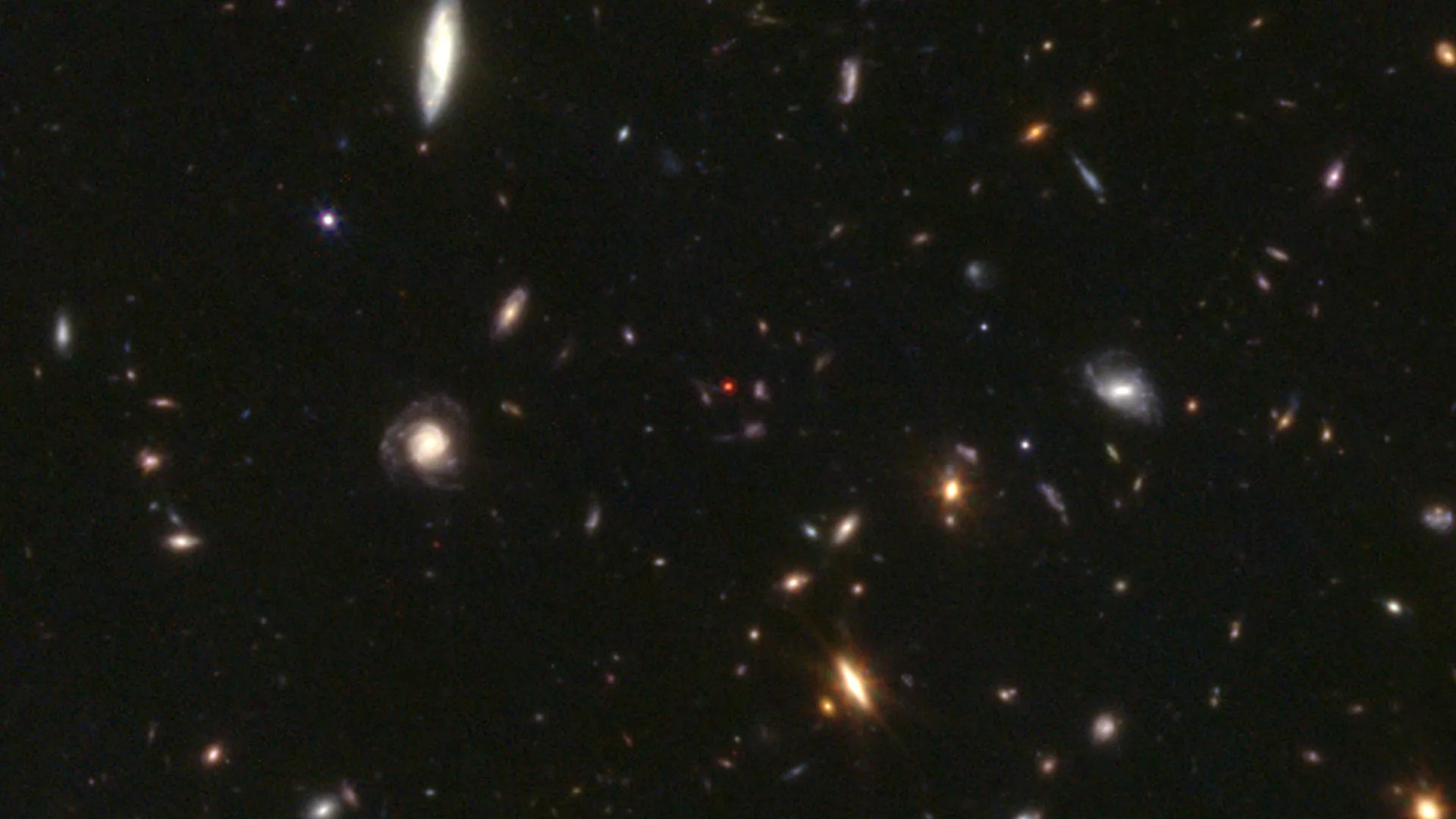
The peculiar red dots observed in images from the James Webb Space Telescope (JWST) have finally been explained, revealing a significant discovery about the early universe. Research conducted by scientists at the University of Copenhagen indicates that these dots represent young black holes concealed within dense clouds of gas, which glow as they consume their surroundings. This groundbreaking finding, published in the scientific journal Nature on January 14, 2026, sheds light on how supermassive black holes may have formed shortly after the Big Bang.
Since the JWST began its scientific operations, astronomers have been captivated by the appearance of these enigmatic red dots in its images of the distant cosmos. The telescope, positioned approximately 1.5 million kilometers from Earth, captured its first images in December 2021, revealing small, unidentified red points of light scattered among stars and galaxies. This unexpected phenomenon prompted questions regarding the nature of these glowing sources.
Researchers initially speculated that these red dots might be massive galaxies detectable across nearly 13 billion years of cosmic history. However, this theory contradicted established understanding of galaxy formation, as such large galaxies could not have existed so soon after the Big Bang, requiring considerably more time to develop.
After two years of detailed analysis, scientists from the Niels Bohr Institute’s Cosmic Dawn Centre arrived at a different conclusion. They determined that the red dots are not galaxies but young black holes, significantly less massive than previously thought. According to Professor Darach Watson, one of the study’s lead authors, “The little red dots are young black holes, a hundred times less massive than previously believed, enshrouded in a cocoon of gas, which they are consuming in order to grow larger.” This process generates an immense amount of heat, producing the unique red coloration observed in the images.
The discovery of these young black holes has gained considerable attention, placing the Cosmic Dawn Centre team on the front page of Nature, one of the world’s leading scientific publications. Scientists have now identified hundreds of these red dots, all representing young black holes. Although they are among the smallest black holes ever observed, their mass can reach up to 10 million times that of the Sun.
Black holes grow by drawing in nearby gas and dust. Due to their relatively small event horizons, the material that falls toward them becomes extremely hot and bright before crossing the point of no return. This phenomenon releases more energy than almost any other known cosmic event, resulting in a process that astronomers have dubbed “messy eating.” Professor Watson elaborates, stating, “When gas falls towards a black hole, it spirals down into a kind of disk or funnel. It generates temperatures of millions of degrees and lights up brightly. However, only a very small amount of the gas is actually swallowed by the black hole; most is blown back out from the poles as the black hole rotates.”
The implications of this research extend to our understanding of supermassive black holes, which are typically found at the centers of large galaxies, including our own Milky Way. The Milky Way’s central black hole has a mass approximately four million times that of the Sun. Despite their critical role in galaxy formation, the origins of these massive objects remain poorly understood.
The new findings provide insights into how supermassive black holes could have existed only 700 million years after the Big Bang, with some reaching masses billions of times greater than that of the Sun. Observing these young black holes during their rapid growth phases fills in a crucial chapter of cosmic evolution. Professor Watson emphasizes the significance of the discovery, stating, “We have captured the young black holes in the middle of their growth spurt at a stage that we have not observed before. The dense cocoon of gas around them provides the fuel they need to grow very quickly.”
As research continues, these discoveries promise to deepen our understanding of the universe’s early history and the formation of its most extreme objects.