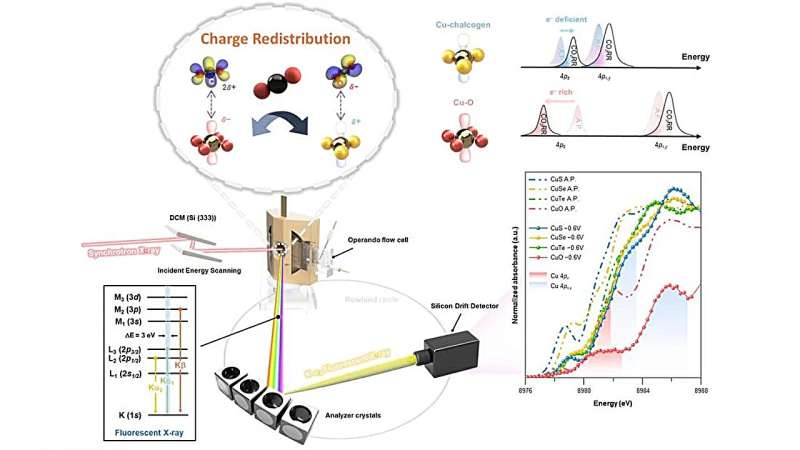
Researchers at National Taiwan University have made a significant breakthrough in understanding how copper chalcogenides convert carbon dioxide (CO2) into formate with remarkable selectivity. This study, published in Nature Communications on December 3, 2025, reveals a charge-redistribution mechanism that has puzzled scientists for years.
Copper chalcogenides have gained attention due to their unique ability to convert CO2 into formate, a process typically associated with p-block metals such as tin or bismuth. In contrast, transition metals like copper (Cu) generally exhibit lower product selectivity. The research team, led by distinguished professor of chemistry Hao Ming Chen, utilized advanced operando synchrotron-based X-ray spectroscopic techniques to capture direct spectroscopic evidence of the underlying mechanism.
The findings indicate that chalcogenide anions stabilize the catalytic structure, preventing the over-reduction of cuprous (Cu+) species to metallic Cu0. This stabilization maintains an electronic configuration that is favorable for the formation of mono-carbon intermediates, such as carbon monoxide (CO) and formate. More importantly, the charge-redistribution process within the Cu+ sites dynamically stabilizes O-bound formate intermediates, steering the CO2 reduction pathway predominantly towards formate production.
The optimal catalyst, CuS, showcased an impressive 90% faradaic efficiency for formate at −0.6 V, with a formate partial current exceeding one ampere. This performance demonstrates the potential scalability of these catalysts for industrial applications, marking a step forward in the field of electrocatalysis.
“Copper chalcogenides have fascinated researchers for decades because of their enhanced formate selectivity,” said Hao Ming Chen. “Our study reveals that charge-redistribution dynamics redefine the fundamental principles governing CO2 reduction selectivity and offer a new design strategy for tuning catalyst electronic structure via chalcogen modification.”
The implications of this research extend beyond academic interest. By providing a deeper understanding of the mechanisms at play, the findings pave the way for the design of more efficient catalysts, crucial for addressing global challenges such as climate change and energy sustainability.
As researchers continue to explore the potential of copper chalcogenides, this work stands as a testament to the importance of fundamental research in shaping future technological advancements in carbon capture and conversion.
For further details, refer to the article by Feng-Ze Tian et al., titled “Charge redistribution dynamics in chalcogenide-stabilized cuprous electrocatalysts unleash ampere-scale partial current toward formate production” in Nature Communications. The DOI for this publication is 10.1038/s41467-025-64472-1.