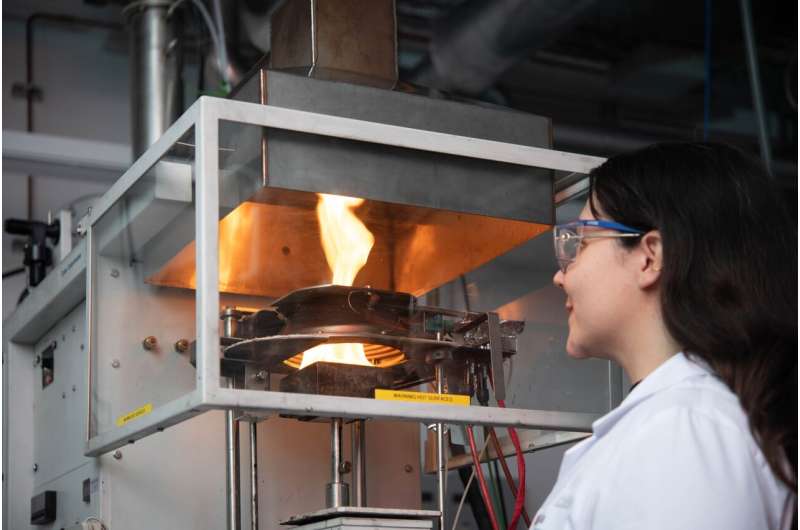
A team at the Swiss Federal Laboratories for Materials Science and Technology has pioneered a new approach to recycling epoxy resin, a plastic known for its durability but challenging to dispose of sustainably. Their innovative polymer, developed at the Empa facility in St. Gallen, incorporates phosphorus to enhance its properties, ensuring it is both recyclable and flame-retardant. This advancement addresses a significant environmental concern, as traditional epoxy disposal methods primarily involve incineration or landfills.
The researchers, led by Arvindh Sekar, have published their findings in the Chemical Engineering Journal on January 13, 2026. The new epoxy resin can be reclaimed through various methods, allowing it to be reshaped after its initial use, a process known as thermomechanical recycling. “We have conducted ten recycling cycles, and the epoxy has maintained its mechanical strength throughout,” Sekar noted.
The challenge with standard epoxy resins arises from their classification as thermosets. Once cured, the long molecular chains become cross-linked, making it impossible to melt them down for reuse. Traditional recycling methods for materials like polyethylene terephthalate (PET) do not apply here. Sekar explained, “Currently, we have only two options for disposing of epoxy resin: incineration or landfills.”
The breakthrough involves incorporating a phosphorus-containing polymer into the resin before curing, which retains both its flame-retardant qualities and mechanical properties. This innovative approach allows the cross-links among polymer chains to rearrange when exposed to heat.
In addition to thermomechanical recycling, the new epoxy can be chemically dissolved, facilitating fiber recovery from composite materials without significant damage. Sekar emphasized that this process can recover over 90% of the epoxy and phosphorus used, although it requires more energy and solvents, making it a less favorable option compared to thermomechanical recycling.
The team at Empa has refined the manufacturing process, making it suitable for industrial applications. They are actively seeking commercial partners interested in bringing this flame-retardant recyclable epoxy to market. Potential applications include indoor and outdoor coatings, as well as adhesives for constructing wind turbines, which are at risk of fire incidents due to electrical faults or lightning strikes.
Thanks to the addition of phosphorus, the new material exhibits improved color stability and reduced yellowing compared to conventional epoxy resins. “In addition to enhancing fire safety, our material simplifies maintenance and component replacement because it can be reshaped under appropriate conditions, even after curing,” Sekar explained.
The researchers are also exploring the combination of the phosphorus additive with other polymers to develop additional fire-resistant and recyclable materials. This work highlights a significant step forward in addressing the environmental challenges posed by plastic waste, particularly in the realm of durable materials. As the world grapples with the consequences of plastic pollution, innovations like these may offer promising solutions for a more sustainable future.