A team of researchers from the Netherlands and Australia has developed a groundbreaking chemical network capable of making decisions based on external conditions. This innovative system employs competing peptides and enzymes, specifically proteases, to create an adaptable enzymatic network. The findings, published in the journal Nature Chemistry on November 12, 2025, represent a significant advancement in the field of synthetic biology.
The ability to respond to environmental changes was previously attributed solely to complex living organisms. While computers have been designed to perform stimulus-response tasks, replicating this behavior in chemical systems has proven challenging. Until now, the expectation that a simple mixture of chemicals could emulate such complex decision-making seemed far-fetched. The newly developed enzymatic network demonstrates that a chemical system can indeed adapt and respond dynamically.
Constructing the Recursive Enzymatic Competition Network
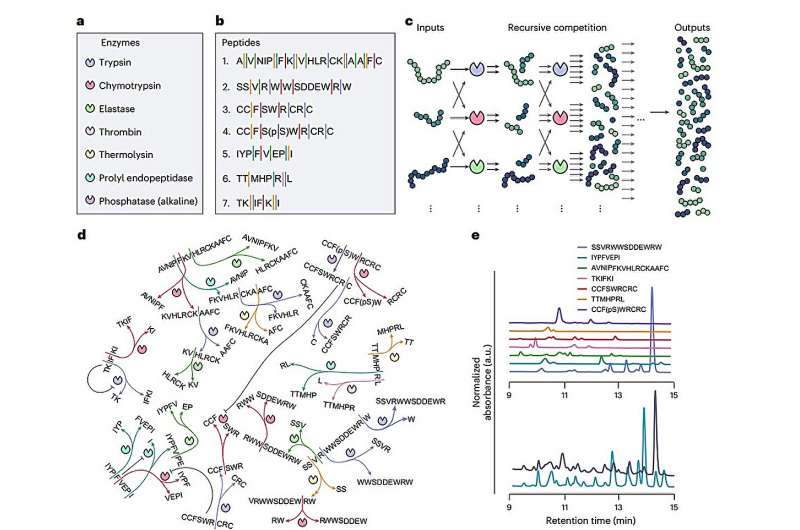
The research team constructed a **recursive enzymatic competition network (ERN)**, which forms the basis of their molecular computer. This complex chemical environment consists of seven enzymes and seven peptides with multiple cleavage sites, creating a competitive reaction network. Peptides compete for enzymes, leading to a continuous process of cleavage that results in a constantly evolving mixture of chemical fragments.
This dynamic network is capable of classifying both chemical and physical signals, accurately sensing temperature within a range of 25–55°C with a precision of about 1.3°C. The network’s ability to handle multiple processes simultaneously brings it closer to mimicking the intricate information processing observed in biological systems.
Data from the chemical reactions is collected in real-time using a mass spectrometer. A simple algorithm known as a linear readout layer interprets this data, decoding fragment patterns to generate decisions or predictions. For instance, this network can sense temperature changes or detect periodic changes based on light pulses.
Implications for Future Technologies
The capabilities demonstrated by the ERN suggest promising applications for dynamic sensing and information storage using optical pulses. These advancements could pave the way for more intelligent biosensors and materials that adapt to various environments. The researchers anticipate that their work might significantly impact fields such as health care and technology.
The findings underscore the potential of synthetic chemical networks to replicate some aspects of biological complexity. While previous studies have attempted to design synthetic networks based on biological motifs, the ERN presents a novel approach through its use of recursive interactions. This allows for a wide variety of chemical products to emerge from a limited number of initial inputs, reflecting the adaptability seen in living organisms.
As research in this area continues to evolve, the implications for both scientific understanding and practical applications are vast. The potential for creating systems that can adapt and respond intelligently to their surroundings marks a significant step forward in the field of synthetic biology.
This article has been prepared by Sanjukta Mondal, edited by Stephanie Baum, and fact-checked by Robert Egan, ensuring a high standard of accuracy and reliability. For further information, please refer to the complete study by Souvik Ghosh et al. in Nature Chemistry.