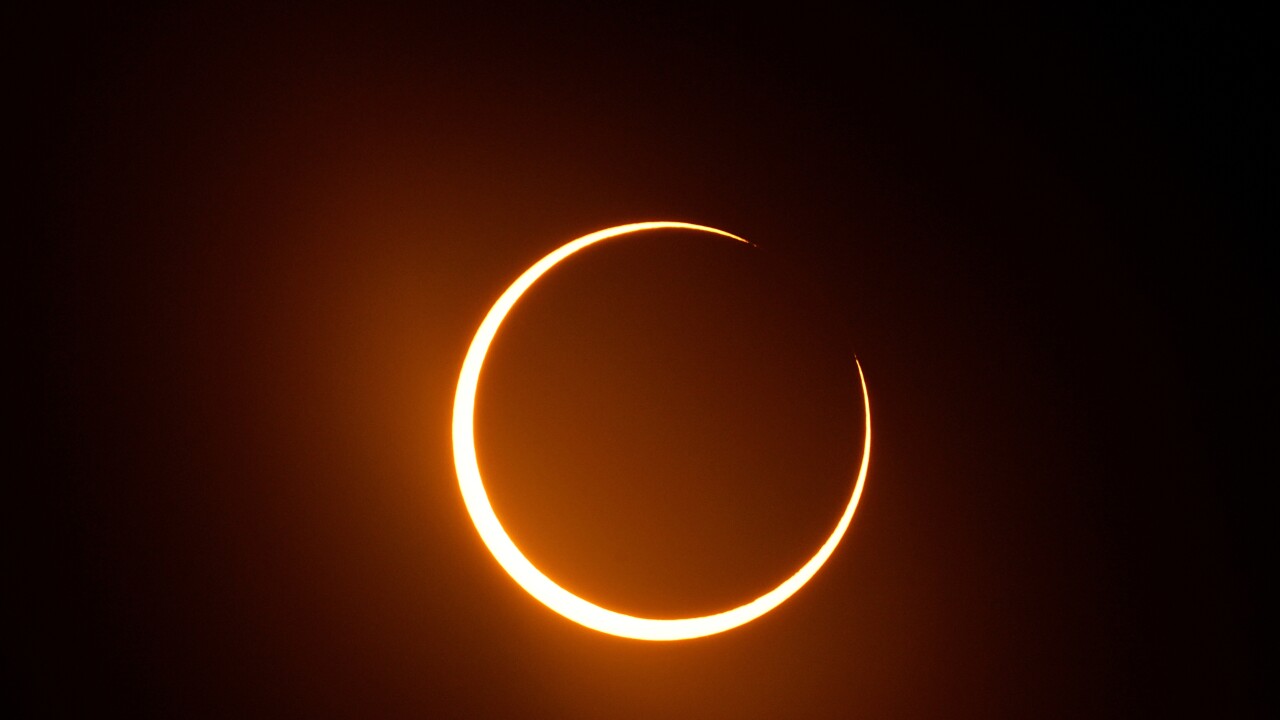
A remarkable solar event is set to unfold in Antarctica on Tuesday, April 9, 2024, as the first solar eclipse of the year graces the southernmost continent. Known as an annular solar eclipse or “ring of fire,” this phenomenon will be visible exclusively in Antarctica, offering a rare opportunity for both researchers and wildlife observers.
Astronomer Joe Llama from the Lowell Observatory expressed excitement about the event, stating, “The penguins down there are going to have a great show.” This eclipse occurs when the moon aligns perfectly between the Earth and the sun, casting a shadow that partially or wholly obscures the sun’s light.
While the full spectacle will be confined to Antarctica, a partial eclipse will be observable from various locations, including parts of Chile, Argentina, and regions of southeastern Africa, such as Madagascar, Lesotho, and South Africa.
Understanding the ‘Ring of Fire’ Eclipse
During an annular eclipse, the moon is at a greater distance from Earth, resulting in it not completely covering the sun. This allows a thin ring of sunlight to remain visible, creating the striking visual effect that gives the eclipse its name. Emily Rice, an astrophysicist at the City University of New York, described it as “this beautiful coincidence between the size and the distance of the moon and the sun.”
Eclipses are a relatively common occurrence, happening several times a year. However, they can only be seen from specific areas within the path of the moon’s shadow. In 2024, skywatchers in North America experienced a total solar eclipse, and another total eclipse is anticipated for August, with visibility in Greenland, Iceland, Spain, Russia, and parts of Portugal.
Viewing Safety and Techniques
It is crucial for viewers to take safety precautions when observing solar eclipses. Looking directly at the sun, even during a partial eclipse, can cause severe eye damage. Joe Llama advises the use of eclipse glasses, which filter out harmful ultraviolet light and nearly all visible light. Regular sunglasses or binoculars do not provide adequate protection.
For those without eclipse glasses, alternative methods exist for indirect viewing. Simple tools such as a pinhole projector made from everyday materials, or using a colander or cheese grater to project images of the eclipse onto the ground, can offer safe viewing experiences.
As the excitement builds for this rare celestial event, many will be looking forward to witnessing the beauty of the solar eclipse, whether in Antarctica or from afar.