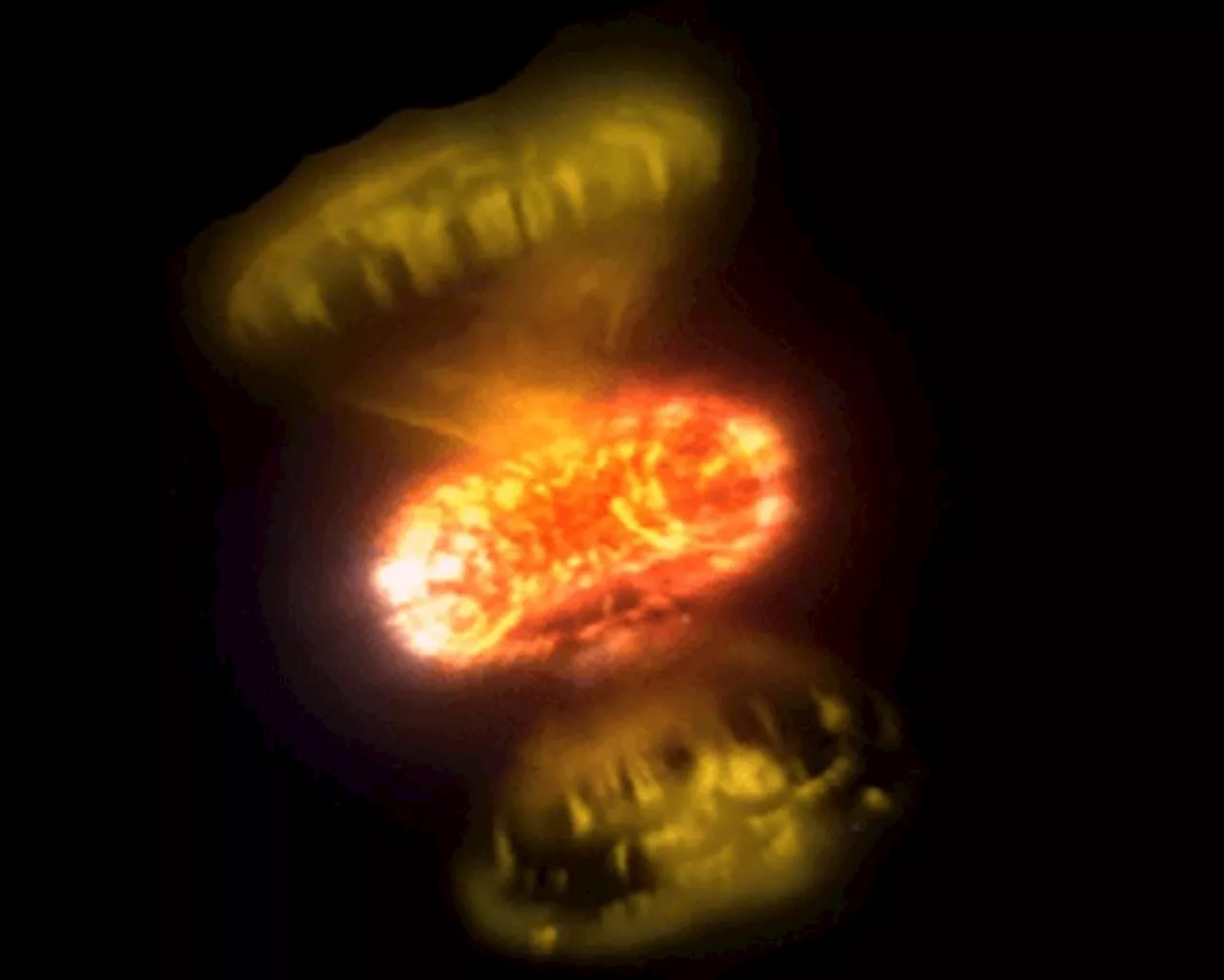
Astronomers have unveiled groundbreaking images that illustrate the intricate nature of nova explosions, significantly expanding current understanding of these thermonuclear phenomena. The new findings, published in the journal Nature Astronomy, detail how these explosions occur on white dwarfs within binary systems, showcasing multiple ejections and shock physics that lead to high-energy gamma-ray emissions.
Nova explosions arise when a white dwarf, a dense stellar remnant, accumulates hydrogen from its companion star. As this material builds up, it reaches a critical temperature, resulting in a sudden thermonuclear explosion. The research highlights the complexity of these events, contradicting earlier assumptions that novae were straightforward explosive occurrences.
Insights from Recent Observations
Researchers focused on two specific novae, V1674 Her and V1405 Cas, to illustrate their points. The findings indicate that V1674 Her, identified as a fast nova, expelled material in two perpendicular outflows just 2-3 days after the explosion. This rapid ejection demonstrates the presence of multiple interacting ejections, suggesting a dynamic and complex explosion process.
Conversely, V1405 Cas exhibited a slower explosion pattern, with the majority of its expelled material not becoming apparent until 50 days post-eruption. This delayed ejection provides crucial evidence of varied explosion dynamics. “These observations allow us to watch a stellar explosion in real time, something that is very complicated and has long been thought to be extremely challenging,” stated lead author Elias Aydi from Texas Tech University.
The research team utilized advanced observational techniques, including interferometry and spectrometry, to gather detailed data. The Georgia State University CHARA Array facilitated interferometric observations, revealing fine details of the explosions. Spectrometry, supported by data from various observatories, allowed scientists to identify new chemical signatures in the ejected material.
Understanding Nova Explosions
The implications of these findings extend beyond mere observation. The study emphasizes that novae serve as natural laboratories for astrophysics, helping researchers explore shock physics and particle acceleration. The authors noted that astrophysicists have detected gigaelectronvolt gamma-ray emissions from over 20 novae, underscoring their potential for future research.
“The formation mechanisms of the energetic shocks that lead to the GeV gamma-ray emissions from novae are still poorly constrained,” the authors explained. Recent insights suggest that these shocks may originate internally within the ejecta, created at the interface of multiple ejections. This interaction produces the high-energy emissions that provide valuable data for scientists.
The research highlights the significance of understanding these extreme astrophysical environments. As Professor Laura Chomiuk from Michigan State University articulated, “Novae are more than fireworks in our galaxy—they are laboratories for extreme physics.” By observing the timing and nature of material ejection, researchers can connect nuclear reactions on the star’s surface with the geometry of the ejected material, enhancing comprehension of these stellar phenomena.
As scientists continue to refine observational techniques and gather more data, the excitement around nova explosions grows. “This is just the beginning,” Aydi remarked, indicating that further studies could answer fundamental questions about stellar life cycles and their wider cosmic impact.
With the exploration of these nova events, researchers are not only uncovering the secrets of stellar explosions but also redefining the complexity of such phenomena in the universe. As new images and data emerge, the scientific community can look forward to deeper insights into these captivating cosmic occurrences.