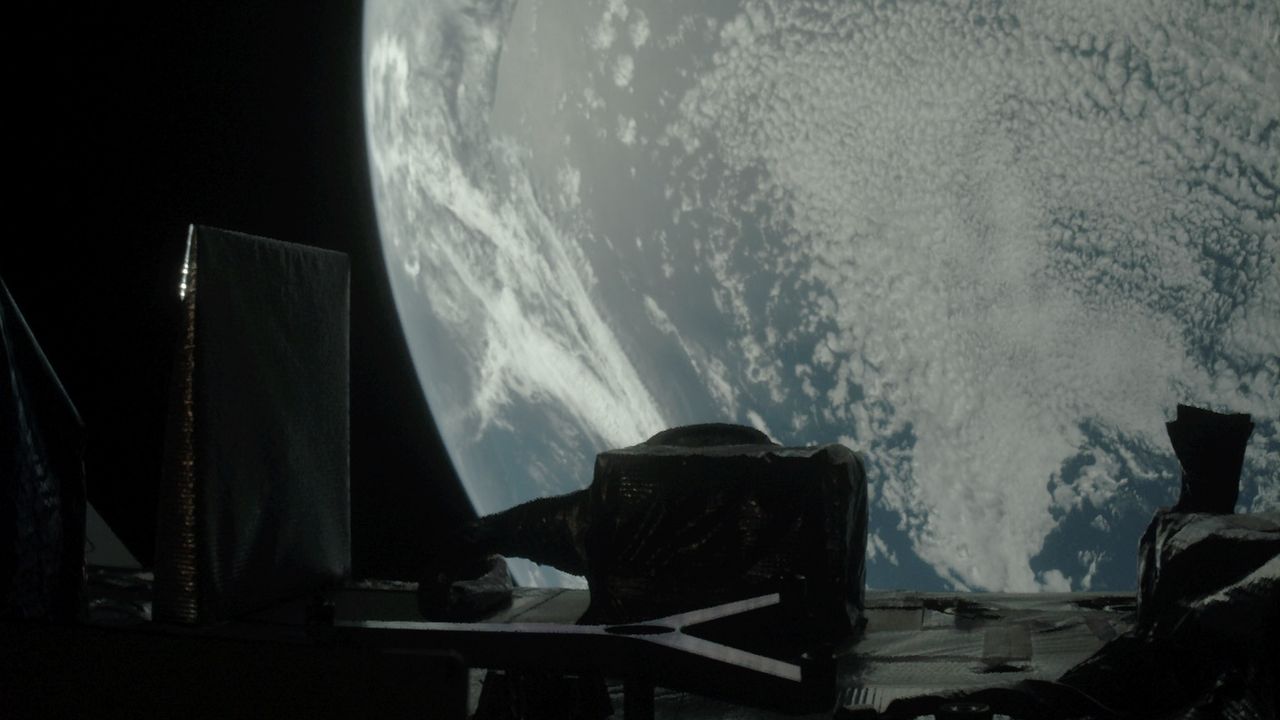
NASA’s OSIRIS-APEX spacecraft has captured remarkable images of Earth during its recent flyby, marking a significant step in its mission to explore the infamous asteroid Apophis. The probe performed a high-speed slingshot maneuver on September 23, 2025, flying just 2,136 miles (3,438 kilometers) above the planet’s surface. This maneuver not only provided stunning visuals of Earth but also set the spacecraft on a direct path toward Apophis.
The images showcase swirling clouds over Earth’s oceans and glimpses of continents, providing a breathtaking view from the spacecraft’s perspective. The following day, OSIRIS-APEX took a striking photograph of the moon from approximately 370,000 miles (595,000 kilometers) away, according to a statement from NASA.
Mission Background and Objectives
OSIRIS-APEX, short for “Origins, Spectral Interpretation, Resource Identification and Security-Apophis Explorer,” represents the second phase of NASA’s OSIRIS-REx mission. This earlier mission successfully returned samples from the near-Earth asteroid (NEA) Bennu in 2023. Following that historic achievement, NASA redirected the spacecraft towards Apophis, a stony, metal-rich NEA that presents a stark contrast to the carbon-rich Bennu.
The recent images confirm that OSIRIS-APEX’s cameras and instruments are fully operational after years in deep space. The September flyby utilized Earth’s gravity to increase the spacecraft’s speed and redirect it toward Apophis, which is expected to pass close to Earth on April 13, 2029. This encounter will bring the asteroid nearer than many satellites, potentially allowing Earth’s gravitational forces to reshape its surface or even alter its orbit.
Future Exploration of Apophis
Once OSIRIS-APEX reaches Apophis, it will embark on a mission to map the asteroid over an estimated period of 18 months. The spacecraft will study Apophis’s composition and capture high-resolution images. Mission planners also intend for the spacecraft to hover a few meters above the surface, using its thrusters to stir up dust and expose previously hidden material.
The new images of Earth were obtained using the spacecraft’s MapCam imager, which employs red, green, and blue filters to enhance the visuals. Additionally, StowCam, capable of both still and video imagery, ensures the safe storage of collected asteroid samples.
As the mission progresses, OSIRIS-APEX will continue to transmit trajectory updates, conduct further instrument checks, and eventually deliver the first close-up views of Apophis. This near-Earth asteroid’s close encounter with our planet is anticipated to provide valuable insights into the evolution of such bodies and their response to gravitational forces.