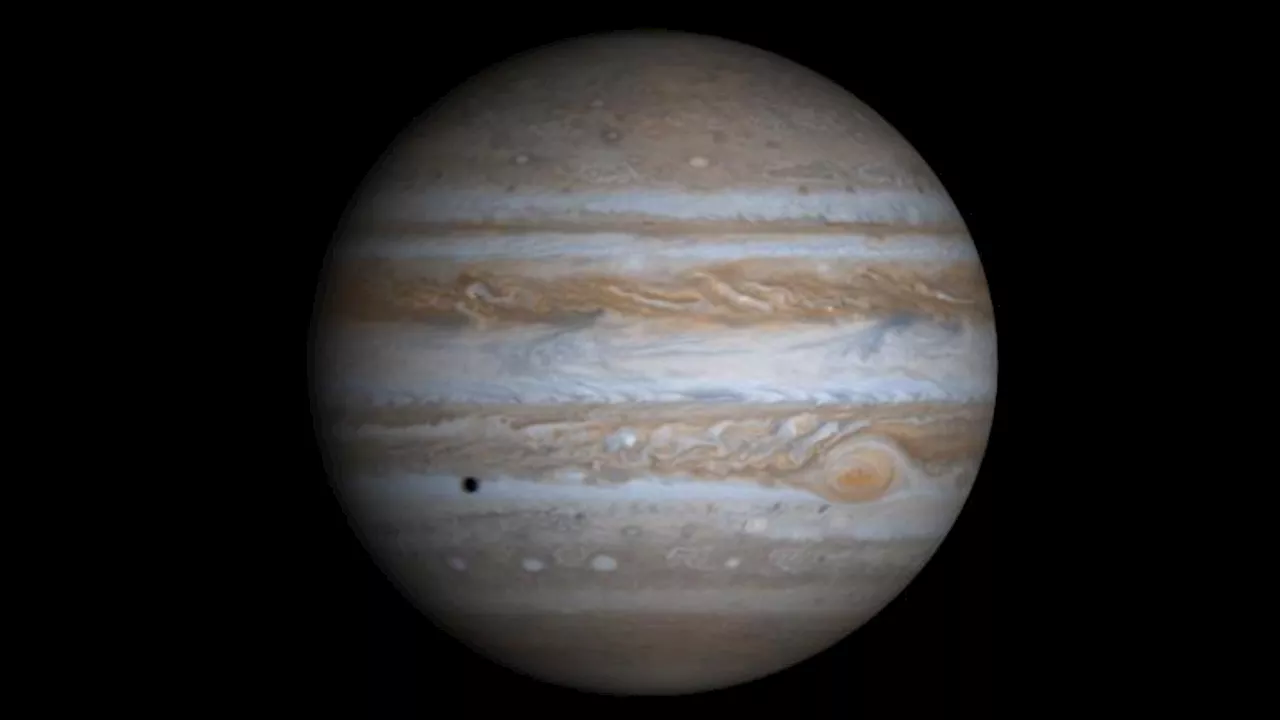
NASA’s Juno mission has fundamentally altered our understanding of Jupiter, revealing that the gas giant is both smaller and flatter than previously estimated. New measurements indicate that Jupiter’s equatorial radius is approximately 5 miles less than earlier calculations, while its polar radius is about 15 miles smaller. This significant update highlights the planet’s unique shape, which is influenced by its rapid rotation speed, completing a full turn in less than 10 hours.
The revelations stem from Juno’s innovative use of a technique called radio occultation. During its multiple flybys of Jupiter, the spacecraft transmitted radio waves back to Earth while passing behind the planet from our perspective. As these signals traversed Jupiter’s dense atmosphere, they experienced bending and slowing, providing critical insights into the planet’s temperature, pressure, and atmospheric structure. These observations allowed researchers to refine their measurements of Jupiter’s dimensions, confirming its noticeably flattened shape.
Implications for Planetary Science
Understanding Jupiter’s shape is crucial for scientists as it informs how the planet’s immense gravitational field operates and how energy circulates within its atmosphere. Accurate dimensions also enhance our knowledge of what lies beneath Jupiter’s swirling clouds. Because Jupiter serves as a benchmark for studying gas giants and distant exoplanets, even minor adjustments to its known size can significantly impact how astronomers interpret observations of planets orbiting other stars.
NASA’s Juno spacecraft, which began its mission in 2016, has provided invaluable insights beyond just size. It has also uncovered details about Jupiter’s magnetic field, deep atmospheric jets, and mysterious interior structures. The updated measurements will likely necessitate revisions in educational materials, as textbooks will need to reflect these new findings.
Future Observations and Studies
As scientists continue to analyze data from the Juno mission, they anticipate further revelations that could reshape our understanding of giant planets. The mission not only enhances our grasp of Jupiter but also contributes to a broader comprehension of planetary science, particularly in relation to gas giants across the universe.
This transformation in our understanding of Jupiter exemplifies the ongoing evolution of planetary science, driven by advanced technology and innovative research methodologies. With Juno’s continued exploration, the quest to decipher the mysteries of Jupiter and similar celestial bodies remains an exciting frontier for astronomers and scientists worldwide.