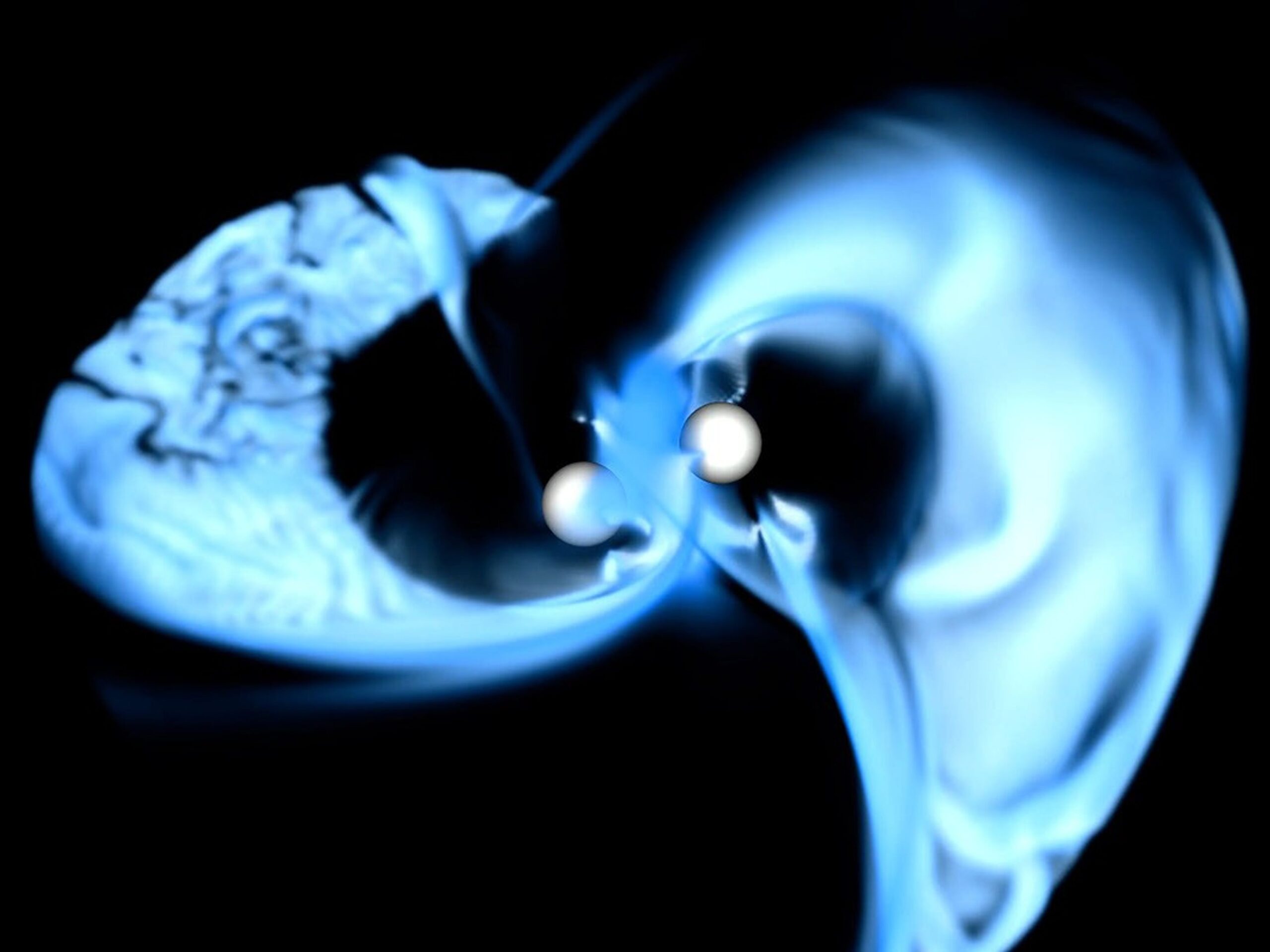
NASA’s latest research sheds light on the critical moments just before neutron star collisions, enhancing our understanding of these cosmic events. The findings, published in The Astrophysical Journal, reveal what occurs merely milliseconds before such collisions, which are significant not only for their astronomical implications but also for the study of gravitational waves.
The research team observed the behavior of neutron stars as they approached each other, focusing on their gravitational wave emissions. These emissions provide vital clues about the stars’ mass and distance, offering insights into the fundamental processes that govern their interactions. The data collected during this study could help refine models of neutron star collisions, an area of great interest since the first detection of gravitational waves in December 2017 by the LIGO and Virgo observatories.
Understanding Neutron Star Collisions
Neutron stars, remnants of massive stars that have undergone supernova explosions, are incredibly dense, with a mass greater than that of the sun packed into a sphere only about 20 kilometers in diameter. When two neutron stars collide, they create extreme conditions that can produce heavy elements like gold and platinum, as well as powerful gravitational waves detectable by observatories worldwide.
The research utilized advanced simulations to model the dynamics of neutron star mergers. Scientists discovered that, in the final moments before collision, the stars exhibit unique light curves and emit gravitational waves at frequencies up to several kilohertz. These findings provide a clearer picture of how the stars interact in their last moments, potentially allowing astronomers to identify similar events in the future.
The ability to predict the characteristics of these collisions can significantly enhance gravitational wave astronomy. Observing the merger of neutron stars not only aids in understanding stellar evolution but also helps in investigating the universe’s expansion and the nature of dark energy.
Implications for Future Research
This research marks a pivotal step in astrophysics, suggesting that with improved observational techniques, scientists may soon be able to identify and analyze neutron star collisions soon after they occur. The collaborative effort between NASA and other research bodies underscores the importance of interdisciplinary approaches in tackling complex astronomical questions.
The findings from NASA’s research could lead to a new era of discoveries in astrophysics. As observational technology advances, researchers aim to capture the dynamics of neutron star collisions in real-time, providing unprecedented insights into the mechanics of these dramatic cosmic events.
In summary, NASA’s exploration into the milliseconds before neutron star collisions opens a new chapter in our understanding of the universe. The implications of this research extend beyond basic science, offering potential applications in various fields including cosmology and material science. As scientists continue to decode the signals from these distant events, our grasp of the cosmos will undoubtedly deepen.