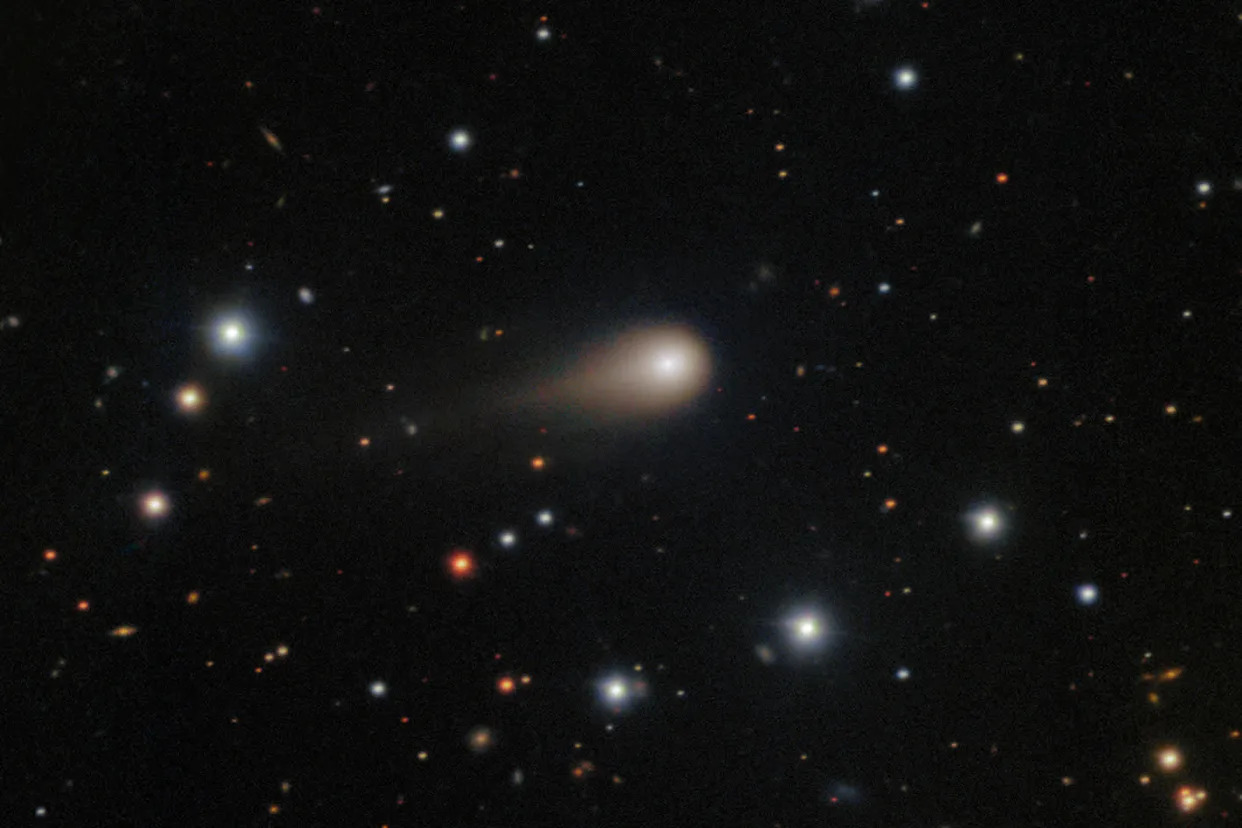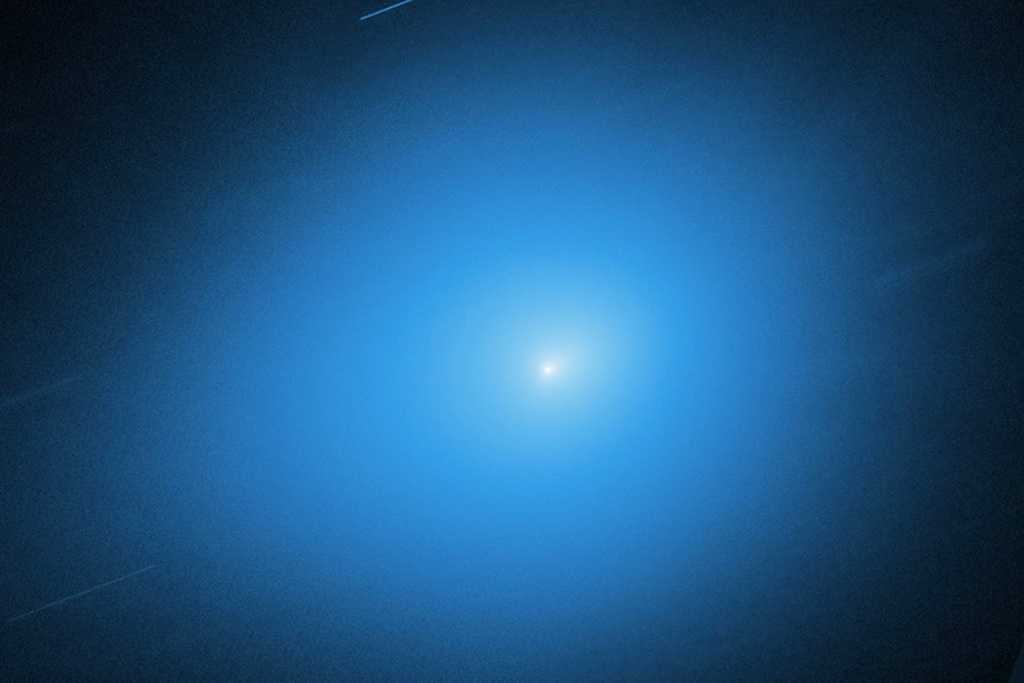
An interstellar comet, designated as 3I/ATLAS, is making its closest approach to Earth on December 8, 2023. Initially detected in July, this comet is now on its departure from our solar system, passing within approximately 167 million miles (270 million kilometers) of our planet. This distance places it on the opposite side of the sun, beyond the reach of the naked eye.
While the best opportunity to view 3I/ATLAS has passed, enthusiasts still have a chance to observe it through telescopes. According to Gianluca Masi, an astronomer at the Bellatrix Astronomical Observatory in Italy, a telescope with an aperture of at least 8 inches (20 centimeters) is necessary to glimpse the comet. The Virtual Telescope Project will broadcast a live stream of the comet on December 9, 2023, at 4:00 a.m. UTC, or 11:00 p.m. ET on December 8, due to previous cloudy conditions that disrupted earlier viewing attempts.
Scientific Observations and Discoveries
Astronomers are eager to study 3I/ATLAS as it nears the sun. The heat from the sun causes the comet to release gas and dust, which can provide valuable insights into its composition and origins. The European Space Agency (ESA) and NASA have employed multiple missions, including the Hubble Space Telescope and the James Webb Space Telescope, to observe the comet across various wavelengths of light, including recent X-ray observations.
Research indicates that 3I/ATLAS may be between 3 billion and 11 billion years old, suggesting it has existed long before our solar system formed approximately 4.6 billion years ago. The comet is primarily composed of ice, dust, and rocky materials, typical of comets that emerge from the outer regions of solar systems. As it approaches the sun, the release of materials is expected to yield further information regarding its primordial materials.
The observations made by missions like SPHEREx have detected various gases, including carbon dioxide and water vapor, emanating from the comet. These findings may offer clues about the stellar environment from which 3I/ATLAS originated.
Unique X-ray Observations
For the first time, X-ray emissions from an interstellar comet have been detected. The Japan Aerospace Exploration Agency (JAXA) deployed the X-Ray Imaging and Spectroscopy Mission (XRISM) to observe 3I/ATLAS for a total of 17 hours. Initial findings indicate that X-rays were emitted from gas clouds surrounding the comet’s nucleus, expanding approximately 248,000 miles (400,000 kilometers) from its core.
Astronomers have long speculated about the behavior of interstellar comets in comparison to their solar system counterparts. The X-ray emissions could result from interactions between the gases released by the comet and the solar wind, a stream of charged particles from the sun. The observations by XRISM and the ESA’s XMM-Newton spacecraft aim to reveal the composition of this interstellar visitor and enhance our understanding of its nature.
As 3I/ATLAS continues its journey away from the sun, astronomers anticipate several months of observation opportunities, which could lead to groundbreaking discoveries about the characteristics of interstellar comets and their origins. The excitement surrounding 3I/ATLAS underscores the ongoing fascination with celestial objects that traverse our solar system, reminding us of the vastness and mystery of the universe.