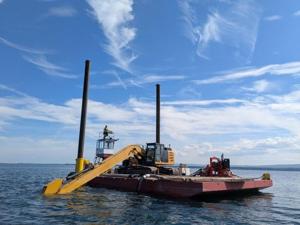
A groundbreaking technique has been implemented to enhance the habitat of lake trout in Lake Erie. The New York State Department of Environmental Conservation (DEC) teamed up with the Seaway Marine Group to conduct high-velocity jetting at Brocton Shoal in Chautauqua County. This innovative method aims to improve the underwater environment, promoting the growth of essential habitats for fish.
The jetting process, likened to a high-tech power washing, involves using water jets to remove invasive species and restore natural habitats. The work focused on areas where lake trout spawn, increasing the likelihood of successful reproduction. This initiative represents a significant effort to maintain the ecological balance in Lake Erie and support its aquatic life.
Pascal Wilkins, a fish biologist with the Lake Erie Fisheries Research Unit, and Aleksandr Davis, a fish technician with Region 9 fisheries, closely monitored the project’s progress. They utilized an underwater drone to conduct assessments before and after the jetting. Initial evaluations indicated that the technique was effective, with visible improvements to the habitat structure.
The success of this project is pivotal for the local fish population. Lake trout have faced challenges due to habitat degradation and invasive species. By restoring spawning areas, officials hope to see a resurgence in the trout population, which is vital for both ecological balance and local fishing industries.
The jetting at Brocton Shoal is part of a broader strategy to combat environmental challenges in Lake Erie. The DEC has been proactive in addressing issues affecting the lake, which is a crucial resource for communities in the region. This project showcases a commitment to using technology in environmental conservation efforts.
As the assessments continue, stakeholders remain optimistic about the long-term benefits of this innovative approach. The collaboration between various experts underscores the importance of combining science and technology to tackle environmental issues effectively.
This initiative not only reflects a dedication to restoring lake habitats but also highlights the ongoing need for sustainable practices in managing natural resources. The outcomes of this project will be closely monitored to ensure the health of Lake Erie’s ecosystem and the viability of its fish populations in the future.