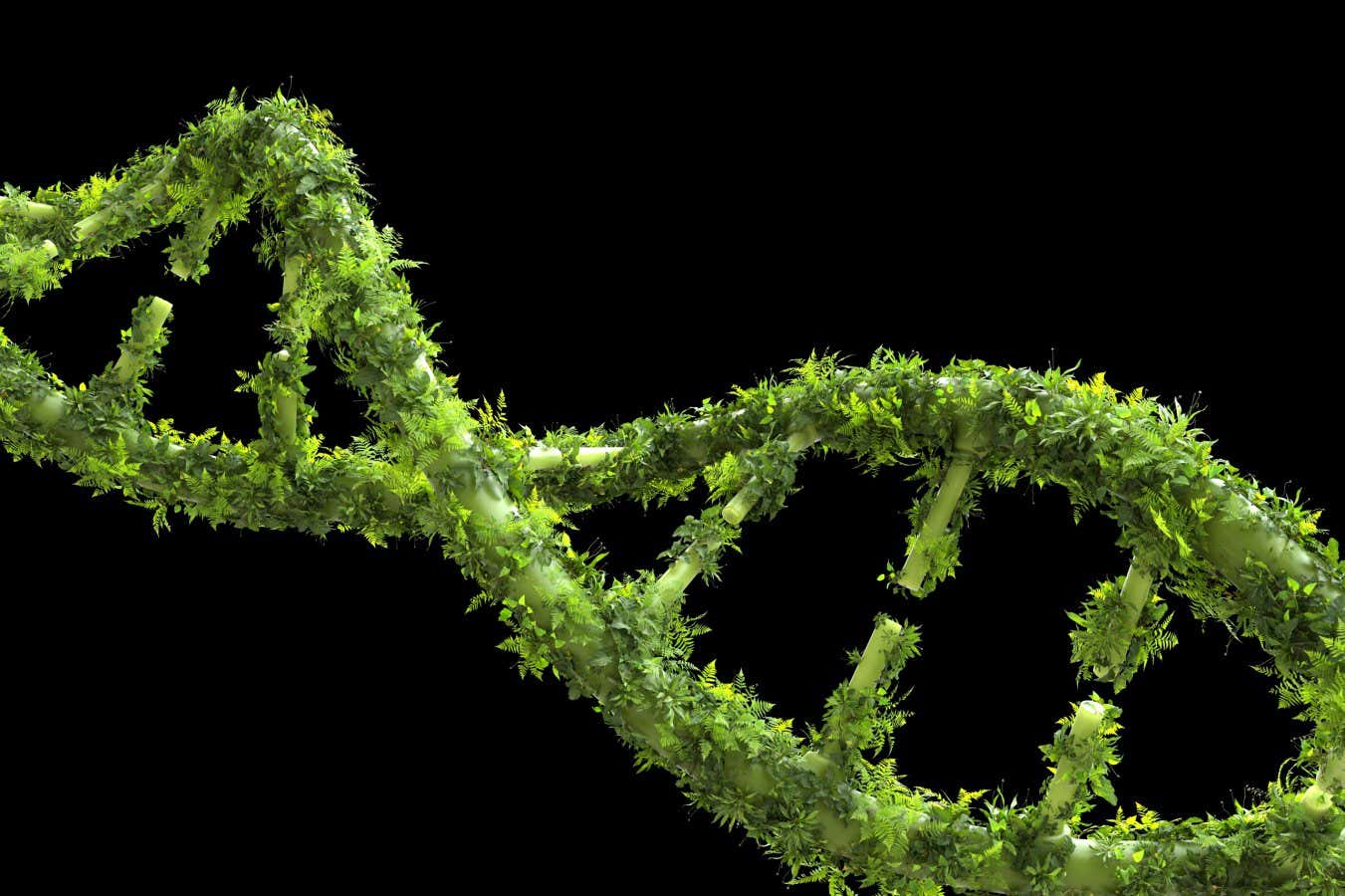
Recent research involving human cells containing plant DNA has provided new insights into the nature of our genome. Scientists have found that large segments of DNA from the plant species Arabidopsis thaliana exhibit significant activity within human cells. This raises questions about the function of much of our own genetic material and supports the notion that a substantial portion may lack any meaningful purpose.
The study led by Brett Adey and Austen Ganley at the University of Auckland demonstrates that the activity of plant DNA in human cells is comparable to that of human DNA. This suggests that much of what previously seemed active could simply be biological “noise.” The findings challenge long-held assumptions about the importance of non-coding DNA, which makes up approximately 98.8% of the human genome and has often been labeled as “junk.”
Sean Eddy, a researcher at Harvard University, previously proposed a concept known as the random genome project to test the functionality of non-coding DNA. His idea involved introducing random synthetic DNA into human cells to assess its activity. The research team’s use of plant DNA is seen as a significant real-world application of this theory, as plants and animals diverged from a common ancestor over 1.6 billion years ago, resulting in a highly randomised non-coding DNA sequence in A. thaliana.
The researchers began by verifying that the plant DNA was effectively random as far as human cells were concerned. They measured the number of starting points for RNA production per 1,000 base pairs of non-coding DNA. Contrary to expectations, they found that the plant DNA exhibited approximately 80% of the activity seen in human non-coding DNA. This indicates that a large portion of the activity observed in previous studies, like those conducted by the ENCODE project, may not signify biological function.
In a statement, Chris Ponting from the University of Edinburgh remarked, “This is an excellent demonstration of how biology is, indeed, noisy.” He emphasized that the biochemical activities within the plant DNA do not confer any functional role in human cells. Meanwhile, Dan Graur from the University of Houston praised the study as further evidence that much of the human genome can be classified as junk, dismissing the term “dark DNA” used by some researchers to describe non-coding DNA.
The research has prompted further inquiry into why human DNA shows 25% more activity compared to plant DNA. While this could indicate some functional roles for certain RNAs, the researchers note that their primary conclusion remains unchanged: a significant portion of the human genome lacks identifiable purpose.
The implications of this work extend beyond mere classification. Understanding the nature of non-coding DNA can influence how researchers approach genetic studies, disease research, and even evolutionary biology. The team is now exploring machine learning techniques to differentiate between potentially meaningful genetic activity and background noise.
As the findings are prepared for publication, the research adds a new layer to the ongoing debate about the role of non-coding DNA in genetics. With every discovery, the scientific community inches closer to unraveling the complexities of our genome, shedding light on what it truly means to be human.