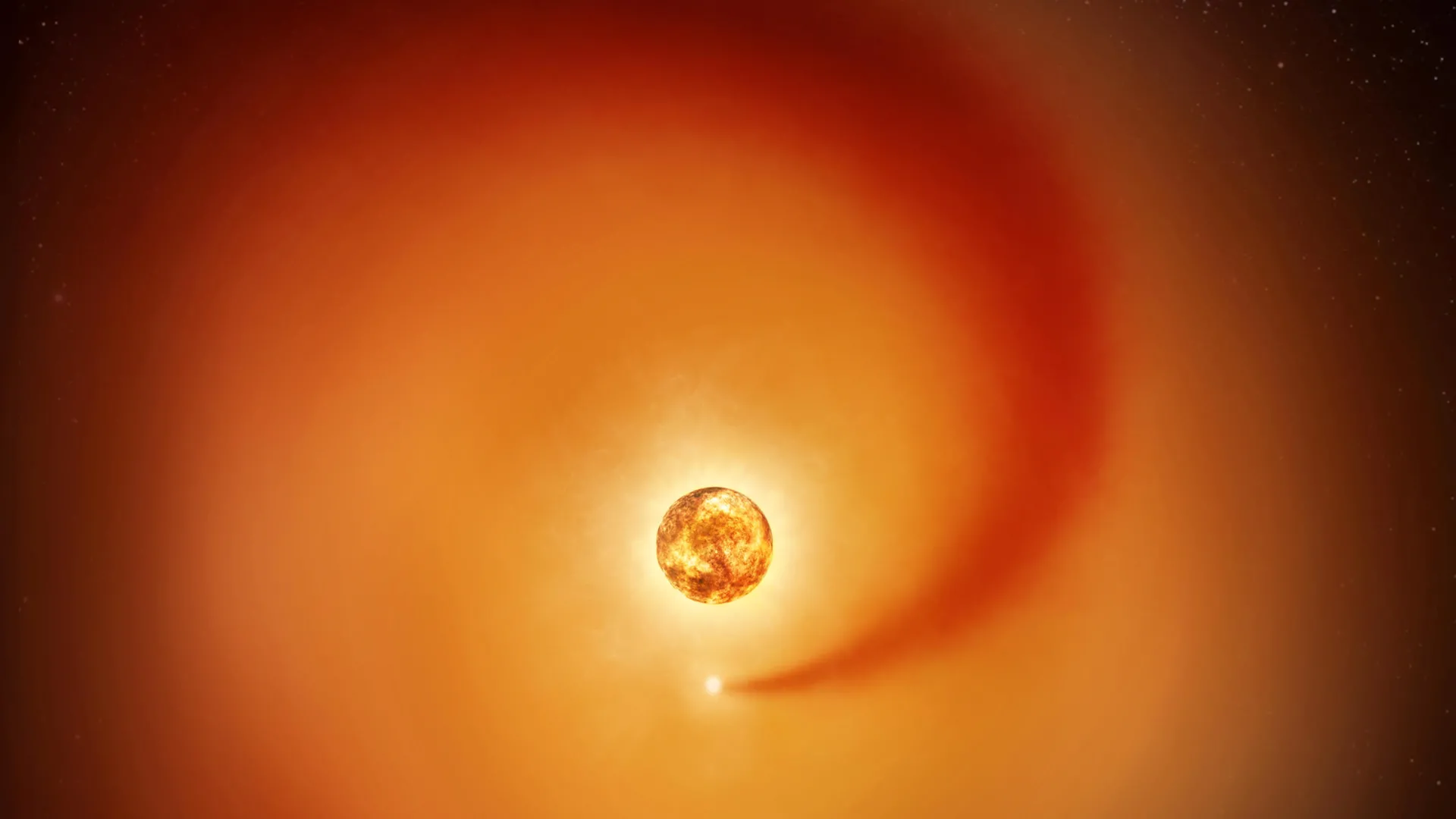
Astronomers have confirmed the presence of a hidden companion star orbiting Betelgeuse, a discovery that sheds light on the giant star’s unusual behavior. Using nearly eight years of data collected from the Hubble Space Telescope and ground-based observatories, researchers identified a small companion star, named Siwarha, that interacts with Betelgeuse’s vast atmosphere, creating a visible wake of gas. This finding was announced at a news conference during the 247th meeting of the American Astronomical Society in Phoenix and is set to be published in The Astrophysical Journal.
The research team, led by scientists at the Center for Astrophysics | Harvard & Smithsonian (CfA), has provided strong evidence that the companion star is responsible for generating a dense stream of gas as it traverses Betelgeuse’s outer layers. This revelation helps explain the long-standing mysteries surrounding Betelgeuse’s brightness fluctuations and atmospheric changes.
Unraveling Stellar Mysteries
By meticulously analyzing Betelgeuse’s light over nearly a decade, astronomers detected subtle variations indicating the influence of Siwarha, which had been suspected but not confirmed until now. The companion star disrupts the surrounding gas, leaving behind a trail of denser material. This breakthrough resolves a key question about Betelgeuse’s unpredictable behavior, allowing astronomers to better understand its evolution.
Located approximately 650 light-years from Earth in the constellation Orion, Betelgeuse is a red supergiant with a size that could accommodate over 400 million Suns. Its proximity enables detailed observation, making it a crucial subject for studying the life cycle of massive stars, including how they evolve, lose mass, and eventually explode as supernovae.
Evidence from Multiple Observatories
The research utilized data from various sources, including the Fred Lawrence Whipple Observatory and the Roque de Los Muchachos Observatory, to identify recurring patterns in Betelgeuse’s behavior. These observations revealed systematic changes in the star’s spectrum and shifts in the motion of gas in the atmosphere. The dense wake formed by Siwarha becomes evident shortly after the companion star passes in front of Betelgeuse approximately every 2,100 days, aligning with earlier theoretical predictions.
Andrea Dupree, an astronomer at the CfA and lead author of the study, likened the phenomenon to a boat moving through water, stating, “The companion star creates a ripple effect in Betelgeuse’s atmosphere that we can actually see in the data.” This confirmation of a hidden companion star marks a significant advancement in understanding the dynamics of Betelgeuse.
The discovery also offers insights into the behavior of other massive stars nearing the end of their life cycles, as astronomers can apply this new knowledge to similar stars.
Understanding Betelgeuse’s Variability
The fluctuations in Betelgeuse’s brightness have puzzled astronomers for decades. Interest in the star heightened in 2020 when it unexpectedly dimmed, an event referred to as a stellar “sneeze.” Researchers identified two primary cycles in its variability: a shorter 400-day cycle related to pulsations and a longer cycle of about 2,100 days. Prior to this discovery, experts proposed various explanations, including convection cells, dust clouds, and magnetic activity, as potential causes for the observed changes.
Dupree noted that the concept of a hidden companion star had gained traction in recent years, but the lack of direct evidence left it unproven. The newly identified wake serves as the strongest indication yet that Siwarha is actively influencing Betelgeuse’s atmosphere.
Future Observations and Implications
Currently, Betelgeuse is eclipsing Siwarha from Earth’s viewpoint, but astronomers anticipate further observations when the companion becomes visible again in 2027. This research not only deepens understanding of Betelgeuse but may also unravel similar mysteries surrounding other giant and supergiant stars.
The Hubble Space Telescope, which has been operational for over 30 years, continues to be an invaluable tool in advancing our knowledge of the universe. Managed by NASA and the European Space Agency (ESA), Hubble remains at the forefront of astronomical research, supported by institutions such as NASA’s Goddard Space Flight Center and the Space Telescope Science Institute.
This landmark discovery not only enriches our understanding of Betelgeuse but also enhances our knowledge of stellar evolution and the cosmic phenomena that govern the life cycles of massive stars.