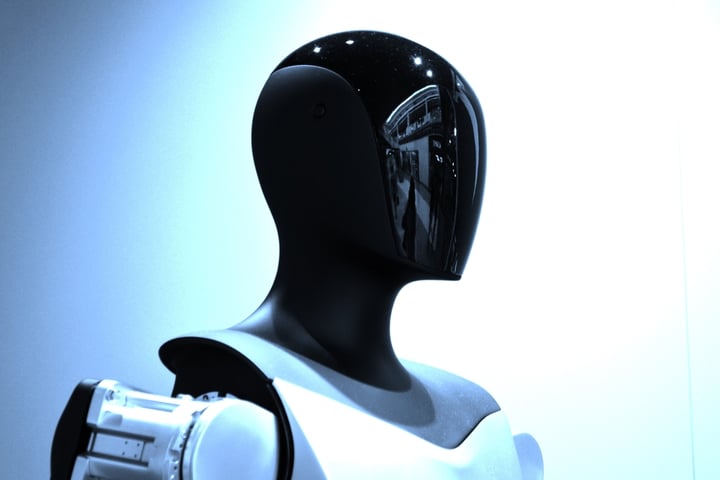
Elon Musk, CEO of Tesla Inc. and SpaceX, has made a remarkable assertion regarding the potential of the company’s humanoid robot, Optimus. He claims that Optimus could be the first von Neumann machine capable of constructing civilizations on distant planets. This statement came in response to a discussion on the social media platform X, where Musk addressed the future implications of artificial intelligence and robotics in space exploration.
Musk’s comments were sparked by a post from user Ryan Dahl, who mentioned the merger between SpaceX and xAI and speculated about the launching of 1 terawatt of AI computing power annually. Musk’s reply suggested that the Optimus robot could indeed fulfill the role of a von Neumann machine, which is a theoretical construct originally proposed by mathematician and physicist John von Neumann. This concept involves a self-replicating spacecraft that would utilize raw materials from various planetary systems to create copies of itself, thereby enabling the exploration of outer space on a larger scale.
By labeling Optimus as a potential von Neumann machine, Musk implies a future where space-based AI could manage robotic operations on other planets. This aligns with his broader ambitions for space exploration and the development of technologies that could facilitate human life beyond Earth.
Transformative Potential of Optimus
Optimus has been positioned by Musk as a revolutionary advancement for Tesla and a significant step towards enhancing productivity. He anticipates that the robot could eventually surpass the entire productivity of the planet, particularly in conjunction with AI computing capabilities based in space. In a strategic move, Musk announced the discontinuation of Tesla’s premium offerings, including the Model S and Model X, to focus on ramping up production of Optimus in Fremont, with a target of producing 1 million units annually.
This ambitious production plan is part of Musk’s vision to integrate advanced robotics into everyday life and industry. As Tesla continues to innovate, the implications of such technology could extend far beyond the automotive sector, influencing various industries and potentially reshaping human interaction with machines.
Market Reactions and Future Outlook
On the financial front, Tesla’s stock experienced a slight decline of 0.67%, closing at $419.15 during after-hours trading on Tuesday. Despite this dip, analysts from Benzinga have indicated that Tesla scores well on momentum metrics, suggesting a favorable long-term price trend amidst the ongoing developments.
As Tesla and SpaceX advance their missions, the integration of AI and robotics will likely be a central theme in future innovations. Musk’s vision for Optimus represents not only a leap in technology but also a bold step towards humanity’s long-term aspirations for colonization and sustainability beyond Earth. The potential for Optimus to embody the principles of a von Neumann machine captures the imagination and raises exciting possibilities for the future of civilization in space.