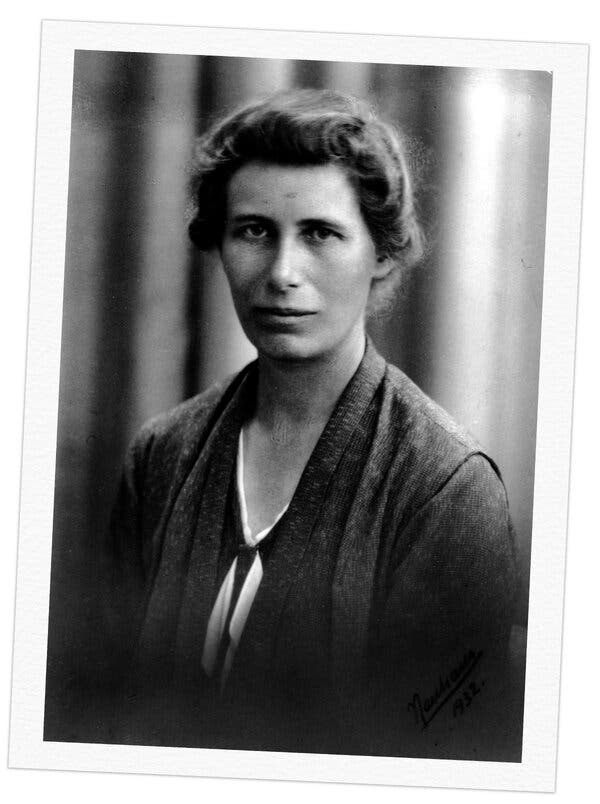
Inge Lehmann, a pioneering Danish seismologist, transformed our understanding of the Earth’s structure in September 1936. She published a groundbreaking paper titled “P’” in a French scientific journal, where she introduced a revolutionary theory about the planet’s inner core. This significant discovery emerged from her meticulous analysis of seismic readings, which contradicted the prevailing belief that the Earth’s interior was entirely molten.
In the 1930s, the field of seismology was predominantly male-dominated, and Lehmann’s decision to prioritize her career over marriage set her apart. Working largely in isolation in Copenhagen, she meticulously examined data from a 1929 earthquake in New Zealand. Her findings indicated the existence of a dense inner core distinct from the liquid outer core that scientists had previously believed existed.
Lehmann’s article spanned nearly 30 pages, filled with detailed calculations, tables, and hand-drawn graphs. Her work identified two primary types of seismic waves produced by earthquakes: primary or pressure waves (P waves) and secondary waves (S waves).
P waves, which are the fastest seismic waves, travel through solids, liquids, and gases. They are longitudinal compression waves, similar to the motion of a Slinky toy. In contrast, S waves can only propagate through solids and move perpendicularly to the direction of the wave, much like the curves formed in a rope when shaken.
Lehmann’s keen observations led her to conclude that the Earth consists of a solid inner core surrounded by a liquid outer core, challenging the long-held belief that the entire core was liquid. This insight laid the foundation for further advancements in geophysics and our understanding of planetary formation.
The impact of Lehmann’s work extended far beyond her initial findings. Her theory prompted subsequent research and exploration, leading to a deeper understanding of the Earth’s composition and behavior.
Despite her groundbreaking contributions, Lehmann’s achievements went largely unrecognized during her lifetime. She faced significant barriers in a male-dominated field that often overlooked the contributions of women. It was only later that her work began to receive the acknowledgment it deserved.
Inge Lehmann’s legacy endures, not only through her scientific contributions but also as an inspiration for future generations of scientists. Her story serves as a reminder of the importance of diversity and inclusion in science, encouraging individuals from all backgrounds to pursue their passions in fields traditionally dominated by one gender.
Her discovery of the Earth’s inner core has become a cornerstone of modern geology, underscoring the critical role that perseverance and dedication can play in advancing our understanding of the natural world.