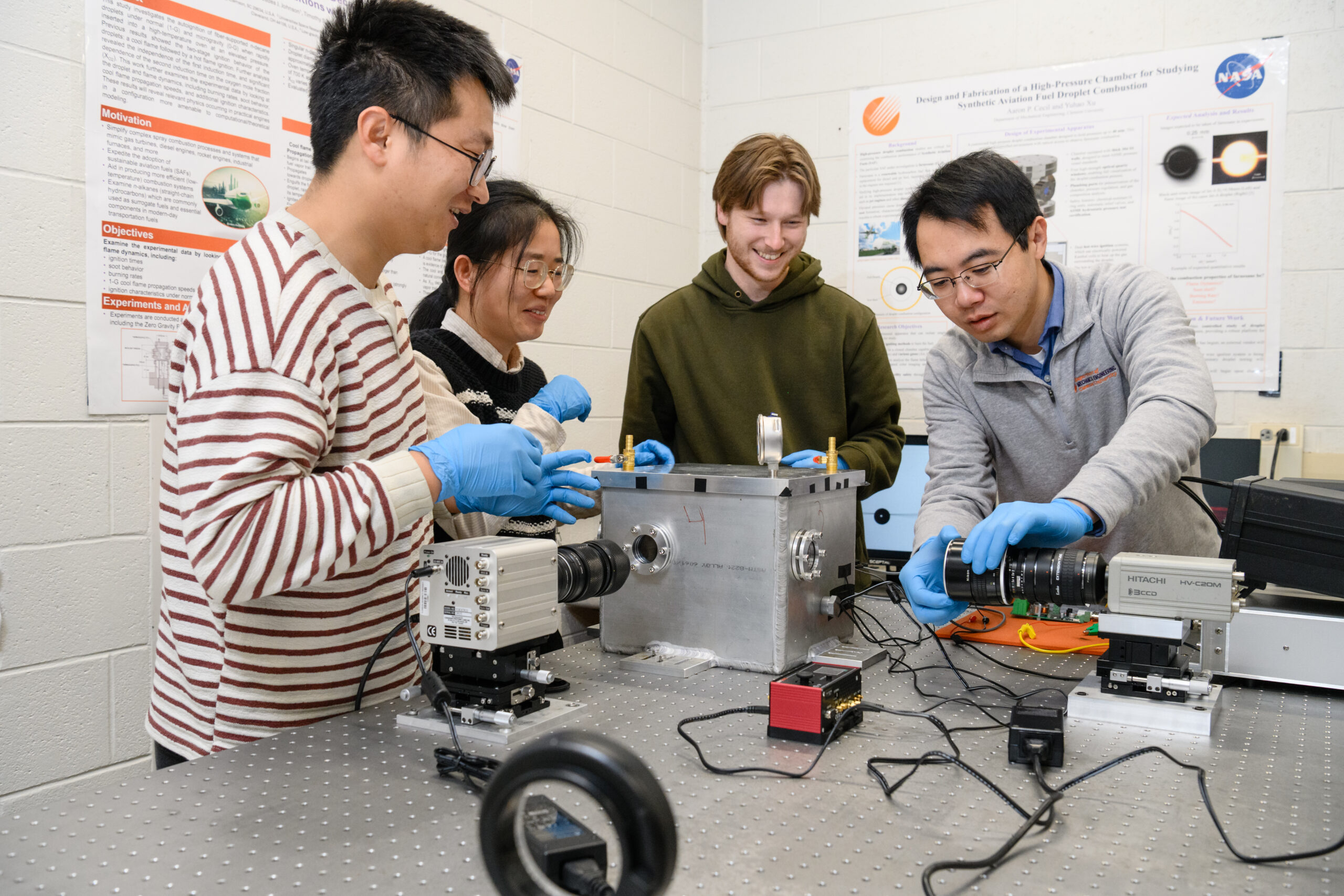
Researchers at Clemson University are making strides in understanding combustion in microgravity, a crucial area for future space exploration. Under the leadership of Yuhao Xu, an assistant professor of mechanical engineering, the team is focused on developing innovative fire suppression techniques, vital for ensuring safety on spacecraft as humanity aims to establish a permanent presence on the Moon and eventually travel to Mars.
Research Contributions and Recognition
Xu, who began his journey into space combustion research as a Ph.D. student at Cornell University twelve years ago, has garnered significant attention for his work. In late 2023, he received the 2025 Thora Halstead Young Investigator Award from the American Society for Gravitational and Space Research (ASGSR), highlighting his contributions to the field. His research not only enhances the safety of astronauts but also pushes the boundaries of scientific discovery.
“It’s very exciting,” Xu noted. “I feel like I’m pushing the boundary of scientific discovery. The human exploration of space is a monumental effort, and I am thrilled to contribute to it, however small my role may be.”
In 2013, Xu supervised experiments aboard the International Space Station, analyzing video data from Cornell and providing real-time feedback to the NASA Glenn Research Center. These experiments yielded a wealth of information that researchers are still examining today.
Innovative Solutions for Space Missions
One of Xu’s most promising projects involves developing a reactor that can create fire in water to recycle wastewater in space. This technology, known as supercritical water oxidation, heats and pressurizes water to form a hydrothermal flame. This process breaks down organic material in wastewater, resulting in clean water, a crucial resource for long missions.
Although still in its early stages, Xu believes this technology could revolutionize how astronauts manage resources during extended stays on the Moon and Mars. “It could become a game-changer for long missions,” he stated, emphasizing its potential impact on human spaceflight.
Beyond space applications, Xu’s research has implications for Earth as well. By exploring cleaner combustion methods, his work could lead to more efficient engines and reduced emissions, contributing to improved air quality.
In addition to his research, Xu’s role on the ASGSR governing board places Clemson University at the forefront of the national space research community. Alexander Leonessa, chair of the Department of Mechanical Engineering, praised Xu’s efforts, stating, “Dr. Xu’s creativity and drive are helping elevate Clemson’s research profile. His work not only advances science and technology but also inspires students with access to cutting-edge projects that could impact our planet and beyond.”
With a focus on safety and sustainability, Yuhao Xu and his team at Clemson University are paving the way for future explorations, ensuring that as humanity reaches for the stars, the risks associated with fire in space are effectively managed.