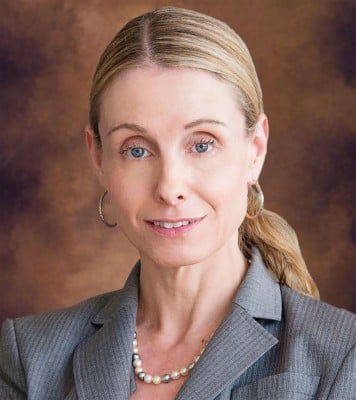
In a groundbreaking achievement, Blue Origin successfully launched a wheelchair-using engineer to the edge of space on Saturday, marking a significant milestone in the journey toward inclusivity in space travel. The mission, which lasted approximately ten minutes, allowed Michaela Benthaus, a German aerospace engineer and advocate for individuals with disabilities, to experience weightlessness at an altitude of more than 65 miles above Earth.
Benthaus, who suffered a spinal cord injury in a mountain biking accident in 2018, was accompanied by a team that included a retired SpaceX manager and four entrepreneurs. After the flight, she expressed her excitement, stating, “It was the coolest experience! I didn’t only like the view and the microgravity, but I also liked the going up. That was so cool, every stage of going up.”
Collaboration and Preparation
Benthaus was supported throughout her journey by Hans Koenigsmann, a former SpaceX executive who played a crucial role in developing the Falcon rocket series. Having met Benthaus online last year, Koenigsmann was inspired by her determination to make space travel accessible for people with disabilities. He reached out to Blue Origin on her behalf, facilitating her historic flight.
“I just asked him, like, you know, you worked for so long for SpaceX, do you think that people like me can be astronauts?” Benthaus recounted in an interview with Blue Origin. “Thankfully it turned out we can do it. So Hans and me ended up flying as a team.”
The launch faced a slight delay due to technical issues but ultimately lifted off from Blue Origin’s West Texas launch pad at 9:15 a.m. EST. The New Shepard rocket accelerated rapidly, reaching speeds nearly three times the speed of sound before its engine shut down approximately two and a half minutes into the flight. The capsule then continued its ascent independently, allowing the crew to experience weightlessness for a few moments, floating freely within the cabin.
A Unique Experience Above Earth
At its peak altitude of just over 65 miles, the New Shepard provided a stunning view of Earth, with a sharply curved horizon and a deep black sky. Passengers were able to gaze through the largest windows ever flown in space. The joy was palpable, as one passenger exclaimed over the capsule’s communication system, “Oh, my God,” while another added, “Incredible.”
As the flight transitioned back into the atmosphere, the crew was instructed to secure themselves in their seats for the descent, which would subject them to about five times the normal force of gravity. The booster, meanwhile, executed a controlled descent, igniting its engine shortly before touchdown. The New Shepard landed safely under parachutes, kicking up a cloud of dust as it settled on a concrete pad near the launch site.
Benthaus, along with her fellow passengers, exited the capsule with visible excitement. She was assisted from the spacecraft by Koenigsmann and a member of Blue Origin’s recovery team and was brought to her wheelchair. “You should never give up on your dreams, right?” she said after the landing. “I just feel very lucky, and I’m very grateful to Blue and Hans and everyone who said yes to this journey.”
Although Blue Origin does not publicly disclose the price of a seat on the New Shepard, it is estimated to be over $500,000. Details regarding the financing of Benthaus’ ticket have not been revealed.
This launch represented Blue Origin’s sixteenth mission with passengers since the inaugural flight in July 2021. Including this latest flight, the company has now sent a total of 92 individuals to space, six of whom have flown twice. Notably, Benthaus has become the first person with a significant physical disability to journey into space.
As the conversation around inclusivity in space travel grows, European Space Agency astronaut John McFall, who has a prosthetic leg, has been cleared for selection for a future flight to the International Space Station. Benthaus expressed hope that her flight would pave the way for more individuals with disabilities to experience space travel.
She emphasized the potential for people with disabilities to contribute to space missions, stating, “People with disabilities actually bring value to a crew. You develop a very special resilience.” The broader challenge for space agencies remains understanding how disabled astronauts can navigate emergencies that may arise during missions, whether on Earth or in space.
As humanity looks toward future long-duration missions, including potential trips to Mars, the necessity for accommodating diverse astronaut profiles becomes increasingly important. Benthaus’ historic flight serves as a beacon of hope and inspiration, demonstrating that space is a frontier that can be accessed by all.