Scientists at the University of Münster have made significant strides in understanding how cells adhere to surfaces, an essential function that facilitates the formation of complex tissues and organs in animals, including humans. Their research reveals that the talin protein plays a central role in this process, offering insights into the evolutionary origins of cell adhesion mechanisms.
The study, published on December 14, 2025, in the journal Nature Communications, was led by Prof. Carsten Grashoff and doctoral student Srishti Rangarajan from the Institute of Integrative Cell Biology and Physiology. While integrins are well-known receptors that mediate cell adhesion in multicellular organisms, their presence is absent in many single-celled organisms, raising questions about the evolutionary development of this crucial function.
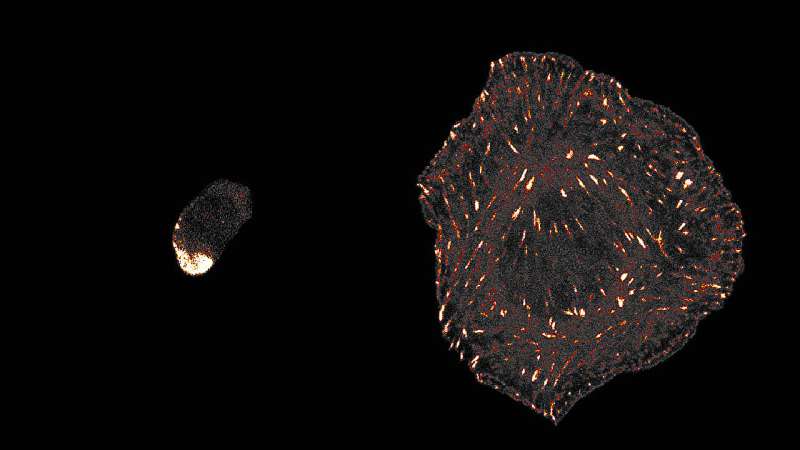
Through their research, Grashoff and Rangarajan demonstrated that talin, a protein found in various eukaryotic single-celled organisms and all animal cells, is integral to the mechanical attachment of integrins to the cell’s interior. Their comparative studies highlighted that talin not only plays a mechanical role in human cells but also in amoebae, a type of single-celled organism.
The team focused on how talin transmits mechanical forces during cell adhesion. Although each talin molecule exerts a force of only a few trillionths of a newton, the researchers found that this mechanical function is vital for effective cell adhesion. Rangarajan noted the significance of their findings, stating, “The integrin-mediated adhesion of animal cells is described in all modern textbooks on cell biology. However, it appears to be merely a specialization of a much older cell adhesion mechanism that originated in single-celled organisms and is mediated by talin.”
The research utilized advanced methodologies, including molecular genetics, high-resolution fluorescence microscopy, and molecular force microscopy measurements, to explore these cellular processes. The discovery underscores the evolutionary significance of the talin protein, suggesting its essential mechanical role likely developed long before the appearance of the first animals.
This groundbreaking study not only enhances the understanding of cell biology but also provides valuable insights into the fundamental processes that govern tissue formation and stability in multicellular organisms. As researchers continue to unravel the complexities of cell adhesion, the implications for medical and biological applications remain vast and promising.