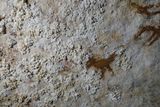
A recent study published in the journal Nature has confirmed that the oldest known rock art, a human hand stencil, is over 67,000 years old. Discovered in a cave on the island of Sulawesi, Indonesia, this ancient artwork provides significant insights into the migration patterns of early humans, suggesting they may have been among the first populations to venture into Australia.
The stencil, located in the Liang Metanduno cave, depicts a hand that appears somewhat claw-like. According to Maxime Aubert, a researcher at the Griffith Centre for Social and Cultural Research in Australia, this finding highlights the rich artistic heritage of Sulawesi, which has been home to one of the world’s oldest artistic cultures. Aubert noted that the origins of this culture date back to the earliest periods of human occupation on the island, estimated to be at least 67,800 years ago.
Significance of Sulawesi in Human History
Sulawesi is not just a treasure trove for ancient art; it also played a pivotal role in the movements of early Homo sapiens. The island may have served as a critical stepping stone for human migration from Asia to Sahul, the now-submerged landmass that once connected Australia, New Guinea, and Tasmania. The study underscores this notion, indicating that the ancient artists of Sulawesi likely belonged to a broader group that eventually migrated to Australia.
Adhi Agus Oktaviana from Indonesia’s National Research and Innovation Agency stated, “It is very likely that the people who made these paintings in Sulawesi were part of the broader population that would later spread through the region and ultimately reach Australia.” This assertion supports the theory that the ancestors of the First Australians were present in Sahul around 65,000 years ago.
Prior research has proposed that Homo sapiens arrived in Sahul through two main timelines: the “long chronology,” which places their arrival around 65,000 years ago, and the “short chronology,” around 50,000 years ago. These studies also suggested that modern humans used two distinct island-hopping routes to reach Sahul, with one route passing through Sulawesi. The discovery of the rock art adds a new dimension to our understanding of these early migrations.
New Findings and Future Research
The research team used various dating techniques, including uranium-series dating and mineral deposit analysis, to determine the age of the claw-like stencil. This artwork predates other known rock art in the region by approximately 16,600 years. The presence of younger paintings in the Liang Metanduno cave indicates a long period of human occupation, potentially lasting over 35,000 years.
Renaud Joannes-Boyau, part of the Geoarchaeology and Archaeometry Research Group at Southern Cross University, remarked, “With the dating of this extremely ancient rock art in Sulawesi, we now have the oldest direct evidence for the presence of modern humans along this northern migration corridor into Sahul.” This finding emphasizes the archaeological significance of Sulawesi and its role in human history.
Looking ahead, the research team aims to further explore the rich archaeological potential of Sulawesi and its surrounding islands. Aubert indicated that there are many other Indonesian islands between Sulawesi and New Guinea that warrant investigation, suggesting that future discoveries could yield even more information about the movements and artistic expressions of our ancient ancestors.