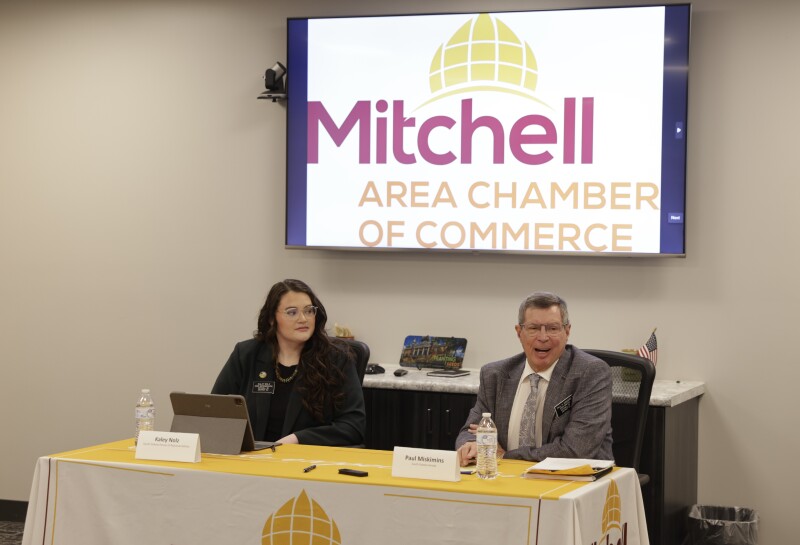
District 20 legislators, State Rep. Kaley Nolz and State Sen. Paul Miskimins, addressed local residents during a forum on January 6, 2026, in Mitchell. The session provided insight into their expectations for the upcoming legislative session, which begins on January 13 in Pierre. Around 20 community members attended the event at the Mitchell Chamber of Commerce.
Budgetary Challenges and Legislative Priorities
During the forum, Nolz highlighted that the state’s budget will be particularly challenging this year. For the first time, Medicaid has become South Dakota’s largest expense, overtaking funding for public school districts. Governor Larry Rhoden is expected to present a budget proposal that maintains flat funding for the state’s “big three” — public schools, state employees, and health care providers. Nolz remarked, “I’ve heard a lot of feedback about no raises for the ‘big three’ and other priorities. The governor’s budget is not necessarily what we as legislators will vote on, but it will be a tight year. Revenues are down, and it’s going to be difficult.”
Miskimins, who serves on the joint appropriations committee, expressed concern over Rhoden’s proposal to increase the state’s rainy-day fund from 10% to 12.5% of the general budget. “This change could free up about $70 million for the budget,” he explained. “That 2.5% will be contentious and likely redirected to our state workers and teachers. It reflects respect for those who serve the people of South Dakota.”
Property Tax Relief and Prison Funding Discussions
Property tax relief emerged as another significant topic during the forum. Both legislators indicated that they have not seen immediate support for any proposals. Miskimins noted that many suggestions from 2025 simply shifted the tax burden rather than providing relief. He stated, “Proposals often redirected costs to multi-unit housing owners, commercial businesses, or agricultural properties.” Nolz emphasized that property taxes are primarily a local issue since schools and counties receive the bulk of this revenue. “State government does not collect property taxes; it relies on sales tax,” she added.
Another pressing matter discussed was the funding and site selection for a new men’s state prison. Miskimins expressed satisfaction with the decision to consider a new site in Sioux Falls, which offers a more cost-effective option than previously proposed locations. “It is frustrating to be told there is only one location for a new prison and that it would cost $825 million. Discovering it can be built for $650 million and that there were 13 other potential sites is disheartening,” he remarked.
Although Miskimins supported the Mitchell location that surfaced in spring 2025, he expressed doubt about the workforce commuting from Sioux Falls. Nolz opposed the Mitchell site due to significant public opposition. Miskimins acknowledged the community’s concerns but noted, “The Mitchell location was considered a good option; however, staffing could have been a challenge.” Nolz supported the September vote on the prison project, appreciating the lower guaranteed maximum price and the prevention of escalating costs.
As the legislative session approaches, District 20 will only have Miskimins and Nolz representing them in Pierre, as State Rep. Jeff Bathke is currently deployed overseas with the South Dakota National Guard. Miskimins remarked, “We will miss Jeff this year. His vote is crucial, especially when a two-thirds majority is needed.” With pressing fiscal and community issues ahead, District 20 legislators are preparing for a demanding session that will require careful navigation of budgetary constraints and local concerns.