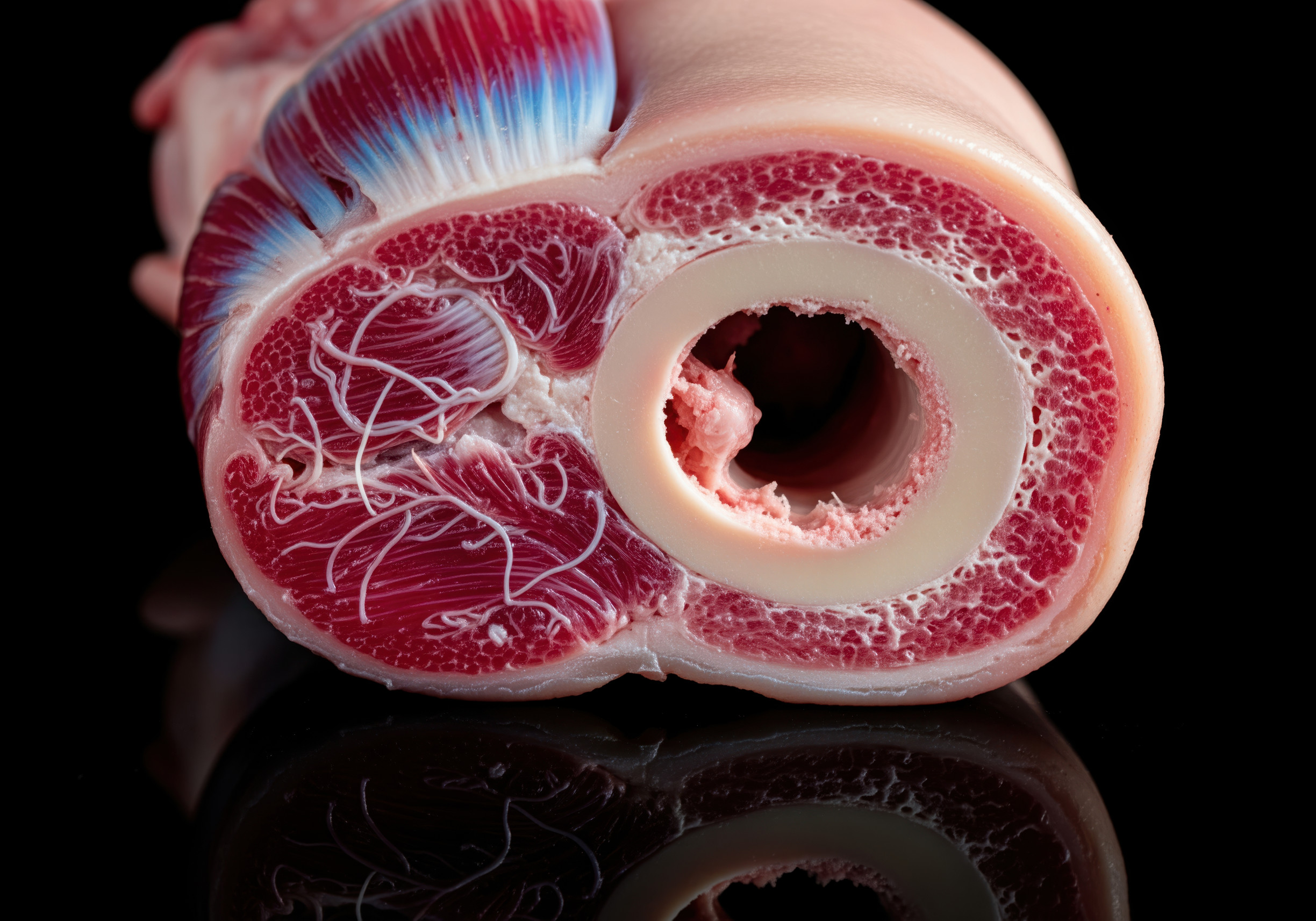
In a groundbreaking development for regenerative medicine, researchers at the University of Basel and University Hospital Basel have created the first fully human-engineered bone marrow model. This innovative “blood factory” has the potential to transform research into blood diseases, offering new avenues for studying conditions such as leukemia and anemia while reducing reliance on animal testing.
Bone marrow plays a crucial role in the human body, hidden within bones and responsible for generating blood cells that support the immune system and transport oxygen. Disruptions in this process, particularly in diseases like leukemia, can have dire, life-threatening effects on patients. Traditional methods to study blood formation have relied on animal models or basic cell cultures, which often fail to accurately replicate the complexities of human marrow function.
The breakthrough study, published in the journal Cell Stem Cell, details the creation of a bioengineered model that mimics the intricate three-dimensional environment of human blood cell production. Led by Professor Ivan Martin and Dr. Andrés García García, the research team utilized a synthetic scaffold composed of hydroxyapatite, a mineral naturally found in human bones, to support the growth of reprogrammed human pluripotent stem cells.
Through a carefully orchestrated process, the scientists successfully guided these stem cells to produce a diverse range of blood-producing cells. The resulting model, measuring just eight millimeters in diameter and four millimeters thick, maintained blood cell production for several weeks in laboratory conditions. Notably, it recreated the endosteal niche, a specific zone within the marrow where blood stem cells reside and where certain blood cancers often show resistance to treatment.
“This model brings us closer to the biology of the human organism,” said Martin. “It could serve as a complement to many animal experiments in the study of blood formation in both healthy and diseased conditions.”
The implications of this research extend beyond mere scientific advancement. By providing a human-specific model, the system has the potential to minimize the ethical concerns associated with animal testing while enhancing the accuracy of scientific outcomes. This aligns with an ongoing movement within the scientific community aimed at refining, reducing, and ultimately replacing animal experiments.
Looking ahead, the research team sees great promise in utilizing the bone marrow model for drug development. While the current model is too large for high-throughput testing, the possibility of creating miniaturized versions could enable researchers to evaluate multiple drug compounds simultaneously.
The researchers also envision even more ambitious applications. In the future, it may be feasible to use a patient’s own cells to construct personalized marrow models, allowing for treatment strategies tailored to individual biological profiles. Such an approach could significantly improve outcomes in blood cancer therapies.
Despite these exciting prospects, the researchers acknowledge challenges ahead. “For this specific purpose, the size of our bone marrow model might be too large,” noted García García. They recognize that further refinements, including downsizing the model and integrating it into wider diagnostic workflows, will be essential.
The development of this fully human, lab-grown bone marrow system represents a significant milestone in medical research. By shifting the focus from animal models to human-specific biology, it opens up new possibilities for drug testing, disease study, and the design of therapies that are more closely aligned with patient needs.
This innovative “blood factory,” while compact, holds immense potential for advancing our understanding of human biology and revolutionizing the treatment of blood diseases.