Volkswagen is launching a renewed strategy in China, aiming to regain market share after facing significant challenges in recent years. The German automaker has established its first development center outside Europe, emphasizing its commitment to adapting to local consumer preferences and the rapidly evolving electric vehicle (EV) landscape.
A few decades ago, foreign manufacturers regarded China’s burgeoning market as a lucrative opportunity. Back then, western companies believed they could capitalize on the vast population by offering vehicles that were merely rebranded versions of their existing models. However, as local manufacturers gained traction and technological prowess, they began to reshape the industry. The competitive landscape shifted dramatically as Chinese companies began innovating at a pace that left many traditional automakers struggling.
Volkswagen’s initial success in China was bolstered by profits that helped the company navigate the fallout from the Dieselgate scandal. These gains, however, started to dwindle as the EV revolution gained momentum, with local manufacturers quickly adapting to new technologies and consumer demands. In contrast, many western automakers found themselves outpaced, leading some to close operations in the country.
Chinese consumers have distinct preferences, notably favoring extended wheelbase sedans and plug-in hybrids with significant electric-only ranges. To address this market demand, Volkswagen has partnered with domestic manufacturer SAIC to redesign its popular Passat model. The newly introduced Passat ePro features a 22 kWh battery, providing an electric-only range of up to 150 km. The vehicle is powered by a 145 kW (194 hp) electric motor, supplemented by a 1.5-liter turbocharged range extender engine rated at 95 kW (128 hp). The total range, according to China’s optimistic CLTC testing standards, reaches approximately 1,300 km (over 800 miles).
New Developments and Strategic Partnerships
Volkswagen’s renewed focus on the Chinese market is evident in its commitment to developing models tailored to local tastes. The Passat ePro, measuring 5,017 mm, offers ample rear seat space, aligning with consumer preferences for comfort. However, this length raises questions about exportability to Europe, where the limit for passenger cars is set at 5,000 mm. This detail may signal Volkswagen’s intent to differentiate its offerings between markets.
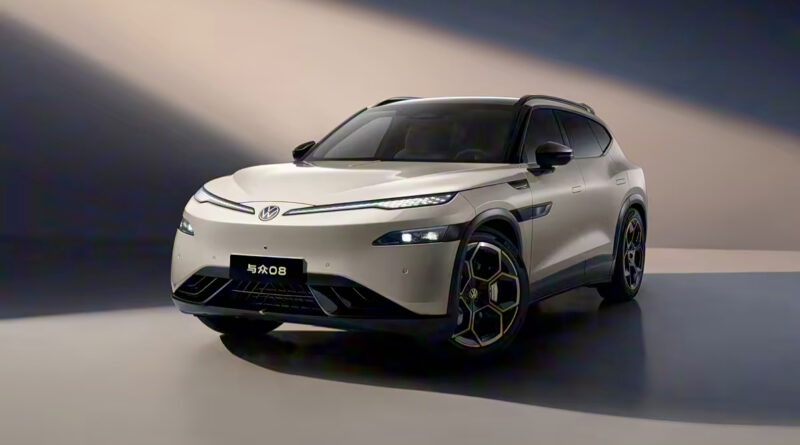
In addition to the Passat ePro, Volkswagen has unveiled the ID. Unyx 08, a product of its collaboration with Xpeng, aimed at addressing software and technological challenges. Notably, this model is precisely 5,000 mm long, positioning it for potential export to European markets. The ID. Unyx 08 is equipped with an array of advanced features, including two battery options—82 kWh and 95 kWh—allowing a range of 630 to 730 km (390 to 450 miles) in the CLTC cycle. Its 230 kW (308 hp) motor is tailored to meet the high expectations of Chinese consumers for technology and performance.
Volkswagen is also integrating sophisticated technology into its vehicles. The ID. Unyx 08 will feature an advanced driver assistance system, along with an AI-powered intelligent assistant. The architecture will support full-vehicle over-the-air updates, ensuring that software remains current and relevant for users.
By 2027, Volkswagen plans to offer more than 20 electrified models in China, with this number expanding to 30 by 2030. This ambitious roadmap suggests that the company is not only keen on regaining its foothold in the Chinese market but is also committed to adapting its product lineup to meet diverse regional demands.
As Volkswagen navigates the complexities of the automotive market, questions linger regarding its strategy. Will the company develop distinct model lineups for the Chinese market compared to Europe and the US? While it remains discreet about its intentions, the precision of the ID. Unyx 08’s specifications hints at a strategic pivot that acknowledges the importance of catering to local consumer preferences.
Volkswagen’s efforts to reestablish its presence in China signify a critical juncture in the automotive industry. The company must harness its partnerships, innovative designs, and technological advancements to thrive in a landscape increasingly defined by local competition and changing consumer expectations.