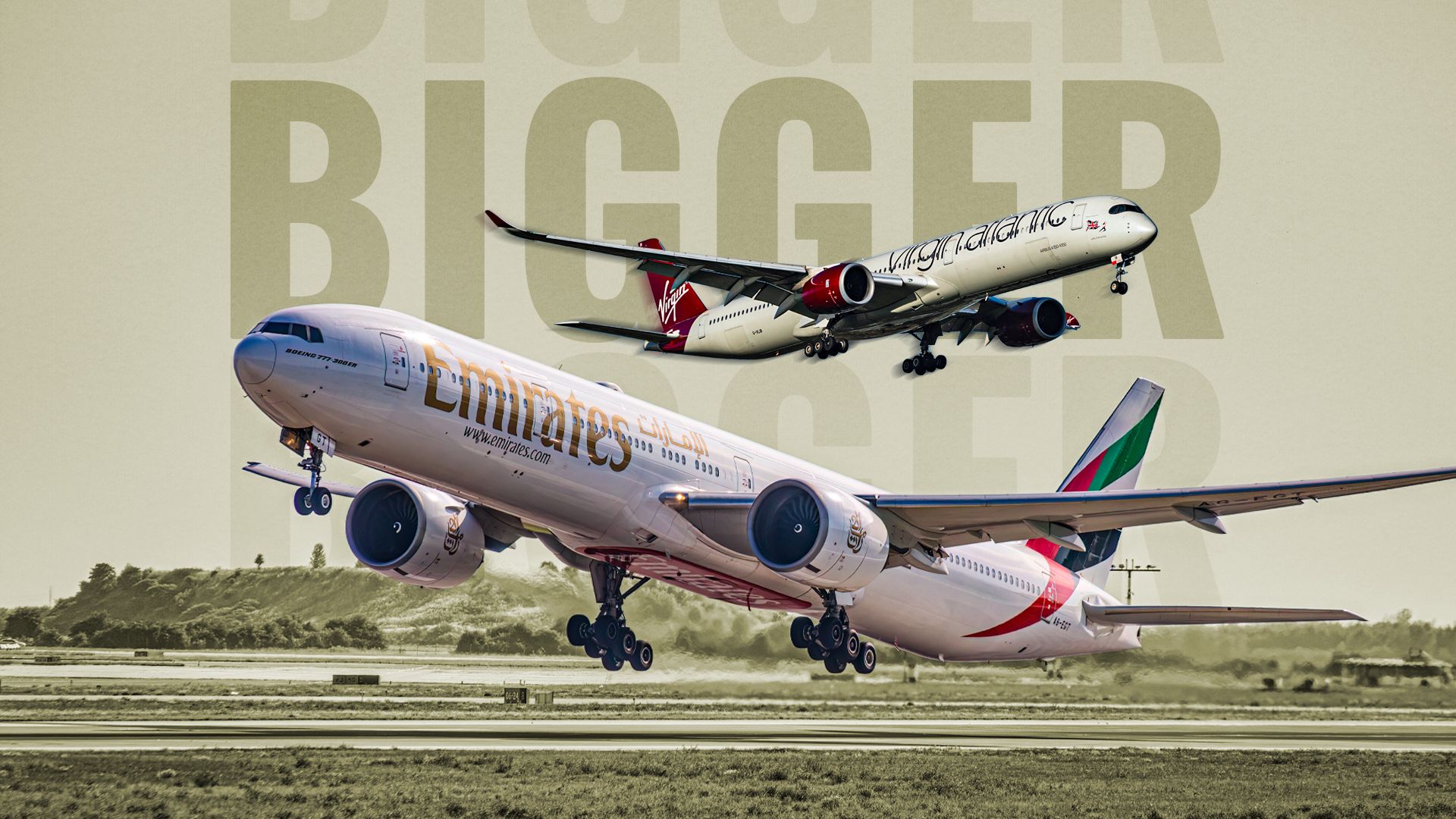
The Boeing 777-300ER and the Airbus A350 represent two of the most significant advancements in long-haul aviation, each catering to the evolving demands of airlines worldwide. While both aircraft are designed for efficiency and passenger comfort, a closer examination reveals distinct differences in size, performance, and operational focus.
Size and Specifications: A Closer Look
When comparing the Boeing 777-300ER to the Airbus A350, the former stands out as the larger aircraft. The 777-300ER boasts a length of 242 feet 4 inches (74 meters) and a maximum takeoff weight (MTOW) of approximately 775,000 lbs (351 tonnes). Its impressive wingspan measures 212 feet 7 inches (64.8 meters), contributing to its dominant presence on airport ramps.
In contrast, the Airbus A350, particularly the A350-1000 variant, measures 242 feet 1 inch (73.8 meters) in length, while maintaining the same wingspan as its smaller counterpart, the A350-900. With an MTOW of around 679,000 lbs (308 tonnes), the A350-1000 is lighter, designed for greater fuel efficiency and passenger comfort.
Engine power also differentiates these aircraft. The Boeing 777-300ER is equipped with two General Electric GE90-115B engines, each generating approximately 115,000 lbs (52,200 kg) of thrust, making it one of the most powerful commercial aircraft ever built. The A350-1000, on the other hand, utilizes Rolls-Royce Trent XWB-97 engines, producing up to 97,000 lbs (43,800 kg) of thrust.
Operational Focus: Capacity vs. Efficiency
The operational strategies of airlines reflect the strengths of each aircraft. The Boeing 777-300ER is renowned for its high-capacity configurations, typically accommodating 360-400 passengers in a two-class layout. Airlines often deploy it on dense trunk routes, such as transatlantic and transpacific flights, where maximizing seat counts and cargo yields is paramount.
Emirates, the largest operator of the Boeing 777-300ER, has more than 120 of these aircraft in service, relying on their capacity to serve high-demand routes effectively. Other significant customers include Qatar Airways, British Airways, and American Airlines, all of whom value the aircraft’s ability to transport large numbers of passengers and cargo across long distances.
In contrast, the Airbus A350 is engineered for flexibility and efficiency. The A350-900 typically seats around 300 to 350 passengers in a standard three-class configuration, while the A350-1000 can accommodate 350 to 410 passengers. This design makes it well-suited for long-haul missions where lower operating costs and fuel efficiency are critical. As of March 2024, over 630 Airbus A350s are operational globally, with major fleets held by carriers like Singapore Airlines and Qatar Airways.
While the Boeing 777-300ER excels in capacity, the Airbus A350 stands out for its advanced aerodynamics and use of composite materials, resulting in a quieter cabin and lower fuel consumption. This focus on passenger comfort is evident in the A350’s optimized cabin design, which allows for a nine-abreast seating configuration with wider seats compared to the ten-abreast layout often found in the 777-300ER.
Both aircraft serve similar markets, yet they cater to slightly different operational needs. The Boeing 777-300ER is often the preferred choice for airlines prioritizing capacity, whereas the Airbus A350 appeals to those looking for operational efficiency and passenger comfort.
In summary, while the Boeing 777-300ER remains a giant in the sky with its impressive size and capacity, the Airbus A350 offers a modern approach to long-haul travel, balancing efficiency with passenger experience. This dynamic between the two aircraft continues to shape the future of aviation, as airlines adapt to changing demands and economic realities.