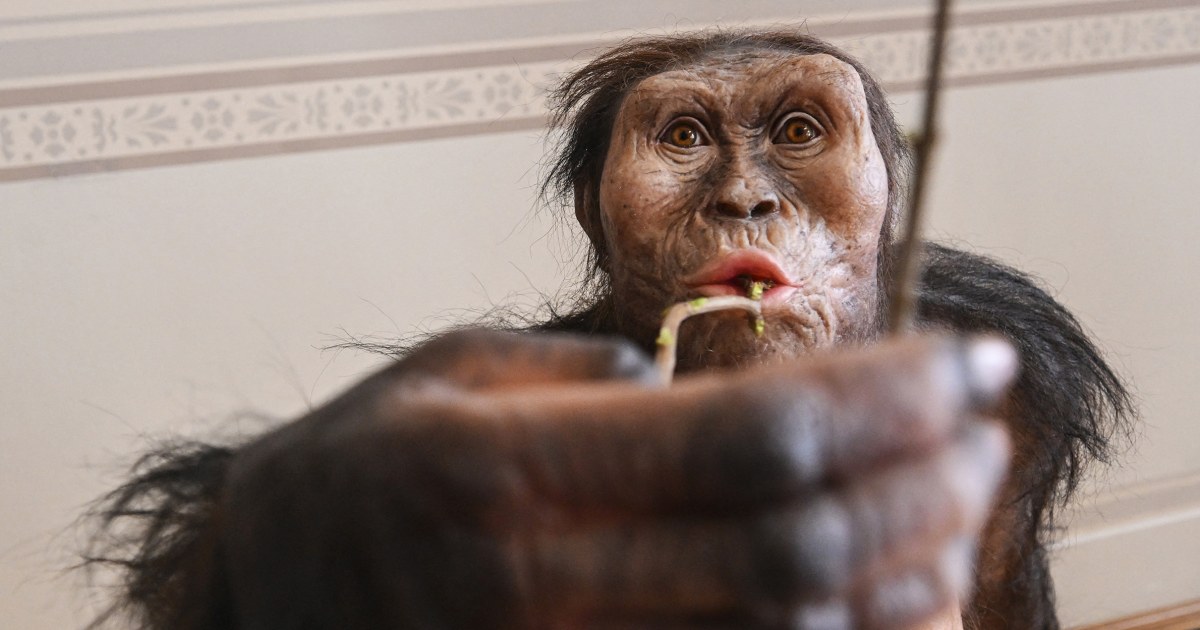
A new discovery in human evolution reveals that a previously unknown ancient relative coexisted with Lucy, an iconic figure in our ancestral lineage. Researchers have dated the mysterious Burtele foot, found in northeastern Ethiopia, to approximately 3.4 million years ago. This finding, detailed in a study published in the scientific journal Nature, indicates that the species represented by the Burtele foot was likely distinct from Lucy.
The Burtele foot, named after the site of its discovery in 2009, exhibits features markedly different from those of Lucy. Notably, the fossilized foot possesses an opposable big toe resembling a human thumb, suggesting that its owner was an adept climber, spending more time in trees than Lucy did. This discovery challenges long-held beliefs about the evolutionary tree of hominids.
For decades, Lucy’s species, Australopithecus afarensis, was considered the direct ancestor of all later hominids, including modern humans. Researchers had difficulty confirming the foot belonged to a new species until they studied additional fossils, including a jawbone with twelve teeth found at the same site. This analysis led to the identification of the species as Australopithecus deyiremeda, confirming the Burtele foot’s association with it.
John Rowan, an assistant professor in human evolution at the University of Cambridge in the United Kingdom, remarked on the significance of the findings. He noted that the conclusion reached by the research team was “very reasonable,” emphasizing the stronger evidence for the existence of a closely related but adaptively distinct species living alongside Lucy.
New Insights into Human Ancestry
The study, spearheaded by Yohannes Haile-Selassie from Arizona State University, explored how these two species shared their environment. The research team concluded that A. deyiremeda likely spent significant time in forested areas, while Lucy primarily roamed the ground. The distinctions in their habitats suggest that the two species may have had different diets and utilized their surroundings in varied ways.
Multiple examinations of the newly discovered teeth indicate that A. deyiremeda was more primitive than Lucy and likely subsisted on a diet of leaves, fruit, and nuts. Ashleigh L.A. Wiseman, an assistant research professor at the McDonald Institute for Archaeological Research, noted that these differences meant the two species were unlikely to compete directly for the same resources.
Wiseman emphasized the broader implications of this discovery on our understanding of human evolution. She stated that it illustrates how human evolution should not be viewed as a linear progression but rather as a complex family tree with multiple “cousins” coexisting at the same time, each adapting uniquely to their environments.
“Did they interact? We will likely never know the answer to that question,” she added, highlighting the ongoing mysteries of our ancestral story.
Challenges in Understanding Ancestry
As discoveries like the Burtele foot emerge, questions about our ancestry continue to multiply. Rowan expressed concern over how to differentiate between direct ancestors and close relatives. “As species diversity grows, so do the number of plausible reconstructions for how human evolution played out,” he stated.
Wiseman cautioned against making definitive species assignments based solely on fossil evidence, stressing the importance of well-preserved skulls and multiple associated specimens for accurate classification. While the new research strengthens the case for A. deyiremeda, it does not eliminate potential alternative interpretations.
As ongoing research continues to shed light on our evolutionary past, the Burtele foot stands as a testament to the complexity of human ancestry and the myriad forms our ancient relatives may have taken.