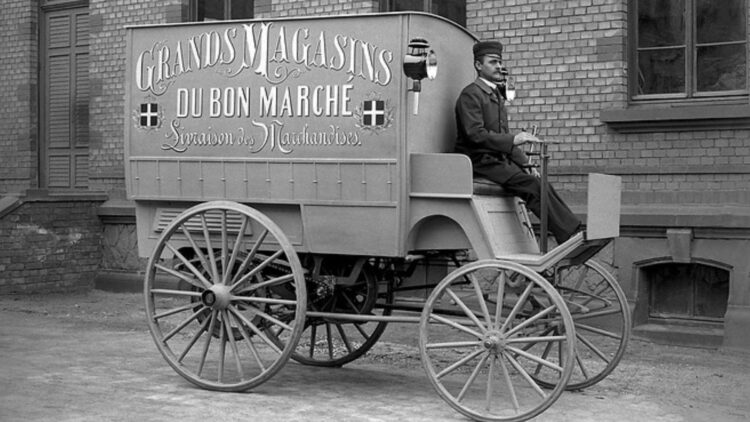
The world’s oldest operational delivery van, a remarkable piece of automotive history, is still running after more than a century. Manufactured by Mercedes-Benz in 1896, the vehicle was originally produced for the Bon Marché department store in Paris. Priced at 4,500 marks, equivalent to approximately 2,300 euros today, this early van laid the groundwork for modern commercial vehicles.
Innovative Beginnings in 1896
The van, created by a company then known as Benz & Cie, was groundbreaking for its time. Unlike the cars of today, it resembled a horse-drawn carriage without the horses, lacking a traditional steering wheel and featuring an exposed driver’s seat. This design was a significant achievement, marking the onset of a legacy that now celebrates 130 years of Mercedes-Benz Vans.
Two initial models emerged from Benz & Cie, both inspired by contemporary automotive designs. The first model, known as the “closed body car,” was based on the 1893 Benz Victoria, a two-seater vehicle with a folding roof. The second model was a mixed van, derived from the Benz Velocipede, a lighter design without a roof. Notably, the mixed van could be converted from a cargo vehicle to a passenger car in just a few minutes—a feature reminiscent of modern versatile vans.
Equipped with rear-mounted engines, these early vans featured a four-stroke single-cylinder engine. The delivery model offered a displacement of 2.7 liters and the mixed van had 1.0 liter, producing between 2.75 and 6 horsepower. They could travel at speeds of 15 to 20 km/h and carry loads of approximately 300 kilos, surpassing the capability of a horse.
A Living Piece of History
Among the surviving models is the Benz Ideal Van, built in 1899 under license from Hewetson’s Ltd. in the United Kingdom. This van, which boasts a 3-horsepower engine, can still transport 100 kilos of cargo alongside the driver. Although it is slightly newer than the first model, its charm and historical significance are undeniable.
Today, this historic vehicle is part of the Mercedes-Benz Classic collection and has been meticulously restored to honor the 130th anniversary. Plans are underway to exhibit it at significant historical events, alongside the company’s latest offerings, notably the Sprinter, which has captured the preference of 77% of European customers, according to Car and Driver.
The celebration of this milestone is not simply a reflection on the past; it underscores the evolution of Mercedes-Benz from a pioneering entity in transportation to a leader in the global market. The journey from the initial order by Bon Marché in 1896 to the current Sprinter model exemplifies the brand’s commitment to innovation and quality.
As Dirk Weyhenmeyer, a historian for Mercedes-Benz in Germany, notes, the company’s legacy of innovation continues to drive its success. The transformation from Benz & Cie’s early creations, such as the Benz Victoria and Benz Velocipede, to the modern vehicles we see today is a testament to the brand’s enduring influence in the automotive industry.
In celebrating 130 years of progress, Mercedes-Benz not only honors its storied past but also looks forward to future advancements in how we transport goods and people around the world.