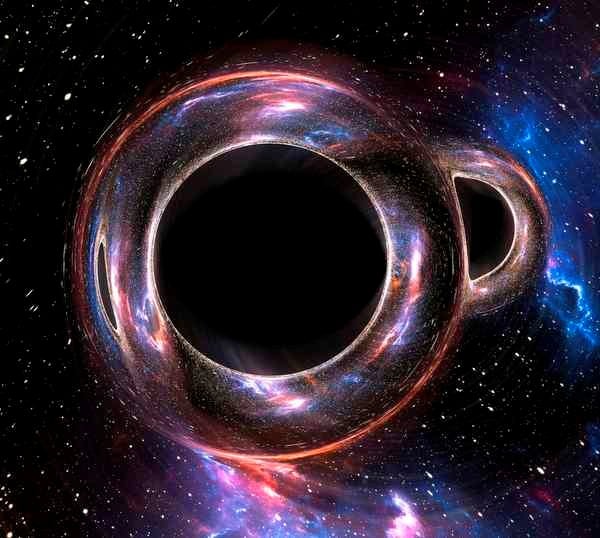
On January 14, 2025, scientists recorded the clearest gravitational wave signal to date, designated GW250114. This signal, detected at the twin Laser Interferometer Gravitational Wave Observatories (LIGO) in the United States, originated from the collision of two black holes in deep space. The remarkable clarity of this signal offers unprecedented opportunities to test the fundamental principles outlined in Albert Einstein‘s theory of general relativity.
The event itself is significant not only for its origin but also for the precision of the data received. When black holes merge, they create a new black hole that emits gravitational waves, akin to a bell ringing, producing specific frequencies that diminish over time. Each frequency or “tone” carries vital information: the oscillation rate and the decay rate. Analyzing these tones allows physicists to derive critical properties of the resulting black hole.
For GW250114, researchers successfully measured two distinct tones and constrained a third. The findings from these measurements align perfectly with Einstein’s predictions, reinforcing the robustness of general relativity. According to Keefe Mitman, a physicist at Cornell University, this discovery stands as yet another confirmation of Einstein’s theory.
Implications for Fundamental Physics
Despite this affirmation, many physicists, including Mitman, acknowledge that general relativity may be incomplete. The theory does not account for phenomena such as dark matter and dark energy, nor does it effectively describe the behavior of gravity at quantum scales. The mathematical framework of general relativity encounters challenges when attempting to merge with quantum mechanics, leading researchers to suspect that a more comprehensive theory is needed.
The implications of GW250114 extend beyond mere confirmation of existing theories. The enhanced sensitivity of gravitational wave detectors is bringing scientists closer to identifying the limits of general relativity. As technology advances, future discoveries may unveil new insights into the fabric of our universe, potentially revealing profound truths about its most intricate workings.
This latest detection, while a testament to Einstein’s enduring legacy, is also a reminder of the mysteries that remain unsolved. As researchers continue their quest to understand the cosmos, the promise of new revelations looms on the horizon, waiting to challenge our current understanding of physics.