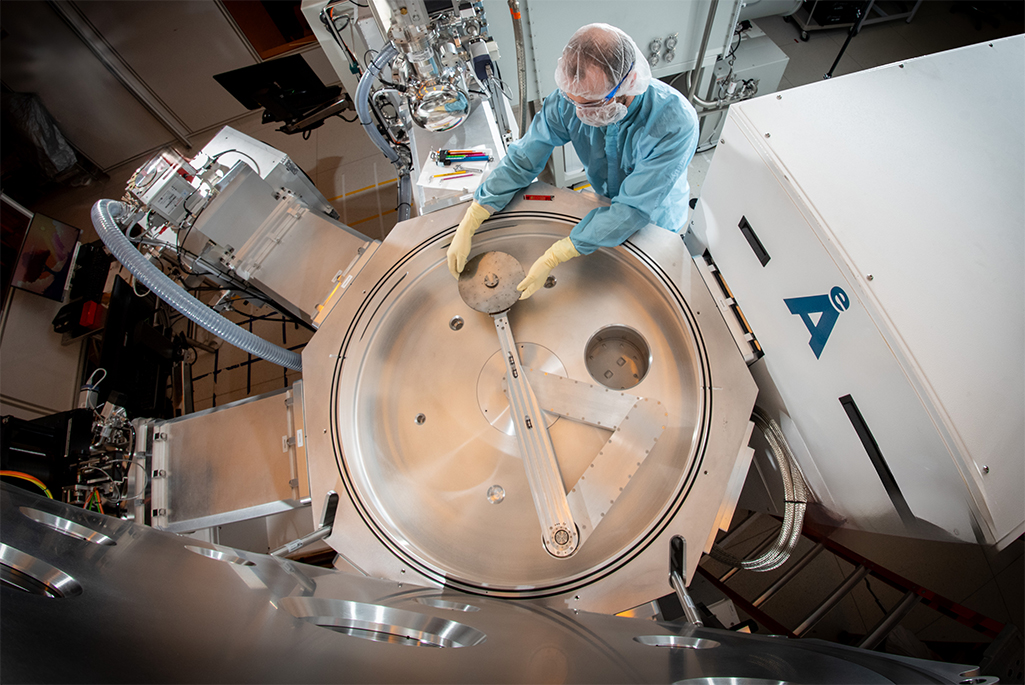
Researchers at the Lawrence Berkeley National Laboratory have unveiled a groundbreaking robotic system known as the Quantum Information Science (QIS) cluster tool, designed to enhance the development of qubit components essential for quantum computing. This innovative tool enables scientists to experiment with various materials and methods within a single automated framework, significantly accelerating discoveries related to long-lived quantum devices.
The QIS cluster tool operates within the Molecular Foundry, a user facility supported by the U.S. Department of Energy that accommodates around a thousand researchers annually from across the globe. By integrating fabrication and analysis processes in a clean, vacuum-sealed environment, the tool allows for the growth of diverse materials without the contamination risks associated with traditional methods.
Enhancing Qubit Stability and Performance
Central to the functionality of quantum computers are qubits, the fragile building blocks that hold the potential to revolutionize fields such as material design, information security, and drug discovery. The QIS cluster tool streamlines the production of qubits by employing a robotic arm that manages an 8-inch disc, or wafer, moving it between various stations that deposit atom-thin layers of material and perform quality checks.
According to Aeron Tynes Hammack, a scientist at Berkeley Lab, “It’s like a robot pizza chef sitting in the middle with a spatula.” This automation not only enhances reliability and reproducibility but also allows researchers to fine-tune their material recipes. The tool automatically collects data compatible with artificial intelligence (AI), which can then be used to identify the optimal conditions for successful qubit fabrication.
The QIS cluster tool excels particularly in producing the Josephson junction, a critical component in quantum computing circuits. These junctions consist of two superconductors separated by an ultra-thin insulating layer, enabling pairs of electrons to “tunnel” through the barrier, a phenomenon that classical physics cannot explain.
As quantum technology advances, these junctions could enable computers to tackle complex problems that exceed the capabilities of current machines, such as simulating molecular interactions or optimizing large-scale networks.
Broadening Material Exploration
The QIS cluster tool provides researchers with the flexibility to experiment with various materials, including aluminum, niobium, titanium, and their compounds. It allows for precise layering and deposition techniques, such as atom painting and sputtering, making it possible to create features just a few atoms wide. This level of precision is crucial, as even minor imperfections can significantly impact the performance and stability of qubits.
With the tool now operational, researchers have focused on producing high-quality aluminum Josephson junctions. Collaborative efforts within Berkeley Lab have also explored alternative materials, including hafnium, leading to promising results for developing sensitive particle detectors capable of identifying low-energy signals associated with dark matter.
Hammack emphasized the importance of exploring fundamental material science, stating, “Modern life is made out of really basic material science stuff.” The QIS cluster tool facilitates this exploration, enabling researchers to investigate how different materials and methods influence the properties of qubits.
The findings from these experiments contribute to a growing dataset that can be leveraged to train AI models aimed at optimizing qubit design and production methods. The ultimate goal is to achieve a level of autonomous operation, where the system can predict the likelihood of producing high-quality qubits based on specific recipes.
As the QIS cluster tool continues to advance, it offers significant potential not only for quantum computing but also for applications in precision microelectronics and sensitive sensors. These sensors could aid in a variety of fields, from dark matter research to detecting new viruses, enhancing scientific responses to future health challenges.
In summary, the QIS cluster tool represents a significant leap forward in quantum research at the Molecular Foundry, positioning Berkeley Lab at the forefront of developing reliable, high-performance qubits essential for the next generation of quantum technology.