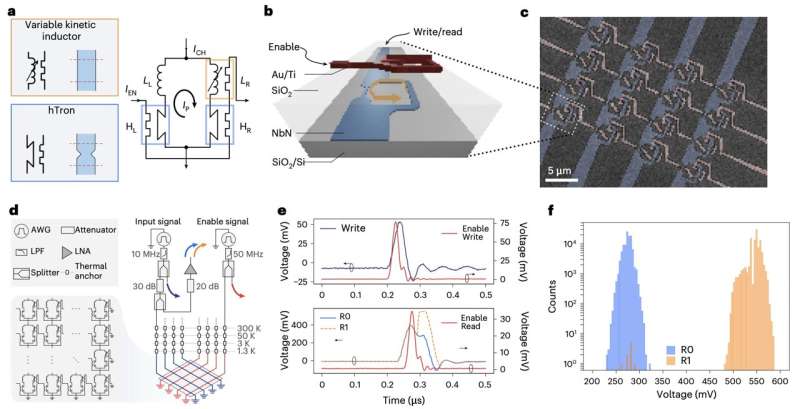
Researchers at the Massachusetts Institute of Technology (MIT) have developed a new superconducting nanowire memory array, achieving a significantly lower error rate compared to previous models. This advancement, detailed in a paper published in Nature Electronics on January 25, 2026, represents a crucial step towards enhancing the efficiency and reliability of memory components for quantum computers.
Quantum computing relies on advanced memory systems that can operate quickly and consume minimal energy. Superconducting memories, made from materials that conduct electricity with no resistance below a critical temperature, have shown promise in this area. However, existing superconducting memory technologies often struggle with high error rates and scalability issues, limiting their practical applications.
The newly developed memory array addresses these challenges by utilizing nanowires—one-dimensional structures known for their unique optoelectronic properties. The research team, including lead authors Owen Medeiros and Matteo Castellani, emphasized that scalable superconducting memory is essential for the evolution of low-energy superconducting and fault-tolerant quantum computers.
Innovative Design and Performance
The researchers constructed a compact array consisting of superconducting memory cells formed from nanowires. Each memory cell incorporates a superconducting nanowire loop, two temperature-sensitive switches, and a kinetic inductor. This design allows for controlled manipulation of electrical currents, enabling stable operations at a temperature of 1.3 K.
The memory cells operate by receiving precisely timed electrical pulses that momentarily heat one of the nanowire switches. This process temporarily increases its resistance, allowing a magnetic flux to enter the loop. The magnetic flux encodes binary data (0s and 1s). Once the pulse concludes and the nanowire returns to a superconducting state, the information remains trapped within the loop.
The research demonstrated that the new nanowire-based memory array can store information with an impressive error rate of approximately one error in every 100,000 operations. This translates to a minimum bit error rate of 10 −5, significantly improving upon the performance of prior superconducting memory technologies.
Implications for Future Technologies
Initial tests indicate that this innovative memory array could play a pivotal role in advancing superconducting memory systems, bringing them closer to practical deployment in real-world applications. The researchers employed circuit-level simulations to analyze the dynamics and stability of the memory cells under varying conditions, further validating the array’s potential.
“This work lays the groundwork for future enhancements and scalability of superconducting memory systems,” the authors noted, suggesting that their design could be refined to create even more reliable and efficient memory solutions.
This research not only highlights the ongoing advancements in superconducting technologies but also underscores the importance of continued innovation in the field of quantum computing. As researchers like Medeiros and Castellani push the boundaries of what is possible, the development of low-energy, high-performance memory components remains a key focus in the quest for more effective quantum systems.
The implications of this work extend beyond theoretical applications, potentially transforming how information is processed and stored in the future. As the field progresses, the integration of such superconducting memory arrays could revolutionize computing capabilities, paving the way for more robust quantum technologies.
In summary, the breakthrough achieved by the MIT team marks a significant milestone in the pursuit of efficient superconducting memory, with the potential to influence both academic research and practical applications in the years to come.