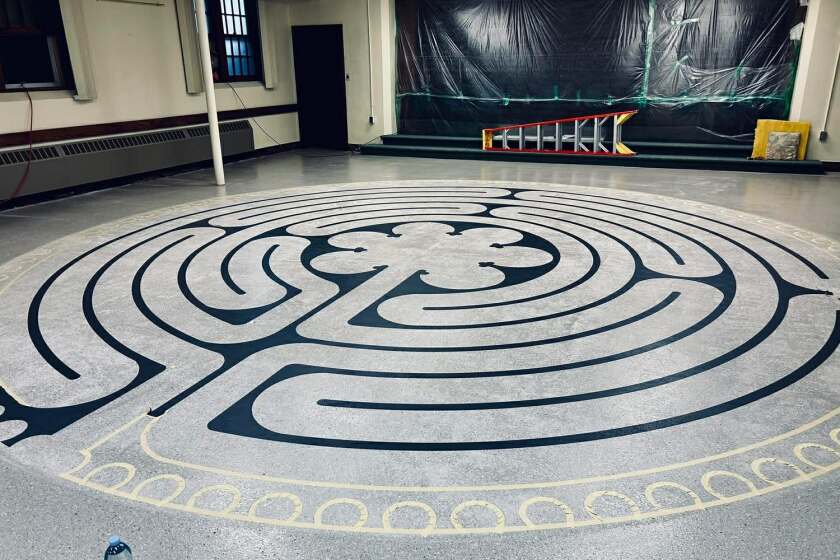
In a significant development for the community, the First Congregational Church in Alexandria, Minnesota, has opened a permanent labyrinth in its basement. This installation not only honors the memory of Dr. Mike Mosleth, a beloved church member who passed away during a pilgrimage in Ireland, but also revives an ancient prayer practice designed for meditation and spiritual connection.
The labyrinth serves as a walking meditation space, contrasting with the common notion of a maze. According to Marcie Watson, a retired Lutheran spiritual director, “A labyrinth is not a maze. It’s designed to be a walking meditation.” With only one entrance and exit, participants follow a single path, which allows them to reflect and focus on their thoughts and prayers as they walk.
Rev. Dr. Jill Sanders emphasized the therapeutic value of this practice, stating, “It’s embodied prayer.” As individuals navigate the labyrinth, they reach a center that symbolizes a union with the divine. This experience is meant to foster a sense of connection with God and the world around them.
The idea of walking prayer dates back to the Middle Ages when labyrinths were built in cathedral floors to provide a symbolic pilgrimage for those unable to travel to the Holy Land. The labyrinth at the First Congregational Church is modeled after the famous labyrinth at Chartres Cathedral in France. Watson explained that while the practice may seem new, it has deep historical roots, having been revived in recent years within many church communities.
The journey to create this permanent labyrinth began about four years ago when the church borrowed a canvas labyrinth for Ash Wednesday. After the service, the church opened it to the community, which facilitated a meaningful encounter for many, including Dr. Mosleth, a retired physician interested in holistic healing. His experience with the labyrinth inspired him to engage further with the church.
Tragically, during a pilgrimage to Ireland in 2024, Dr. Mosleth passed away unexpectedly at a retreat center. Following his death, his family sought a way to honor his memory. “They wanted to give the labyrinth, have it be permanent, and make it available to the whole community,” Sanders shared. His children, Amanda Choudary and Tim Mosleth, funded the project, which amounted to approximately $6,000 to $7,000.
In the months following Dr. Mosleth’s passing, the church faced several logistical challenges in bringing the labyrinth to fruition. They needed to remove asbestos from the floor and install appropriate flooring before the labyrinth could be painted. Thankfully, they connected with Lisa Moriarty, an artist from Stillwater, Minnesota, who specializes in painting labyrinths.
By the end of October 2023, the labyrinth was completed ahead of schedule, marking a significant milestone for the church community. The next step involves determining how best to make the labyrinth accessible to everyone who wishes to use it.
Sanders reflected on the impact this project has had on the church. “I cannot imagine how pleased Mike would be if he knew what his kids had done. This is the place he connected with our church, literally in this space, but on canvas.”
The labyrinth at the First Congregational Church stands as a testament to the enduring power of community, remembrance, and the pursuit of spiritual connection through an ancient practice that continues to resonate today.