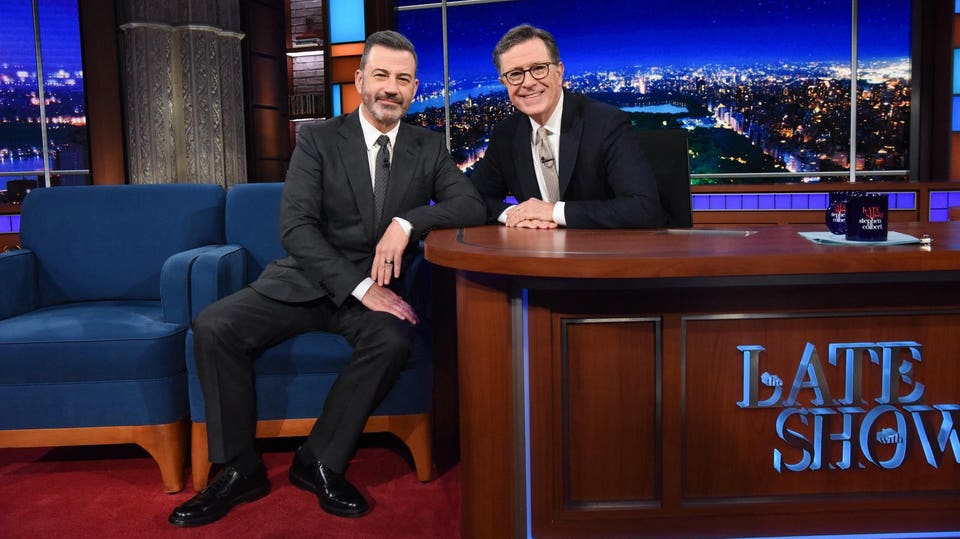
Late-night hosts Jimmy Kimmel and Stephen Colbert are raising alarms following the Federal Communications Commission (FCC)’s recent decision to enforce its “equal time” rule on talk shows. This mandate requires networks to offer equal airtime to opposing political candidates, a move Kimmel and Colbert are calling a “crackdown” aimed at silencing their platforms.
In an explosive monologue on July 13, 2023, Kimmel condemned the FCC’s actions, claiming they are an attempt by the agency, led by Brendan Carr, to “stifle” free speech on television. He accused the FCC of “reinterpreting long-agreed-upon rules” and referred to Carr as “Brendan Cartel.” “This is more than just a fight with the FCC; it’s about our ability to express viewpoints that differ from those in power,” Kimmel stated.
Kimmel pointed out the absurdity of enforcing this mandate at a time when traditional broadcast TV viewership is plummeting, acknowledging that it now represents only around 20% of total viewing. He recalled that late-night shows have been exempt from this rule since 2006, following an appearance by then-Governor Arnold Schwarzenegger on “The Tonight Show.” “Broadcast TV used to account for 100% of viewing; now it’s like 20%,” Kimmel emphasized, questioning the relevance of the FCC’s move in the current media landscape.
Colbert echoed Kimmel’s sentiments during his own segment later that night, humorously addressing the FCC’s crackdown. “I got to watch what I say about Trump, because Johnny Law is once again coming after yours truly here,” he quipped, igniting boos from his audience. Referring to a New York Times headline labeling the FCC’s action a “new crackdown on late-night TV,” Colbert remarked, “That has enormous implications for me for four more months,” hinting at CBS’s decision not to renew his show.
Colbert’s lawyer had warned him against discussing the newly imposed rules, which he characterized as a blatant attempt to silence him and his fellow late-night hosts. “Hey, I’m flattered you think that appearing on my show has the power to affect politics in any way,” he said directly to the camera, asserting, “If our government had turned out the way I had chosen, you would not have the power to make this announcement.”
The reaction from both Kimmel and Colbert underscores a broader concern regarding free expression in the media, particularly as political tensions rise. As networks face pressure to comply with the FCC’s demands, the future of late-night programming hangs in the balance.
These developments are crucial not just for viewers who rely on late-night commentary but also for the broader media landscape, where the ability to address political issues freely is increasingly under threat. As this situation unfolds, audiences are left wondering how it might impact the already turbulent political discourse in the United States.
Stay tuned for further updates on this rapidly developing story as late-night hosts continue to push back against what they view as government overreach.